
ASTANA — From global pop concerts and major film productions to historical anniversaries and new cultural institutions, 2025 saw Kazakhstan’s cultural life unfold across stages, screens, museums and public spaces. The year featured a wide range of international and local events, reflecting how culture was expressed through mass entertainment, heritage-focused projects and emerging creative formats.

Dimash Qudaibergen. Photo credit: DimashNews
Global stars and mass culture moments
Some of the year’s most visible cultural events came from large-scale music performances. In August, Jennifer Lopez held her first-ever concerts in Kazakhstan, performing in Almaty on Aug. 10 and later in Astana as part of her Up All Night world tour. The shows attracted tens of thousands of spectators, including visitors from more than 35 countries, and generated an estimated $21 million in overall economic turnover.

Jennifer Lopez held her first-ever concerts in Kazakhstan, performing in Almaty on Aug. 10 and later in Astana as part of her Up All Night world tour. Photo credit: Photo Credit: Malik Khassenov
In September, the Backstreet Boys returned to Kazakhstan with concerts in Almaty on Sept. 19 and Astana on Sept. 21. The performances drew more than 30,000 fans, including over 12,000 international visitors from 45 countries, making them among the largest ticketed music events of the year.

In September, the Backstreet Boys returned to Kazakhstan with concerts in Almaty on Sept. 19 and Astana on Sept. 21. Photo credit: Carter’s instagram page
Throughout 2025, Kazakh singer Dimash Qudaibergen remained one of the country’s most internationally visible cultural figures. In the spring, he participated in the Virtuosos project in Budapest, performing with opera legends Plácido Domingo and José Carreras, as well as Croatian cellist Stjepan Hauser. The collaboration included a recorded rendition of Frank Sinatra’s “My Way,” broadcast on Hungary’s Duna TV beginning April 25, as well as a new duet with Hauser featuring an orchestral version of Qudaibergen’s song “Stranger,” arranged with the Kazakh folk instrument qobyz.
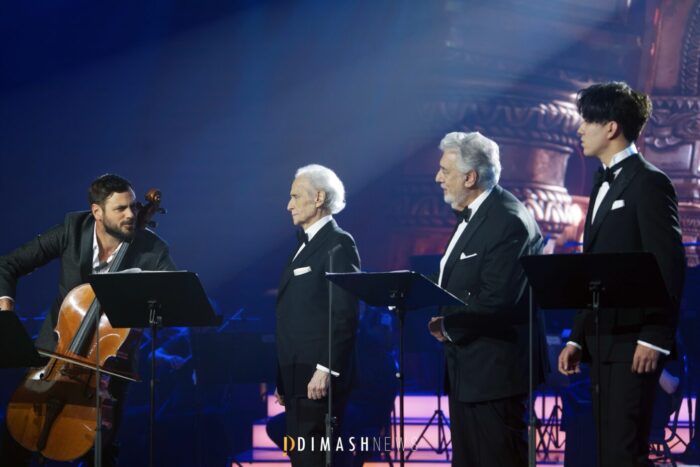
Opera legends Plácido Domingo and José Carreras, along with renowned cellist Stjepan Hauser and world famous Kazakh singer Dimash Qudaibergen. Photo credit: Dimash News
In November, ahead of his concert at London’s OVO Arena Wembley, Qudaibergen appeared live on CNN’s “What We Know with Max Foster,” where he discussed his musical education, international career, and artistic philosophy.
The International Organization for Migration (IOM) of the United Nations (UN) appointed him a Global Goodwill Ambassador during the council’s annual session in Geneva on Dec. 8, citing his involvement in humanitarian initiatives.
Cinema: festival circuits and international productions
In the first half of the year, Askhat Kuchinchirekov’s “Bauyryna salu” (Adoption) feature film continued its international festival run and was selected as Kazakhstan’s official submission for Best International Feature Film at the 97th Academy Awards. The film later screened in the United States and Europe and opened the No Violence Film Festival in Astana and Shymkent in November, organized in partnership with the UN.
In October, Salem Entertainment announced that “Armor of God: Ultimatum,” the fourth installment of Jackie Chan’s long-running franchise, would be partially filmed in Kazakhstan. Later that month, Kazakh filmmaker and stunt coordinator Robert Kun was confirmed as director and action choreographer. The project entered pre-production, with filming planned for 2026.

In October, Salem Entertainment announced that “Armor of God: Ultimatum,” the fourth installment of Jackie Chan’s long-running franchise, would be partially filmed in Kazakhstan. Photo credit: Salem Entertainment
Regional film cooperation was highlighted at the Korkyt Ata Turkic World Film Festival, held in Aktau from Oct. 1-5. The festival brought together filmmakers from Turkic-speaking countries and concluded with cooperation memorandums covering co-productions, training and distribution. Awards were presented to feature films, documentaries and individual artists from across the region.
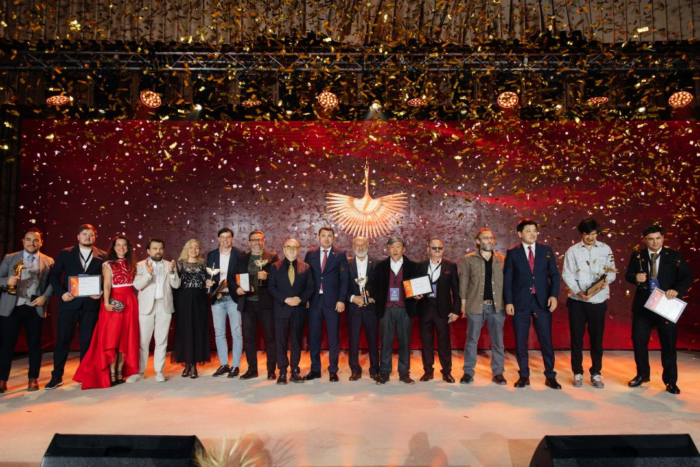
Regional film cooperation was highlighted at the Korkyt Ata Turkic World Film Festival, held in Aktau from Oct. 1-5. Photo credit: Ministry of Culture and Information
Earlier this year, the feature film “Citizens of the Roof” received international recognition after winning the Best International Feature Film and Best Debut Filmmaker awards at the Golden Lion International Film Festival in Kolkata in January.
Kazakhstan also strengthened its institutional presence in global cinema when the Kazakhstan Association of Film Critics joined FIPRESCI in January.

The Comic Con Astana 2025 audience was treated to an exclusive first look at “La Tregua” – a joint Kazakh-Spanish production. Photo credit: Comic Con Astana press service.
First screened at Comic Con Astana in July, the Kazakh-Spanish historical drama “La Tregua” (The Truce) marked its debut for audiences in Kazakhstan. The film is directed by Spanish filmmaker Miguel Ángel Vivas and stars Miguel Herrán and Arón Piper, known internationally for La Casa de Papel (Money Heist) and Élite. Set between 1937 and 1945, it depicts events at Karlag, one of the largest Soviet labor camps in Kazakhstan. It later became the first Kazakh production confirmed for global distribution on Netflix.
Historical narratives and the Jochi Ulus anniversary
A major historical focus in 2025 was the 800th anniversary of the formation of the Jochi Ulus, a milestone reflected across film, publishing, and museum projects.

In Kazakhstan, Jochi Khan is remembered not just as the son of a conqueror, but as a founder of the Great Ulus, later known as the Golden Horde. Photo credit: daraqory.kz
Production continued “The Golden Empire”, a six-part documentary drama supported by the Dara Foundation and produced by Karga Seven Pictures. Filming took place across several regions of Kazakhstan, with the series focusing on Jochi Khan and the formation of the Golden Horde.
Related projects included the release of the book “Joshy Khan. Ruler of the Great Ulus” by journalist and documentary producer Maya Bekbayeva, as well as a feature-length documentary that premiered in Astana in March. Museums also hosted exhibitions and discussions drawing on archival and academic sources.
In February, historian Darkhan Kydyrali presented a multilingual collection of his works on Turkic history, expanding public access to research on the region’s political and cultural development. The Central State Museum in Almaty also opened an exhibition presenting Kazakhstan as a successor to the Golden Horde, featuring archaeological artifacts, numismatic materials and architectural fragments from medieval cities.
Museums, exhibitions and cultural infrastructure
September marked the opening of the Almaty Museum of Arts, the country’s first contemporary art museum built to international standards. The museum launched with a permanent collection featuring Kazakh, Central Asian and international artists and announced a long-term exhibition program.
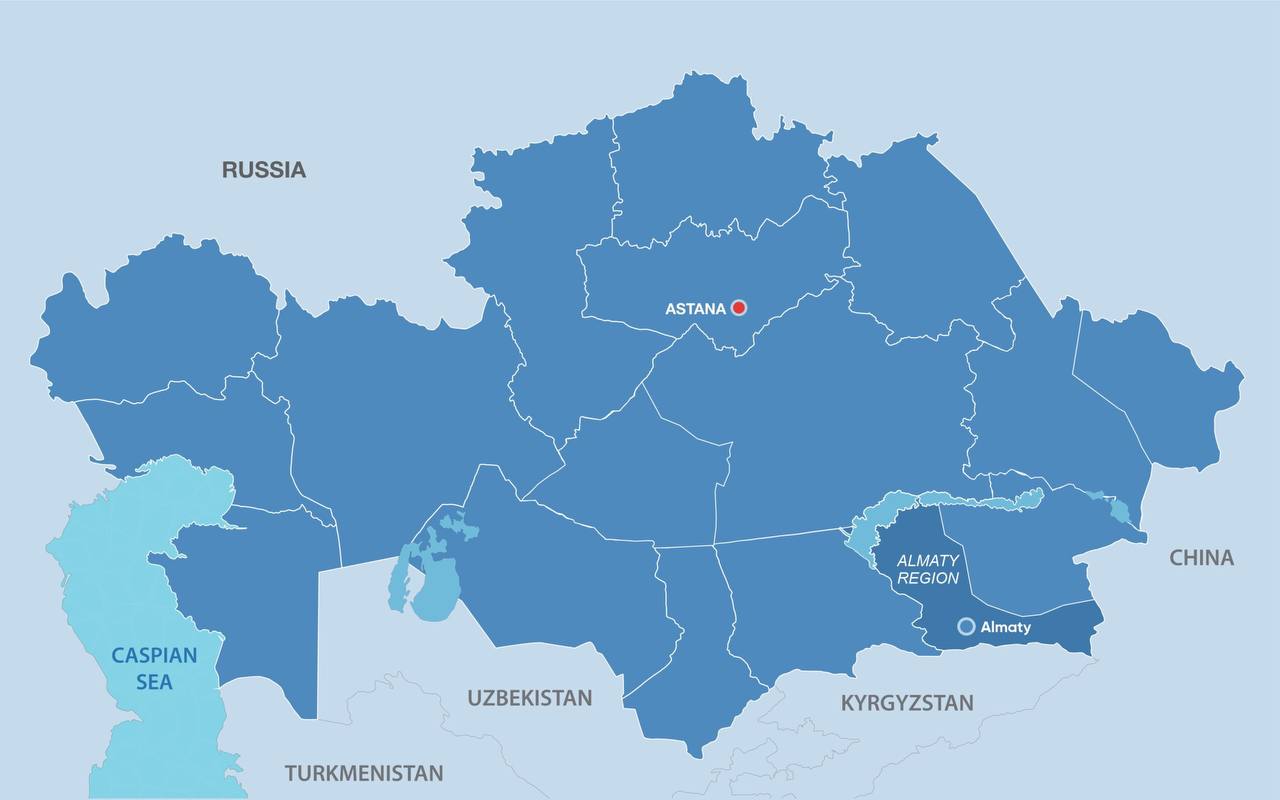
Almaty Museum of Arts. Photo сredit: Alexey Poptsov. Click to see the map in full size. The map is designed by The Astana Times.
At the same time, the former Tselinny cinema in Almaty was prepared for reopening as the Tselinny Center of Contemporary Culture, a multifunctional venue for exhibitions, performances, film screenings and research, redesigned by British architect Asif Khan.
Exhibition exchanges continued throughout the year. These included the presentation of Hungarian Matyó embroidery in Almaty and the exhibition titled “Serbian Women Through the Ages”, featuring artifacts from the Belgrade City Museum.
Kazakh and Central Asian contemporary art also gained international recognition. From April to May, artists Aya Shalkar and Altynai Osmo presented a joint exhibition in New York exploring mythology, gender and Central Asian cosmology. In September, Spanish artist Juan Saliquet concluded a residency in Almaty with a solo exhibition focused on urban memory and spatial research.
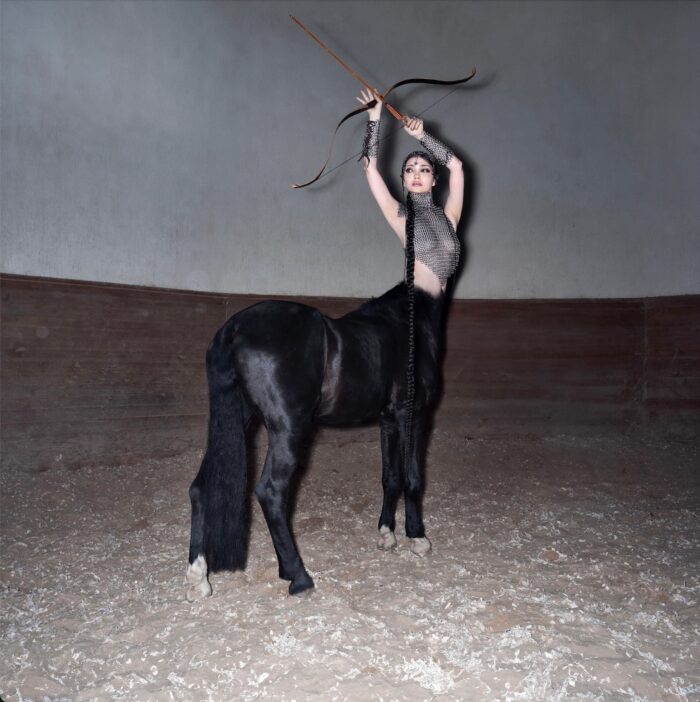
“Mergen” by Aya Shalkar. Photo Credit: Baurzhan Bismildin, Stylist & Creative Directors of the shoot are Goar Igitian & Assemgul Kulmagambetova
Music, opera and ballet
Classical performance remained a consistent part of the cultural calendar. In June, Opera singer Aigerim Altynbek performed with Andrea Bocelli in Pompeii, followed by a joint appearance with José Carreras in Astana later that month. She also became the second Kazakh artist admitted to the Academy of Teatro alla Scala in Milan.

Aigerim Altynbek and Andrea Bocelli. Photo credit: Aigerim Altynbek’s personal archive.
In May, Astana Opera presented three one-act ballets by French choreographer Roland Petit as part of the Operaliya festival. In March, the Assyl Mura audio archive, a national collection of historical recordings, was launched on global streaming platforms, making thousands of archival performances accessible online.
In February, artists from Astana Opera and leading choreography institutions represented Kazakhstan at Singapore’s Chingay Parade, one of Asia’s largest cultural festivals. In November, Kazakh ballet principal Bakhtiyar Adamzhan performed at Dubai Opera as part of the Roberto Bolle and Friends gala, following appearances in China earlier in the year.
Festivals, public traditions and everyday culture
Several festivals highlighted both traditional practices and contemporary reinterpretations. In October, the Shygys Salburyny international falconry festival in the East Kazakhstan Region marked its fifth anniversary, bringing together participants from seven countries. In April, Bozjyra Fashion Week in Astana presented collections inspired by Turkic history and cultural motifs.
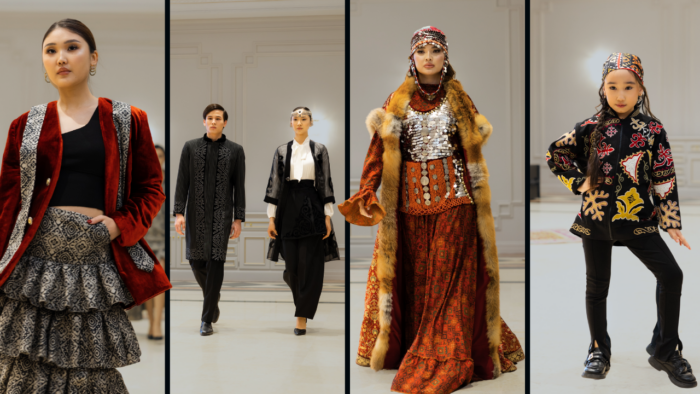
Bozjyra Fashion Week. Photo Credit: Iskakov Gaidar
Urban cultural formats also gained visibility. Alcohol-free morning coffee dance events appeared in Astana and Almaty, reflecting changing approaches to social gatherings and leisure.
In April, Kazakhstan observed its first National Book Day on April 23, following a presidential initiative to promote reading and library culture.
Feature stories: culture through personal lenses
The year was also highlighted by the individuals and communities shaping cultural expression across music, craftsmanship, visual art, literature, and heritage preservation, with the examples below representing only a small part of a much broader creative landscape.
Producer Yerkebulan Kurishbayev spoke about the development of OYU Fest, an open-air summer music festival held annually in Almaty and Astana that brings together contemporary Kazakh musicians working across traditional and modern genres. He also discussed the broader shift toward Kazakh-language music among younger audiences.
Dombra player Alibek Kaiyrbek continued a long-term project combining mountaineering with music. This year, he performed Kurmangazy’s composition “Adai” at the summit of Mount Kilimanjaro, Africa’s highest peak at 5,895 meters.
Another musical initiative emerged through Sezim, Kazakhstan’s first all-female orchestra, founded by Botagoz Kaliyeva, Madina Bekmadiyeva, Shyryn Bazarkulova and Jordan Arakelyan, which held its debut concert on Feb. 7 featuring film soundtracks associated with female-led narratives.
Beyond conventional performance formats, ethno-musician and composer Aizada Kemel shared with The Astana Times how she explored experimental sound rooted in nature, combining voice, unconventional instruments and improvisation distinct from established throat-singing traditions.
Traditional craftsmanship also gained attention through Yerzhigit Toktaruly, a saddle-maker from the Pavlodar Region who uses social media to share instructional content and adapt historical saddle-making techniques to contemporary practice.
