
ASTANA – Kazakhstan in 2025 was marked by major political, economic, technological and cultural developments that directly affected daily life. The Astana Times rounds up some of the most widely read domestic stories of the year.
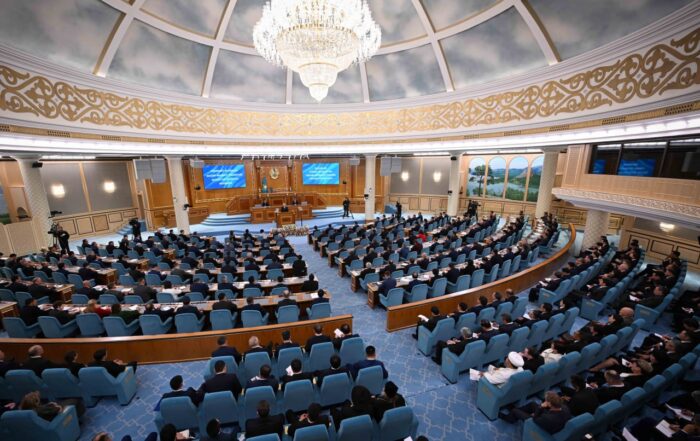
President Kassym-Jomart Tokayev announced the establishment of the Ministry of Artificial Intelligence and Digital Development during his annual state-of-the-nation address in September. Photo credit: Akorda
Digital transformation at the forefront
Digitalization dominated Kazakhstan’s domestic policy agenda in 2025, as the country accelerated its ambition to become a regional leader in artificial intelligence.
A major milestone came with the launch of Central Asia’s most powerful supercomputer, designed to support large language models, AI research and data processing at scale.

Photo credit: Shutterstock
To consolidate this push, Kazakhstan established the Ministry of Artificial Intelligence and Digital Development, signaling its goal of becoming a fully digital country within three years. President Kassym-Jomart Tokayev announced the move in his annual state-of-the-nation address in September.
***
The country later adopted Central Asia’s first artificial intelligence law, establishing a regulatory framework for the safe, transparent and ethical use of AI across the economy and public sector.
***

Pavel Durov, the founder and CEO of Telegram during the Digital Bridge forum on Oct.2 in Astana. Photo credit: Akorda
During the Digital Bridge forum in Astana, Kazakhstan opened the Alem.ai International Center for Artificial Intelligence, positioning it as a global hub for ethical AI solutions. Telegram also announced plans to open an AI laboratory in Kazakhstan as part of cooperation linked to the national supercomputer.
***
Looking ahead, Kazakhstan is preparing for the mass rollout of Voice over Wi-Fi (VoWiFi) technology in 2026, aimed at eliminating weak mobile coverage inside buildings, alongside the gradual replacement of 3G with 4G.
***
Another major step will begin in 2026, when all government budgets transition to the digital tenge. Officials say the digital currency is intended not just as a payment tool, but as a mechanism to improve transparency and efficiency in public finance.
Economic reforms and financial pressure
Several major regulatory changes shaped the economic landscape. Parliament approved a new Tax Code aimed at simplifying administration, adjusting tax burdens and stimulating growth.

Photo credit: Shutterstock
At the same time, Kazakhstan prepared a new law on banks and banking activities, expected to be adopted by the end of 2025. For the first time, the country plans to introduce two types of banking licenses, basic and universal, to support micro and small businesses. The law also proposes regulation of digital financial assets, including stablecoins and tokenized instruments.
***
Economic conditions remained challenging. In October, the National Bank of Kazakhstan raised the base rate from 16.5% to a historic 18%, marking the second sharp tightening of monetary policy in 2025 amid inflationary pressures and financial risks.
Safety and accountability in focus
Public safety legislation drew heightened attention in 2025 as Kazakhstan strengthened its legal framework. In the summer, Tokayev signed amendments introducing criminal liability for stalking and forced marriage, part of broader efforts to modernize and optimize the country’s criminal legislation.
***
Later in the year, the Kazakh Parliament approved a unified law on the Prevention of Offenses, establishing administrative liability for wearing face-covering clothing in public places, a move officials said was aimed at enhancing public safety and order.
***
Kazakhstan continued efforts to recover illegally withdrawn assets. Authorities reported that more than 1.2 trillion tenge (US$2.3 billion) had been returned through a two-year recovery campaign.
Funds channeled through the Special State Fund have been allocated to 406 projects nationwide, with hundreds already underway in education, health care, sports, water supply and public infrastructure.
Tourism and global visibility
Tourism remained one of the key drivers of economic growth. In the first half of 2025, Kazakhstan welcomed 7.5 million foreign visitors, including five million overnight tourists, amid a broader regional travel boom.
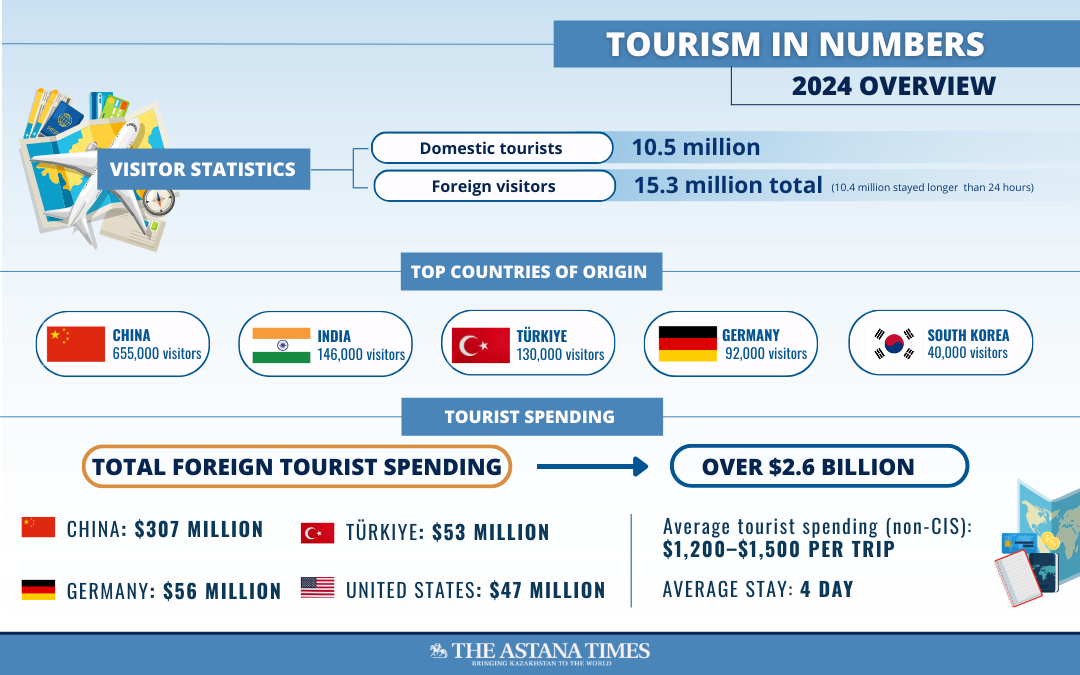
Tourism statistics for 2024. Photo credit: The Astana Times
Event tourism surged following major concerts and sporting events. Jennifer Lopez’s first-ever concert in Almaty drew 27,000 fans, including 7,000 international visitors, generating an estimated 10 billion tenge (US$21 million) in economic turnover. The Backstreet Boys later filled Astana Arena with around 30,000 attendees, more than a third of them foreign visitors.
***
Kazakhstan also expanded visa options. The Neo Nomad Visa continued attracting foreign professionals. While a new investor visa, requiring at least $300,000 in local investments, was introduced to strengthen long-term business ties.
Nuclear power decision
After years of debate, Kazakhstan moved forward with plans to build its first nuclear power plant. The government selected Russia’s Rosatom to lead the international consortium, while retaining full ownership, operational control and responsibility for nuclear fuel production.
***
The decision highlighted the need to train engineers and technical specialists, placing workforce development for the nuclear sector firmly on the national agenda.
