
ASTANA — Kazakhstan has created its first DNA bank for the national dog breeds Tazy and Tobet, following several years of nationwide genetic research aimed at preserving their unique heritage and preventing genetic loss. The project combines science, culture, and conservation as the country prepares for broader international recognition of its indigenous breeds.

Kazakh tazy. Photo credit: From the personal archive of Elena Hardina
For centuries, the Tazy and Tobet have been part of Kazakhstan’s nomadic culture, associated with hunting, protection, and pastoral life. Despite their cultural importance, both breeds were largely understudied scientifically until recently, leaving their genetic history, diversity, and health insufficiently documented. It was a gap that prompted a large-scale research effort beginning in 2021, led by Kazakhstan’s scientific institutions in cooperation with cynology and veterinary organizations.
“Over the past several years, we managed to change this situation. In 2021, a project to study the Tazy gene pool was launched, and shortly afterward, a large program began to research the Tobet and develop technologies to preserve its genetic resources,” said Anastasia Perfilyeva, a candidate of biological sciences and a leading researcher at the Institute of Genetics and Physiology.
According to Kazinform, the work brought together the Institute of Genetics and Physiology, the Institute of Zoology of Kazakhstan, the Kansonar Association, the Union of Cynologists of Kazakhstan, veterinary organizations, animal shelters, and public foundations.
Genetic research and what it revealed
Research began with expeditions across Kazakhstan, where scientists and cynologists met directly with breeders, hunters, and shepherds to identify authentic representatives of both breeds.
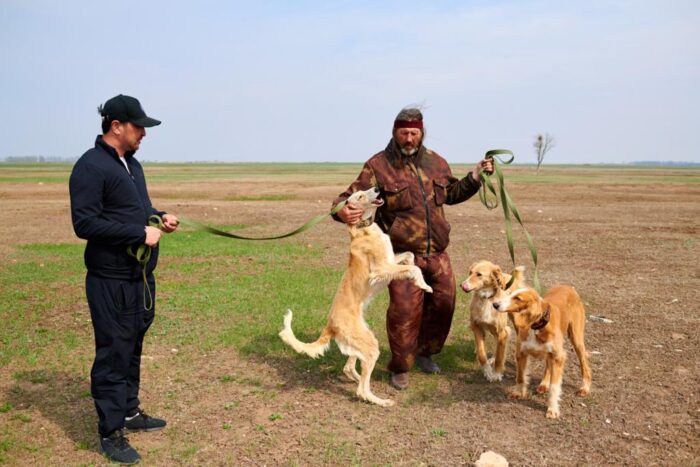
Photo credit: Nomad National Hunting Club.
“Many owners learned for the first time that their dogs could have serious scientific value,” said Perfilyeva.
Each identified dog contributed genetic material, allowing researchers to document ancient bloodlines and environmental adaptation. These samples now form the country’s first structured DNA bank for Tazy and Tobet, ensuring the data is preserved and not lost over time.
Genetic analysis confirmed that the Tazy is an independent ancient breed, and that the Tobet developed at the intersection of the Arctic and East Asian dog lineages. Researchers found that the Tobet differs genetically from more than 140 dog breeds worldwide, including other guarding breeds.
Scientists also identified specific regions of the dogs’ DNA associated with traits such as speed, endurance, guarding behavior, cognitive ability, and resistance to physical stress. These findings provide a scientific basis for responsible breeding and long-term population health management.
Practical tools for breeders and owners
More than 600 dogs have received genetic passports, which help breeders avoid inbreeding, confirm lineage, assess the rarity of bloodlines, and improve the animals’ official status.
For the Tobet, researchers developed and patented a genetic verification technology that detects breed admixture, protecting the population from uncontrolled crossbreeding. A cytogenetic test was also introduced to identify hidden chromosomal abnormalities and monitor the overall health of the breed.
Another outcome was the development of a set of trichological markers, which is a method that identifies dog breeds through microscopic hair analysis. Such techniques are rarely used worldwide and are particularly valuable for veterinary forensic examinations, where a breed can be determined from a single hair.
“This is a major step forward. If something happens to the population, we will have a reserve. For the first time, the country has this kind of genetic insurance,” said Perfilyeva.
International recognition and ongoing work
In 2024, the Tazy received preliminary international recognition from the International Canine Federation (FCI), confirming Kazakhstan as the holder of the official breed standard. Scientific materials prepared by Kazakh researchers were included in the official documentation package, marking a milestone in formalizing the breed’s genetic status. The decision was later reflected at the national level, as Kazakhstan marked the Day of Kazakh Dog Breeds for the first time on Sept. 3.
Work on the Tobet continues. Researchers have created an interactive map showing the breed’s distribution and genetic condition, developed conservation guidelines, and established infrastructure for cryopreservation and long-term monitoring. These materials have been transferred to the Union of Cynologists of Kazakhstan and have attracted the interest of government bodies.
“We went from field expeditions to genomics and international recognition. Most importantly, we created a foundation that will allow the Tazy and Tobet to be preserved not only today, but for future generations,” said Perfilyeva.
International interest in the Tazy has continued to grow. At the World Dog Show 2025, the Kazakh national team presented eight Tazy dogs and won seven major awards, drawing attention from international judges, experts, and breeders.
President Kassym-Jomart Tokayev previously gifted Kazakh Tazy dogs to French President Emmanuel Macron and to renowned Kazakh artist Dimash Qudaibergen. In Kazakh tradition, the Tazy is part of Zheti Kazyna, the “Seven Treasures,” symbolizing key values of nomadic life, including mobility, hunting, protection, and cultural continuity.
