
ASTANA — Strengthening trade and investment across priority sectors with Kazakhstan is among the United Kingdom’s main objectives in the region, said Lord John Alderdice, U.K. Trade Envoy to Azerbaijan and Central Asia and Member of the House of Lords, in an interview with The Astana Times.
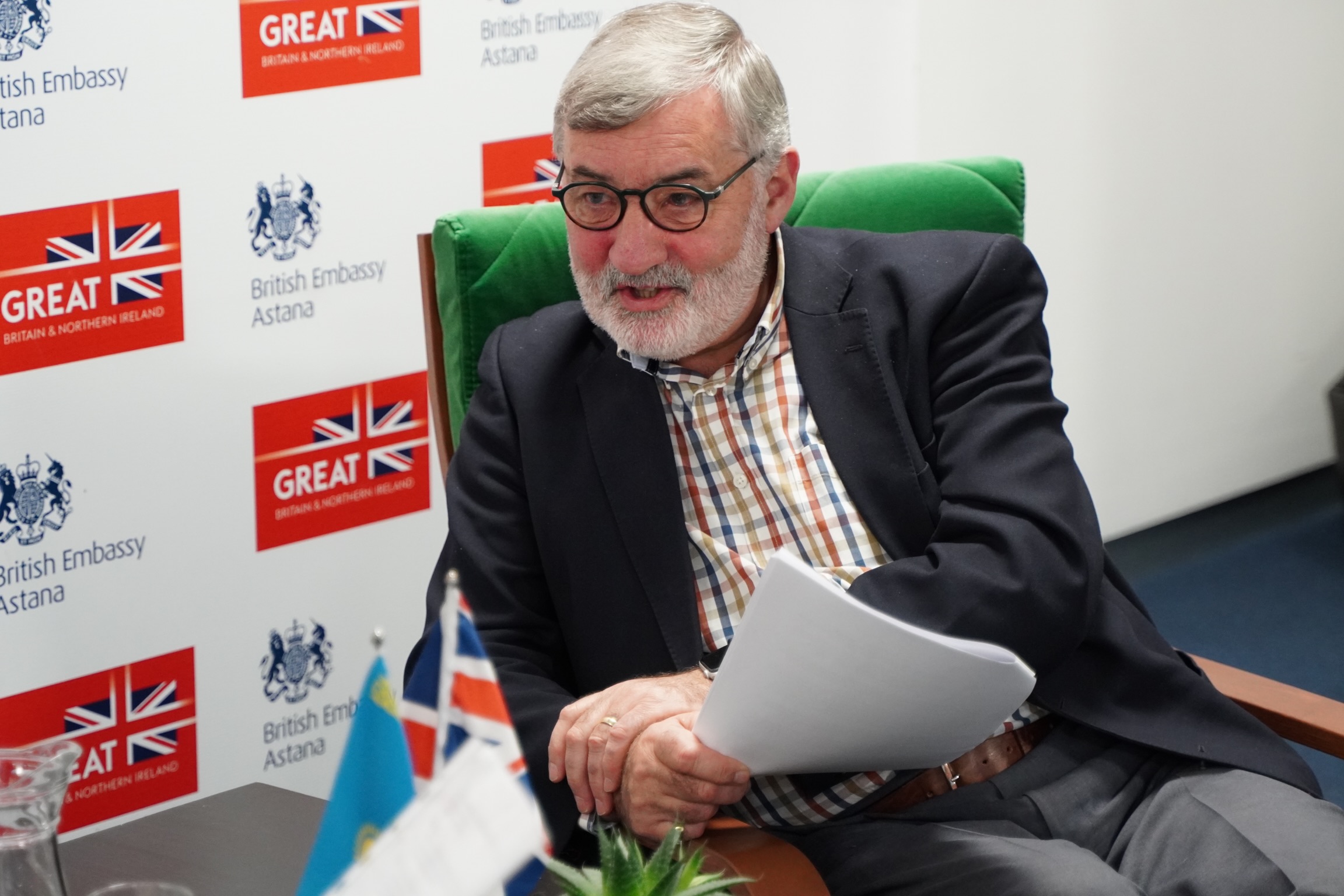
Lord John Alderdice, U.K. Trade Envoy to Azerbaijan and Central Asia and Member of the House of Lords, in an interview with The Astana Times. Photo credit: Fatima Kemelova / The Astana Times
His visit to Almaty and Astana on Oct.10-13 marked his first trip to Kazakhstan in his new role, underscoring London’s intent to strengthen cooperation in trade, education, digitalization, and sustainable development.
Alderdice’s visit reflected the U.K.’s broader policy of strengthening economic cooperation with Kazakhstan and supporting sustainable growth.
Trade between Kazakhstan and the U.K. rose 51.1% in the first eight months of 2025, reaching $874 million.
“They have to be mutually beneficial relationships and partnerships if they’re going to last. It has to support sustainable growth and innovation and diversification, because the world is changing, and we need to be able to do new things and do them in different kinds of ways,” said Alderdice.
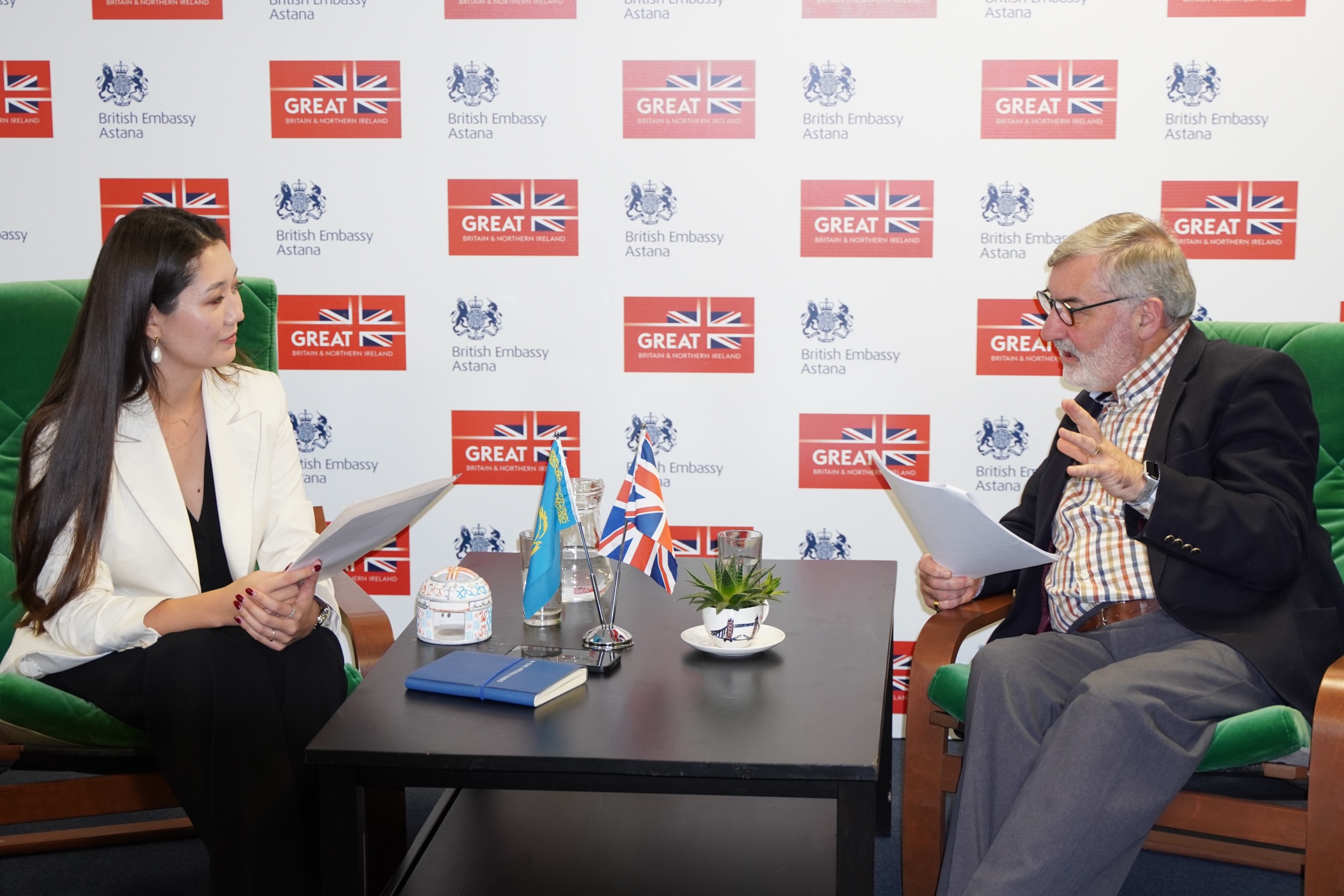
The Astana Times reporter Nagima Abuova and U.K. Trade Envoy to Azerbaijan and Central Asia Lord John Alderdice. Photo credit: Fatima Kemelova / The Astana Times
“Long-term, lasting, mutually sustainable and beneficial relationships are really, for me, the key thing,” he added.
Alderdice said Kazakhstan’s scale, resources, and geopolitical significance make it a natural starting point for his regional mission. During his meetings with government leaders and business representatives, he noted that the focus was on expanding British participation in investment and infrastructure projects, as well as new cooperation in critical minerals, healthcare, transport, finance and energy.
“This is a particularly interesting country because of its geopolitical significance. (…) It’s a place with loads of potential, with a lot of young people who are very enthusiastic and lively, who want to build their country. Their enthusiasm is quite infectious,” said Alderdice.
Diplomacy grounded in experience
Drawing on his background in psychiatry and peacebuilding in Northern Ireland, Alderdice emphasized the importance of understanding history and diversity when building partnerships. He noted Kazakhstan’s linguistic, ethnic, and religious diversity as both a challenge and an asset that can enrich society.
“You can’t understand how people in a country feel if you don’t understand their memories, and not just their individual memories, but their national memories of the past. Some of them are good, but there are also ‘not-so-good’ memories, and those influence how people approach their relationships within communities,” said Alderdice.
“There’s a temptation to see collaboration in transactional terms. (…) My own experience has been that although transactions are important, it’s relationships that are really the fundamental thing. And I suppose that’s one of the things I’m keen to see developing here between the U.K. and Kazakhstan is a relationship,” he said.
He pointed to Kazakhstan’s role in hosting the Congress of Leaders of World and Traditional Religions and peacefully settling borders with neighbors as evidence of its capacity for dialogue and compromise.
“So whether it’s political diplomacy or economic diplomacy, I think it’s very important that we build relationships and produce results that can benefit both sides,” said Alderdice.
Education and innovation as cornerstones
Education emerged as one of the most promising fields of cooperation. British universities such as De Montfort, Coventry, Cardiff, Heriot-Watt, and Queen’s University Belfast operate campuses in Kazakhstan. Alderdice visited several of them during his trip, including Narxoz University, where Queen’s University Belfast, his alma mater, offers a dual-degree program.
“I find it really inspiring and exciting to meet with these young people. They make me very hopeful, because they bring a real enthusiasm for working, for learning, for building up their country. And if you combine together that youthful enthusiasm and energy with the kind of experience and background that I think we can bring from the U.K. educational system, I think you’ve got a marvelous future in that collaboration,” he said.
He also highlighted digitalization and artificial intelligence as areas of shared potential, citing the U.K.’s success in fostering innovation across multiple regions. He said scientific progress depends on international collaboration between universities and companies, noting that the COVID-19 pandemic demonstrated the potential of online cooperation.
“This is an area where we ourselves, I say modestly, are doing quite well. We are able to see how we can do that in a dispersed way throughout the United Kingdom, and I see absolutely no reason why that’s not something that we can share with our friends in Kazakhstan,” said Alderdice.
Toward sustainable and enduring partnerships
According to Alderdice, cooperation has expanded into multiple fields, from academic partnerships to innovation projects such as OneWeb’s launch of the world’s first satellite internet service on trains with the Kazakhstan Temir Zholy national railway company.
He highlighted Kazakhstan’s vast biodiversity, noting the U.K.’s acknowledgment of conservation efforts through the Altyn Dala initiative. The project helped protect the endangered saiga antelope and earned the Prince of Wales’s Earthshot Prize, an example of collaboration that has brought both global recognition and tangible results.
