
ASTANA — Almaty hosted the first United Nations Tourism Regional Conference on the Empowerment of Women in Tourism in Europe on Oct. 22-23, providing a platform for nearly 400 participants from international organizations, government, business, and the expert community.
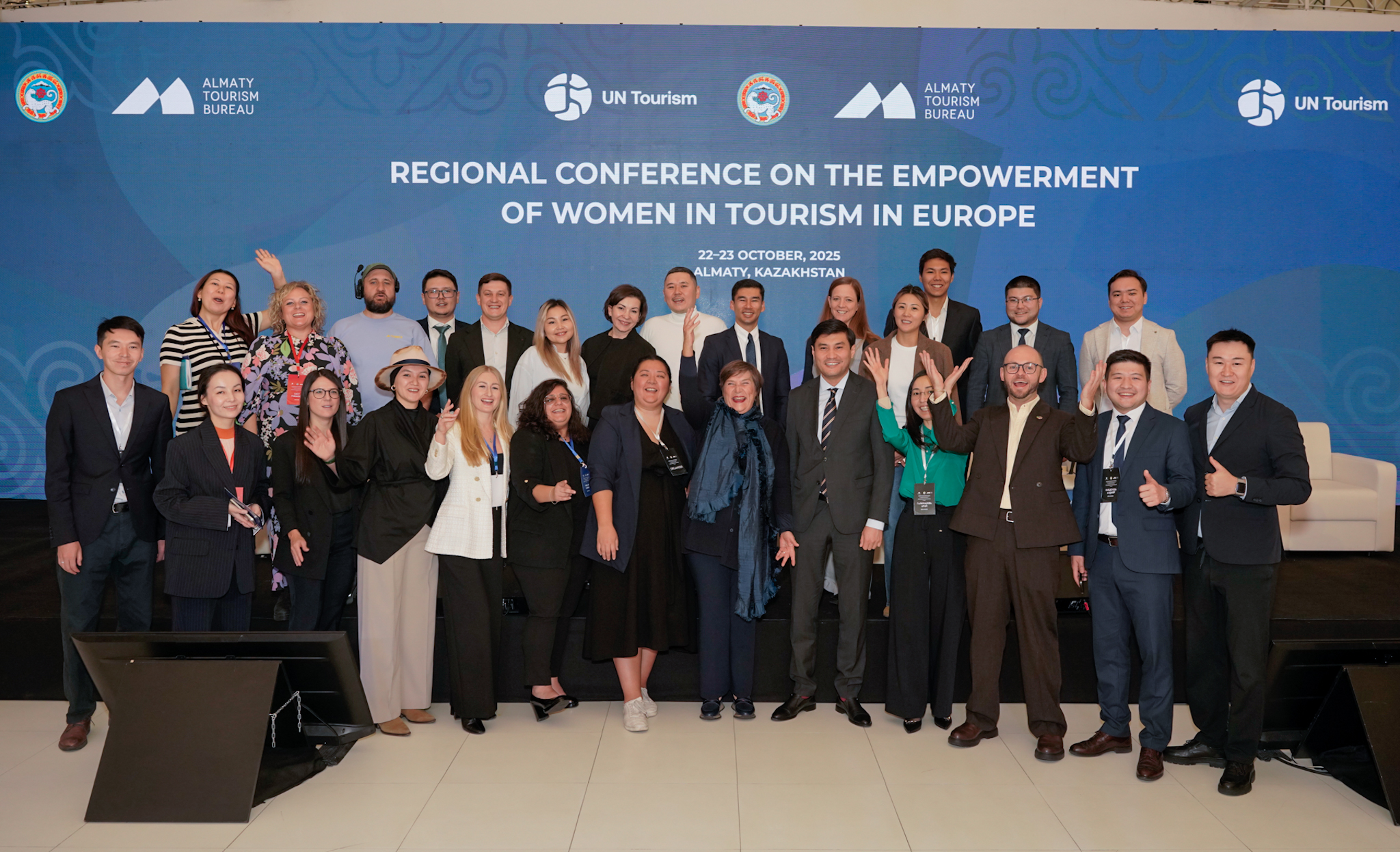
UN Tourism Regional Conference on the Empowerment of Women in Tourism in Europe on Oct. 22-23 in Almaty. Photo credit: UN Tourism X account
The conference, organized by the Almaty Tourism Bureau, Kazakh Tourism, UN Tourism, and the Kazakh Ministry of Tourism and Sports, featured panel discussions on women in male-dominated sectors, the digital divide in tourism, and the experiences of women shaping Kazakhstan’s tourism industry.
“Tourism is not only a driving force of the economy but also an indicator of social development, a tool for preserving cultural heritage and supporting creativity. Kazakhstan adheres to the principles of sustainability and equal opportunities, considering tourism as one of the priority areas for economic diversification,” said Nurtas Karipbaev, chairman of the Committee for Tourism Industry of the Ministry of Tourism and Sports.
Karipbaev added that Kazakhstan welcomed more than 12 million international visitors in the first nine months of 2025, while Almaty continues to see steady growth in both foreign and domestic arrivals. He noted that Kazakhstan’s Tourism Development Concept through 2029 sets out concrete goals for growth and international cooperation.
According to the ministry, Kazakhstan currently ranks 57th in the global tourism development index, with Almaty recognized as a major hub in Central Asia.
“Almaty is proud to be a hub where tourism and sustainability come together, and where women play a growing and vital role across all sectors of our industry. Empowering women in tourism is essential for driving innovation, inclusivity, and sustainable growth, and their leadership makes a real difference for communities and for the city as a whole,” said Diyar Askarov, director of Almaty Tourism Bureau.
“Through our partnership with UN Tourism, we are committed to supporting women professionals and entrepreneurs, ensuring they have the opportunities and resources they need to thrive. Together, we are shaping Almaty’s future as a center of opportunity, global connection, and shared progress,” he added.
UN Tourism perspective
Zoritsa Urosevic, UN Tourism executive director, highlighted the sector’s resilience and its potential for empowerment.
“Today, international tourism has not only recovered but surpassed pre-pandemic levels by 5%, a remarkable achievement that reflects our sector’s resilience and vitality. (…) Today, it is up to us to ensure that everyone has the chance to benefit from the opportunity this growth brings and that everyone can travel without barriers, no matter the gender,” said Urosevic.
“UN tourism works with member states to do just that, through our flagship Center Stage program. Under the program, we work with government, businesses, and civil society on activities and measures to promote empowerment, placing women at the center stage of tourism development,” she said.
Almaty’s Call to Action
The conference also featured the adoption of the Almaty Call to Action for Women’s Empowerment in Tourism. The framework calls for reducing the gender pay gap, ensuring equal access to technical and leadership roles, strengthening policies against workplace harassment, and expanding women’s entrepreneurship through training, financial support, and greater market access.
The delegates also emphasized the importance of education and lifelong learning, particularly in science and technology, to help women advance into higher-paying positions. The action plan urges governments and businesses to improve data collection, disaggregated by sex, to design more effective gender-responsive tourism policies.
Regional and global context
According to the second edition of the Global Report on Women in Tourism, women represent 54% of the world’s tourism workforce, higher than their share in the broader economy at 39%.
In Europe, women make up an estimated 53% of workers in the accommodation and food services sector. Despite these numbers, women are concentrated in lower-paid and informal roles, while leadership and technical positions remain largely male-dominated.
UN Tourism data shows that although tourism has slightly narrowed the wage gap, parity is still distant. Women earn around 14.7% less than men, compared to 16.8% in other sectors.
In Central Asia, many women have turned to grassroots initiatives such as networks, cooperatives, and mentorship groups. These community-based efforts have helped women share knowledge, improve visibility, and negotiate better conditions, offering long-term potential for greater economic participation and social leadership across the region.
