
ASTANA – While diplomatic relations between Kazakhstan and Croatia date back to October 1992, the opening of Croatia’s embassy in Astana in April 2019 marked a new phase in the relationship. Refik Šabanović has served as Ambassador of Croatia since the mission’s launch and in an interview with The Astana Times, he shared how bilateral ties have since expanded across trade, energy and people-to-people exchange.

Refik Šabanović, Ambassador of Croatia. Photo credit: The Astana Times
“Friendly and increasingly diverse practical cooperation is rooted in diplomatic ties established shortly after Croatia’s independence in 1991. Over the years, both countries have opened embassies, signed bilateral agreements, and maintained a regular political dialogue,” said the ambassador.
Bilateral cooperation has deepened through a series of economic and political milestones over the past two years, including the first meeting of the Joint Commission on Economic Cooperation in Zagreb in January 2024 and the inaugural Croatia–Kazakhstan Business Forum in April 2024, which brought together more than 50 companies across sectors from energy and pharmaceuticals to IT, agriculture, transport and tourism.
High-level exchanges followed, including a Croatian business delegation led by Minister of Foreign and European Affairs of Croatia Gordan Grlić Radman to Astana in April, where more than 70 companies participated in a business forum and B2B meetings.
“It means both 2024 and 2025 were very successful years,” Šabanović said, noting that Croatia’s Parliament had recently invited Kazakhstan’s parliamentary friendship group to visit Zagreb, with the trip expected to take place in September.
Šabanović also said Croatia is preparing for its Prime Minister to visit Kazakhstan by the end of March, accompanied by several ministers, and to hold the second session of the intergovernmental committee in Astana.
Growing trade
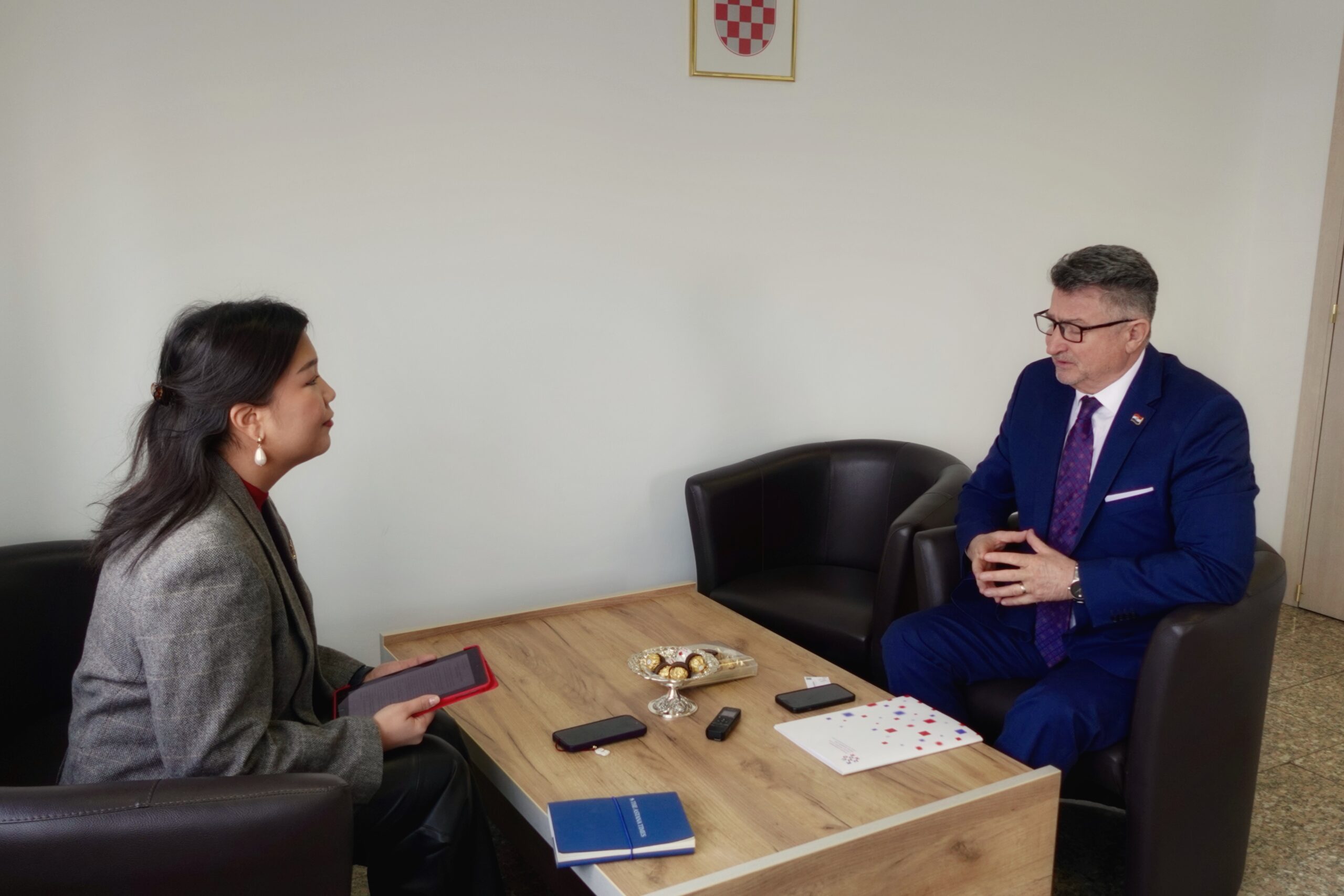
Assel Satubaldina during an interview with Refik Šabanović. Photo credit: The Astana Times
The ambassador emphasized the growing trade between Croatia and Kazakhstan, noting that bilateral trade exceeded $375 million in 2024. In the first 10 months of 2025, trade reached $363 million, up more than 21% compared with the same period a year earlier.
Šabanović said Croatia sees major opportunities to expand energy cooperation with Kazakhstan through Jadranski naftovod, known as JANAF, noting that the Adria pipeline offers a reliable route via the Middle Corridor at a time when northern routes have become increasingly vulnerable due to the war in Ukraine. The company signed a memorandum of understanding with KazMunayGas in January 2024 to explore joint opportunities in the transportation and storage of crude oil and petroleum products.
“JANAF could deliver around 15 million tons of oil per year,” said Šabanović, pointing to the recent shipment of 85,000 tons of Kazakh oil to Hungary via Croatia as a practical demonstration of the corridor’s viability.
“While the volume was relatively modest, the delivery signaled a significant milestone in bilateral energy cooperation and highlighted the capacity of Croatian infrastructure to support Kazakhstan’s outreach to European markets,” he added.
He also said Croatian ports, including Rijeka, Zadar, and Ploče, could serve as gateways for Kazakh goods entering the EU’s market, describing them as “strategically vital to Kazakhstan’s evolving export strategy.”
“As the Middle Corridor gains prominence as a resilient and geopolitically balanced trade route, Croatia’s role as a conduit for Kazakh oil and other goods reflects a broader shift toward deeper connectivity between Central Asia and Southeast Europe. This growing interdependence offers clear mutual benefits, strengthening both countries’ positions within the global logistics and energy landscape,” he said.
Shared path
Beyond trade, there is something more common between Kazakhstan and Croatia.
Both emerged as independent states in the early 1990s following the collapse of larger political systems: Kazakhstan after the dissolution of the Soviet Union, and Croatia after the breakup of Yugoslavia, forcing each to build new institutions, redefine national identity, and navigate complex regional environments. According to the ambassador, bilateral ties benefit a lot from this shared experience of transition.
Visa facilitation process
The ambassador pointed to the positive momentum in ties between the EU and Kazakhstan, which marked 33 years on Feb. 2.
“Kazakhstan’s foreign policy is defined by its multi-vector approach, balancing relations with global powers while expanding ties with regional and international organizations. In recent years, its relationship with the European Union has gained significant momentum, particularly in areas such as trade, energy, digitalization, and transport connectivity,” he said.
Croatia has also been among the EU members backing the launch of visa facilitation talks with Kazakhstan, which officially began in December. According to Šabanović, visa facilitation boasts broad support among EU member states, reflecting the bloc’s role as Kazakhstan’s largest trading partner and biggest investor
“The European Union is Kazakhstan’s biggest trading partner and biggest investor,” he said. “We have to make it easier to meet each other in Brussels, in Zagreb, or Madrid, and we are working on that.”
The proposed facilitation would streamline visa procedures for Kazakh citizens, offering faster processing, less paperwork, and lower costs.
“Croatia, as both an EU and NATO member, has expressed strong support for Kazakhstan’s European engagement, including its visa facilitation initiative. During bilateral meetings and regional forums, Croatian officials have emphasized the importance of enhancing mobility, academic exchange, and business travel between the two countries,” said the ambassador.
Launching direct flights as a priority
Šabanović said one of his priorities is to launch direct flights between Kazakhstan and Croatia. This, he noted, would strengthen tourism, business travel and people-to-people ties, adding that many Kazakh visitors currently travel via third countries.
He said discussions with airlines and tourism authorities are ongoing. Though aircraft availability remains a constraint, he hopes to launch a seasonal charter flight in the near future.
“Croatia has less than 3.9 million people, and last year we had 21.6 million tourists,” he added.
“While no official launch date has been announced, the groundwork is being laid. With rising trade volumes, growing diplomatic engagement, and mutual interest in tourism, direct flights between Croatia and Kazakhstan are not only feasible-they are increasingly likely in the near future,” said the ambassador.
Promoting Kazakhstan in Croatia
While in Kazakhstan, the ambassador said he has spent much of his tenure traveling across Kazakhstan, visiting more than a dozen regions to better understand local priorities and opportunities. He said these trips, often organized alongside EU Ambassadors’ visits, but also independently, have taken him from Shymkent and Kyzylorda to the Aral Sea region, Oskemen, Petropavl and Almaty.
During each visit, he said he seeks meeting regional and city akims (mayors) to discuss ways to expand bilateral economic cooperation. Šabanović believes this on-the-ground engagement has helped build trust and identify concrete opportunities, contributing to the steady growth of trade between Croatia and Kazakhstan in recent years.
He also stressed that tourism should flow both ways, noting that Croatia is just as interested in encouraging Croatians to travel to Kazakhstan as it is in welcoming Kazakh visitors.
As an example, the ambassador said many Croatians traditionally travel to Alpine destinations such as Austria and Switzerland to ski, but Kazakhstan also offers compelling alternatives. He mentioned Shymbulak as an attractive, more affordable winter destination that meets European standards.
Best time to visit Croatia
Šabanović also shared his practical advice on the best time to visit Croatia that boasts more than 3,500 miles of coastline.
While travel preferences vary, he said, peak summer from late June through August appeals to visitors seeking hot weather and beach holidays, though it is also the most crowded period. For a more relaxed experience, he recommended the second half of June and September, when temperatures remain warm, sea conditions are more pleasant, and tourist pressure is lower.
