
ASTANA – Kazakhstan celebrates the 140th anniversary of Mirzhakyp Dulatov on Nov. 25, an influential Kazakh poet, educator, and leader of the Alash movement.
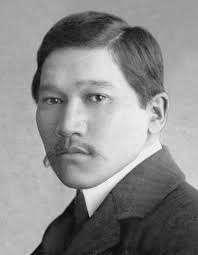
Mirzhakyp Dulatov, an influential Kazakh poet, educator, and leader of the Alash movement. Photo credit: e-history.kz
Born in 1885 in the windswept steppe of the Turgai Region, Dulatov’s childhood was marked by early loss. His mother died when he was two years old, while his father passed away when he was 12. Yet the boy who grew up in a small aul (village) showed a relentless hunger for knowledge. He completed primary school in his village and in 1897 enrolled in a Russian-Kazakh pedagogical school, graduating in 1902 and becoming a rural teacher.
In 1904, he moved to Omsk, where he met Akhmet Baitursynuly, a future leader of the Kazakh intelligentsia. Together, they moved to Karkaralinsk, where Dulatov witnessed the political upheavals surrounding the 1905-1907 Russian revolution. Those events shaped his worldview, fueling both his literary voice and his political convictions.
Dulatov’s rising influence
During this time, Dulatov wrote poetry, prose, scholarly articles and commentary, and responded to current events with essays and correspondence. His 1909 poetry collection “Oyan, Kazakh!” (Wake Up, Kazakh), published in Kazan, immediately brought him recognition among Kazakh, Russian, Tatar, Kyrgyz, and Bashkir intellectuals. The book, which called for social responsibility, education and women’s equality, was quickly confiscated. He republished it in 1911.
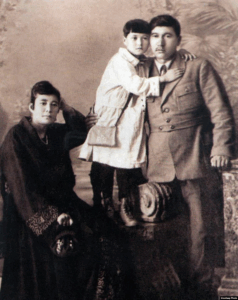
Mirzhakyp Dulatov with his wife, Gainizhamal, and their daughter, Gulnar, in Orynbor, 1923. Photo credit: alash.semeylib.kz
Dulatov also wrote “Bakytsyz Zhamal” (Unfortunate Zhamal), published in 1910. Considered the first work of modern Kazakh prose, it tells the story of a young woman victimized by patriarchal customs, highlighting the tension between tradition and emerging modern ideas.
As his influence grew, Dulatov became a leading figure in the Kazakh reformist and national liberation movement. His writings drew the attention of the police and the Tsarist secret service, and he struggled to find work. In 1911, he was arrested in Semipalatinsk and spent 18 months in prison.
After his release, he wrote regularly for the Aiqap journal and the Kazakh newspaper, which he co-founded with Baitursynuly and Alikhan Bokeikhanuly in 1913. Dulatov used his writings to criticize the economic and political oppression of Kazakhs under imperial rule. He published the patriotic poem “Azamat” (Citizen) in 1913 and “Terme” in 1915.
Along with Baitursynuly and Bokeikhanuly, he opposed the tsar’s June 1916 decree conscripting Central Asians for labor at the front, arguing it would push an already struggling population toward famine. That year, he helped establish the first public fund to support the hungry, earning respect across Kazakh communities.
The awakening of an Alash leader
In the summer of 1917, Dulatov helped organize the First All-Kyrgyz (Kazakh) Congress in Orenburg, where the Alash party, the first Kazakh political party, was formally created.
Delegates adopted key resolutions on autonomy, land management, education, militia formation, judicial affairs and women’s status. The congress affirmed the right of Kazakhs to territorial and national autonomy within a federal, democratic Russian republic. The Alash-Orda government existed until February 1920, when it was dissolved by the Bolsheviks.
Although its leaders were amnestied and joined local government bodies, they remained under the surveillance of NKVD, also known as the People’s Commissariat for Internal Affairs.
From 1922 to 1926, Dulatov taught at the Kazakh Institute of Public Education in Orenburg while continuing his cultural, journalistic, and literary work, writing textbooks on history, language, and literature, and contributing to the Enbekshi Kazakh newspaper.
The enduring legacy
In 1928, he publicly opposed replacing the Arabic script, arguing the reform would sever the Kazakh people from their written heritage and weaken the native language. Later that year, he was arrested along with other former Alash leaders and sentenced to death. His sentence was later commuted to 10 years of hard labor.
In his letter from Butyrka prison in 1929, known as the “Urpakka Khat” (Letter to the Generation), he wrote: “I consider it my duty to help my enslaved, oppressed people escape from this servile situation. (…) What is being interpreted as a struggle against Soviet power is only my desire to see the Kazakh nation free and happy.”
Dulatov was sent first to the White Sea-Baltic Canal project and later to the Solovetsky labor camp. There, he wrote a Turkic-Russian dictionary and a geometry textbook for Kazakh schools, both of which prisoners copied and shared. Dulatov died of illness on Oct. 5, 1935.
His name and works were banned for decades. He was rehabilitated on Nov. 4, 1988. His daughter dedicated her life to preserving his literary legacy. In 1991, his collected works, including poetry, prose, and journalistic writings, were published.
In 2023, Kazakhstan released “Mirzhakyp. Oyan, Kazakh!,” a film that traces Dulatov’s life and the defining moments of Kazakh history under Tsarist and later Soviet rule.
