
ASTANA — The American Chamber of Commerce in Kazakhstan, also known as AmCham, outlined how business leaders assess the country’s reform agenda, fiscal trajectory and geopolitical environment in the Investors’ Voice 2026 edition report published on Jan.5. 2026 is seen as a defining moment for diversification, regulatory clarity and expanded Kazakhstan-U.S. economic engagement.
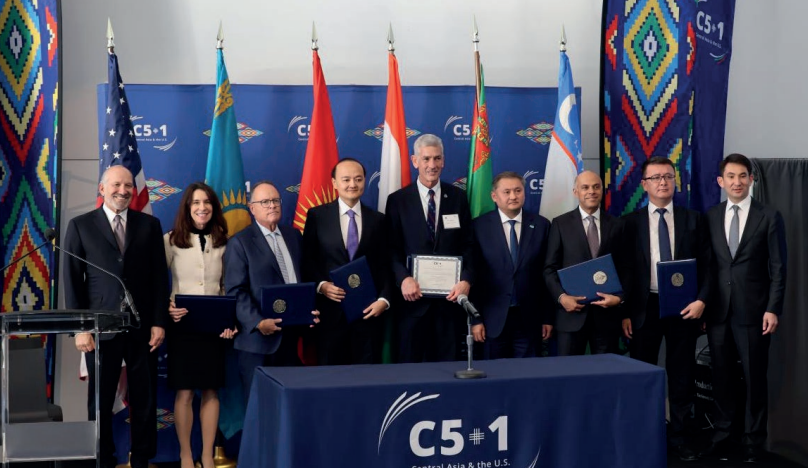
U.S. companies sign landmark deals at the C5+1 10th Anniversary Business Conference, Washington, November 2025. Photo credit: AmCham
Founded in 1999, AmCham represents more than 100 international and local companies and serves as a platform for policy dialogue grounded in the principles of free enterprise, fair competition, and the rule of law.

AmCham president and Citi country officer and banking head Saule Zhakayeva. Photo credit: AmCham
“At the core of AmCham’s mission is the importance of constructive dialogue between the business community and the government. Through this collaboration, we can identify challenges, propose solutions, and build a path for sustainable economic growth,” writes AmCham President and Citi Country Officer and Banking Head Saule Zhakayeva in the foreword.
The American Chamber of Commerce in Kazakhstan found that its role as a voice for investors was widely valued, leading it to establish a clearer process for identifying and advancing the issues its members care about most, according to Jeff Erlich, the chamber’s executive director. He pointed to regular engagement with Parliament, government ministries and the Prime Minister’s council on improving the investment climate.
Growth targets and investment needs

Jeff Erlich, AmCham’s executive director. Photo credit: AmCham
Christopher Weafer, chief executive officer of Macro-Advisory, described Kazakhstan’s current phase as defined by scale and ambition. Nominal gross domestic product has doubled over the past eight years to nearly $300 billion. President Kassym-Jomart Tokayev has set a goal to double it again by the early 2030s. Achieving that target requires more than $160 billion in combined public and private investment by 2030.
“The fact that Kazakhstan offers significant investment opportunities is not in doubt. The country’s geography and natural resource base ensure this,” said Weafer.
It was also a point echoed during the C5+1 summit in Washington in November, where sectors of mutual interest included critical minerals, chemicals, logistics, agriculture, renewable energy, and advanced technologies such as AI and nuclear sciences.
At the same time, he noted that fiscal consolidation could complicate expansion. Plans to balance the budget by 2030, increase value-added tax from 12% to 16% and raise utility tariffs may sustain inflationary pressures, even as authorities aim to bring inflation to 5%. According to Weafer, policy uncertainty, frequent senior personnel changes and legal disputes in major oil projects also weigh on investor confidence.
Structural transition and competitiveness
Zafar Khashimov, International Finance Corporation (IFC) country manager for Kazakhstan, shifted the focus from growth targets to structural transformation.
“Spanning the heart of Eurasia, Kazakhstan isn’t just big. It is bold. Since achieving upper-middle-income status in 2006, it has turned scale into strength, lifting GDP per capita to $14,140 in 2024 and driving nearly two-thirds of Central Asia’s total output,” he said.

Astana Sundowner. May 30, 2025. Photo credit: AmCham
He noted that diversification, decarbonization, and investment in human capital will be central to sustaining long-term competitiveness. With approximately 80% of electricity generated from coal, decarbonization presents both environmental and economic challenges.
“Kazakhstan’s journey is far from over. The country faces the dual challenge of sustaining growth while transitioning to a greener, more diversified economy. By investing in infrastructure, human capital, and innovation, Kazakhstan can unlock new opportunities and cement its status as Central Asia’s economic powerhouse,” said Khashimov.
Outlook for 2026
Sultan Zhumagali, head of research at BCC Invest, an Almaty-based investment firm, reviewed macroeconomic projections for 2026. While official forecasts place growth at 5.4%, he suggested that 4-5% may be a more conservative estimate under current global conditions.
“In recent years [2022-2023], the dynamics of real wages have lagged significantly behind GDP growth, effectively stagnating. This indicates a widening gap between economic growth and living standards,” he said.
Zhumagali noted that fiscal discipline, sovereign reserves and ongoing diversification provide buffers against external volatility.
“For investors, Kazakhstan’s 2026 outlook offers promising opportunities in renewable energy, agribusiness, logistics, and value-added manufacturing,” he added.
Transit and regional connectivity
Contributors to the report highlighted Kazakhstan’s transit potential as a structural advantage.
Located along the Trans-Caspian International Trade Route (TITR), also known as the Middle Corridor, and the International North-South Transport Corridor, Kazakhstan plays an expanding role in connecting China, Central Asia and Europe.
Contributors from Boston Consulting Group (BCG) said infrastructure connectivity and a multi-vector foreign policy support regional integration amid shifting trade patterns.
“Given the economy size and development level, geographical and natural resource advantages, Kazakhstan is well positioned to benefit from the global upheaval and lead the region,” said Mikhail Volkov, managing director and partner at BCG’s Almaty office.
Digital transformation and knowledge economy
Digital transformation is seen as an emerging investment area. Diana Ryan, HP Inc. director for government affairs and public policy in Central Asia and Türkiye, highlighted Kazakhstan’s shift toward a knowledge-based economy.
“For the global investment community, Kazakhstan has long been synonymous with energy and natural resources. Today, a new, equally compelling investment narrative is being written-one of digital transformation, technological innovation, and a deliberate pivot to a knowledge-based economy,” said Ryan.
Ryan pointed to opportunities in AI, cloud infrastructure, cybersecurity and digital governance.
Roxana Stancescu, Procter and Gamble (P&G) Kazakhstan general manager, highlighted demographic trends, noting that approximately 60% of citizens are under 35 and internet penetration is widespread. She said consumer preferences increasingly reflect demand for quality, affordability and products aligned with local identity.
“Consumers everywhere expect the right balance between quality, affordability, and emotional reward. Authenticity is its superpower. As cultural pride strengthens both in Europe and Kazakhstan, consumers increasingly prefer products that reflect their traditions and fit local habits,” said Stancescu.
United Nations Children’s Fund (UNICEF) Kazakhstan education specialist Tatiana Aderikhina added that investment in early childhood education and care strengthens workforce readiness and long-term productivity.
Across its sections, the report underscores that fiscal discipline, diversification and regulatory predictability will shape Kazakhstan’s ability to translate geography and resource wealth into broad-based growth.
