
ASTANA – President Kassym-Jomart Tokayev highlighted the strategic role of Kazakhstan’s transport sector on Aug. 1 in Astana, marking Transport Workers’ Day. Addressing industry professionals, he outlined key infrastructure and logistics projects aimed at strengthening the country’s position as a vital Eurasian transit hub.
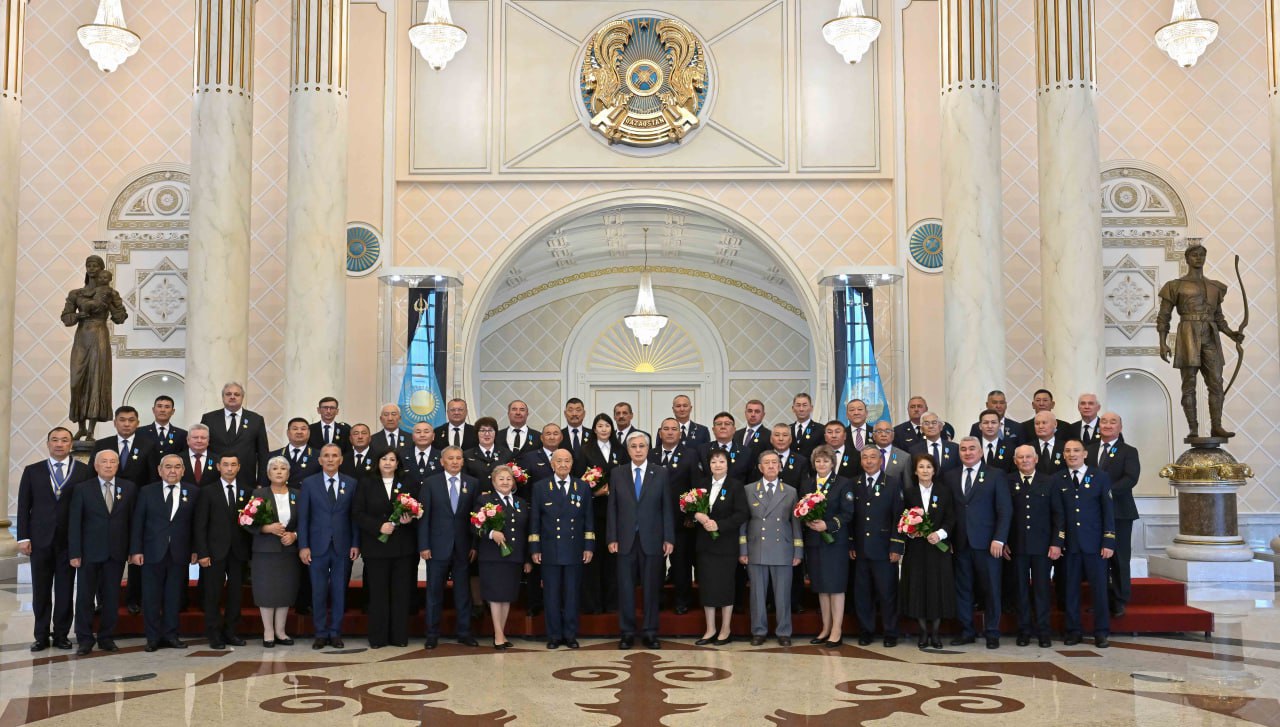
Group photo of President Tokayev with transport sector workers. Photo credit: Aqorda
Tokayev emphasized that the country’s vast geography and transit potential place the transport sector at the core of Kazakhstan’s economic growth and regional integration.
“The transportation system is the driving force of the economy, a guarantor of progress and prosperity. Our country has enormous, one could say unique, potential in this area. Kazakhstan serves as one of the key transit hubs of Eurasia,” said Tokayev.
Expanding Eurasian connectivity
Tokayev highlighted Kazakhstan’s role in developing the Trans-Caspian International Transport Route (TITR), also known as the Middle Corridor, connecting China, Central Asia, and Europe. In 2023, Kazakhstan and China launched a joint logistics center in Xi’an under the Belt and Road Initiative, aiming to boost cross-border freight traffic.

Tokayev highlights strategic role of transport sector in Kazakhstan’s development. Photo credit: Aqorda
Domestically, Kazakhstan is implementing a large-scale modernization of its railway infrastructure. The President noted that the construction of a second railway track between Dostyk and Moyinty, a vital part of the transit route connecting China and Europe, is expected to be completed this year, increasing freight capacity fivefold. The project is being carried out by local companies.
He also highlighted the imminent commissioning of a bypass railway line around Almaty to ease pressure on the city’s transport network. Plans include the repair of 11,000 kilometers and the construction or modernization of an additional 5,000 kilometers of railways. Key projects currently underway include the 323-kilometer Moiynty-Kyzylzhar line and new sections along the Darbaza-Maktaaral and Ayagoz-Bakhty routes.
Boosting domestic production and logistics
Addressing the transport machinery sector, Tokayev called for strengthening local manufacturing through partnerships with leading global companies.
“At the moment, leading foreign corporations are operating in Kazakhstan. Earlier this year, I visited a locomotive manufacturing plant in Astana, where both freight and passenger electric locomotives, as well as spare parts, are produced. I would especially like to note that the plant employs local specialists,” said Tokayev.
“The state will continue to support such high-impact projects,” he added.
Civil aviation and regional airports
The President stressed the significance of developing air connectivity. Last year, new terminals were launched in Almaty, Shymkent, and Kyzylorda, significantly expanding airport capacity.
“Almaty’s airport, which previously could serve 2.5 million passengers annually, now serves up to 14 million,” he said.
New airports are under construction in Zaisan and Katon-Karagai in the East Kazakhstan Region, as well as in Kenderli in the Mangystau Region, while the Arkalyk Airport in the Kostanai Region is undergoing restoration.
“The implementation of such projects not only boosts passenger traffic but also stimulates the development of logistics, tourism, trade, and a range of related industries,” said Tokayev.
“Kazakhstan currently has direct air connections with more than 30 countries. However, given the country’s potential, this is not enough – efforts to expand these connections will continue,” he added.
Tokayev also noted plans to establish a national air cargo carrier, aiming to strengthen Kazakhstan’s status as a regional aviation hub.
“The development of civil aviation and air cargo transportation in Kazakhstan goes far beyond its basic transport function. It is a strategic direction that impacts the country’s economic growth, international standing, and the strengthening of its sovereignty,” he said.
Modern highways and regional infrastructure
Tokayev highlighted unprecedented efforts to improve national and local roads. In 2023, 7,000 kilometers of roads were commissioned, including the modernization of major routes such as Taldykorgan-Oskemen, Karagandy-Almaty, and Aktobe-Atyrau-Astrakhan.
Significant new infrastructure includes Kazakhstan’s longest bridge across the Bukhtarma Reservoir, linking two regions, seven districts, China and Russia, as well as the country’s first tunnel at the Shakpak Baba mountain pass in the Turkistan region.
Honoring industry contributions
During the event, Tokayev paid tribute to the country’s more than 770,000 transport workers, highlighting their role in shaping a just and prosperous Kazakhstan.
He awarded the nation’s highest honor, Kazakhstan’s Hero of Labor, to Kaltai Sambetov, a veteran of Kazakhstan Temir Zholy with 66 years of continuous service. It was the first time the award had been presented to a representative of the transport industry.

Kaltai Sambetov, Kazakhstan Temir Zholy national railway company veteran. Photo credit: Aqorda
Other honorees received the title of Honored Worker of the Transport Sector of Kazakhstan, including industry veterans Boris Isinamanov, Vladimir Averkin, Kanat Shaimin, and Andrei Gorvat, who were recognized for their contributions to infrastructure development and modernization.
