
ALMATY — Cargo transportation along the Trans‑Caspian International Transport Route (TITR) has grown fivefold over the past seven years, rising from 0.8 million tons to 4.5 million tons annually, strengthening its role as a key link in global logistics, reported the Kazakh Ministry of Transport on March 10.
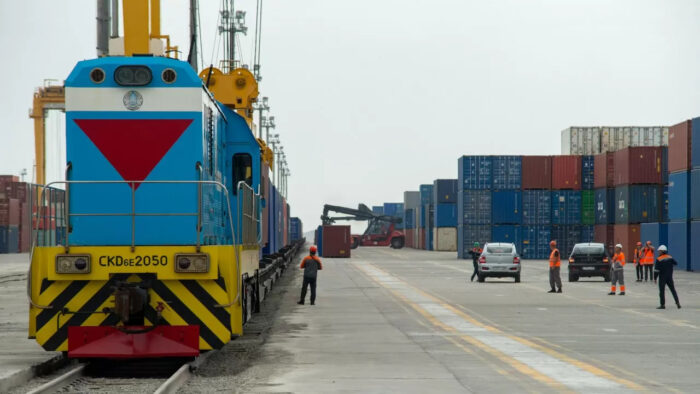
Photo credit: inbusiness.kz
Annual cargo volumes have shown steady growth over recent years, reaching 2.76 million tons in 2023, 4.48 million tons in 2024, and 4.12 million tons in 2025.
Container transportation along the corridor has expanded particularly rapidly. In 2025, around 77,000 TEU were transported via the route, while the target is to increase the volume to 300,000 TEU by 2029.
Today, the corridor functions as a multimodal transport artery linking China, Kazakhstan, the Caucasus region, Türkiye and European markets.
Key drivers behind growth
According to the ministry, the growth in cargo volumes has been driven not only by infrastructure expansion but also by strengthened strategic cooperation among participating countries and transport operators.
Key factors include improved conditions for international transit, particularly through the simplification of customs procedures, as well as the route’s increased competitiveness thanks to shorter delivery times. Transit time along the corridor has been reduced from 28–32 days to 13–17 days.
Demand has also grown for single-window logistics services, which offer greater transparency and reliability for international freight operations.
Efforts to further develop the corridor are continuing under joint roadmaps adopted by Kazakhstan, Azerbaijan and Georgia in Aktau in 2022 and in Almaty in 2025, to eliminate bottlenecks along the route.
Infrastructure development
Significant infrastructure projects are underway to support the corridor’s expansion. Dredging works have been completed in the waters of the Port of Kuryk, while similar works are planned this year at the Port of Aktau.
Construction is also underway at the Port of Kuryk on the Sarzha multifunctional terminal, a joint project with Abu Dhabi Ports Group, with a projected capacity of five million tons.
In addition, a container hub has been completed at the Port of Aktau, while the lifting and transition bridge at berth No. 1 of the Port of Kuryk has been modernized. A Kazakhstan-owned terminal with a capacity of 120,000 TEU has also been launched at the Port of Poti in Georgia.
The European Union has allocated a grant for the reconstruction of berths No. 3 and No. 12 at the Port of Aktau, with funds expected to be used to purchase cargo-handling equipment, including wind-resistant ship-to-shore cranes, enabling ports to operate reliably even in adverse weather conditions.
As part of efforts to expand maritime capacity, two container vessels have been ordered at Baku Shipyard, with construction expected to be completed in 2027. Delivery of six additional multipurpose dry cargo vessels is also planned for the same year.
Meanwhile, railway infrastructure is undergoing modernization across more than 2,000 kilometers of track. In 2025, projects covering 911 kilometers were completed, including the construction of second tracks on the Dostyk–Moiynty railway section (836 km) and the Almaty railway bypass line (75 km), both of which form part of the Trans-Caspian corridor.
The Trans-Caspian route has already established itself as an important component of the global logistics network. Participating countries plan to continue working together to enhance the corridor’s capacity, improve its attractiveness for international cargo shippers and strengthen its institutional framework.
