
ALMATY— Trade between Kazakhstan and the Czech Republic reached $705 million in 2025, marking a 13% increase year-on-year, as the two countries moved to deepen economic and investment cooperation during high-level talks in Astana on April 28.
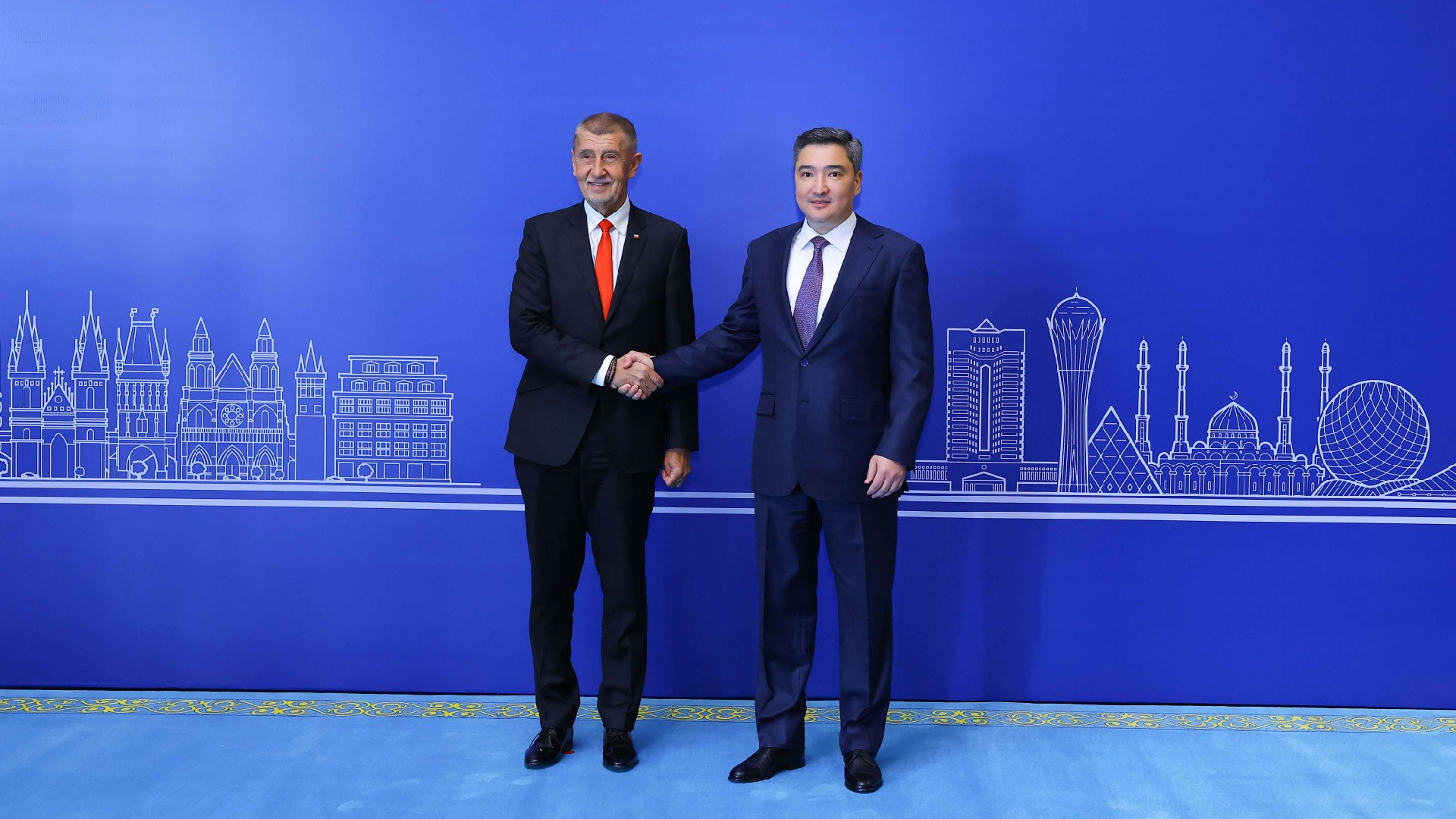
From L to R: Czech Prime Miister Andrej Babiš and Kazakh Prime Minister Olzhas Bektenov. Photo credit: Prime Minister’s press service.
Kazakh Prime Minister Olzhas Bektenov met with his Czech counterpart Andrej Babiš, who arrived in the capital on an official visit, to discuss expanding ties across key sectors, including industry, energy, transport, digitalization, and humanitarian cooperation.
Focus on investment and industrial cooperation
The Czech Republic remains one of Kazakhstan’s important economic partners in Europe. In addition to growing trade, gross inflows of foreign direct investment from the Czech Republic reached $59 million in 2025, a 39% increase.
“Kazakhstan is consistently creating conditions for attracting investment, fostering technological partnerships, and developing non-resource sectors,” Bektenov said.
Both sides emphasized the importance of translating political dialogue into concrete projects, particularly in industrial cooperation, including localization of production and the development of service hubs.
The Czech side expressed interest in expanding collaboration in the chemical industry, energy, water management, and critical minerals, with a focus on deep processing and technology transfer.
Energy and strategic sectors
Energy cooperation featured prominently in the talks, including prospects for modernizing industrial facilities using environmentally friendly technologies and advanced engineering solutions.
Particular attention was given to nuclear energy, including cooperation between Kazatomprom and the Czech energy company ČEZ, as well as opportunities in the nuclear fuel cycle and workforce training.
Transport and connectivity
The two sides also discussed strengthening transport connectivity. In the first three months of 2026, rail cargo volumes reached 10,100 tons, an 18% increase compared to the same period last year. Road transport volumes exceeded 38,000 tons in 2025.
Kazakhstan’s geographic position and developing infrastructure were highlighted as key advantages for Czech companies seeking access to broader regional markets.
Digitalization and investment climate
Cooperation in digital technologies, including GovTech and artificial intelligence, was also identified as a promising area.
The role of the Astana International Financial Centre was noted as a platform for attracting investment and supporting international business, with Czech firms such as Wood & Company already operating there.
Kazakhstan also outlined recent reforms aimed at improving the investment climate, including the transformation of Baiterek Holding into a national investment holding, the expansion of Kazakh Invest, and new legal protections for investors.
As a result, foreign direct investment in Kazakhstan grew by 14.4% last year, reaching $20.5 billion. According to data from the United Nations Economic and Social Commission for Asia and the Pacific, $19 billion of this was directed to greenfield projects, accounting for 89% of all such investments in Central Asia.
Business forum and agreements
Bektenov and Babiš also participated in the Kazakhstan–Czech business forum, which brought together companies from both countries to explore opportunities in engineering, transport, energy, IT, and aviation.
“Kazakhstan is not only a bridge between continents, but also a global hub for innovation and strategic investment,” Babiš said, emphasizing the Czech Republic’s long-term interest in the Kazakh market.
Examples of ongoing cooperation include an $8.2 million vehicle assembly project by Škoda Auto, highlighting growing industrial collaboration. In addition, the Czech company BBS plans to launch production of heat-exchange equipment in Kazakhstan with an investment of $9 million by the end of the year.
Following the forum, six memorandums of cooperation were signed between Kazakh and Czech companies, covering joint projects in energy, transport, engineering, and insurance.
Both sides reaffirmed their commitment to strengthening long-term economic partnership and expanding practical cooperation across priority sectors.
