
ASTANA – Kazakhstan now hosts over 550,000 international migrant workers, nearly 21,000 more than in January, said International Migration Organization (IOM) Chief of Mission Serhan Aktoprak as he discussed the latest Baseline Mobility Assessment during the Astana Think Tank Forum on Oct. 16.
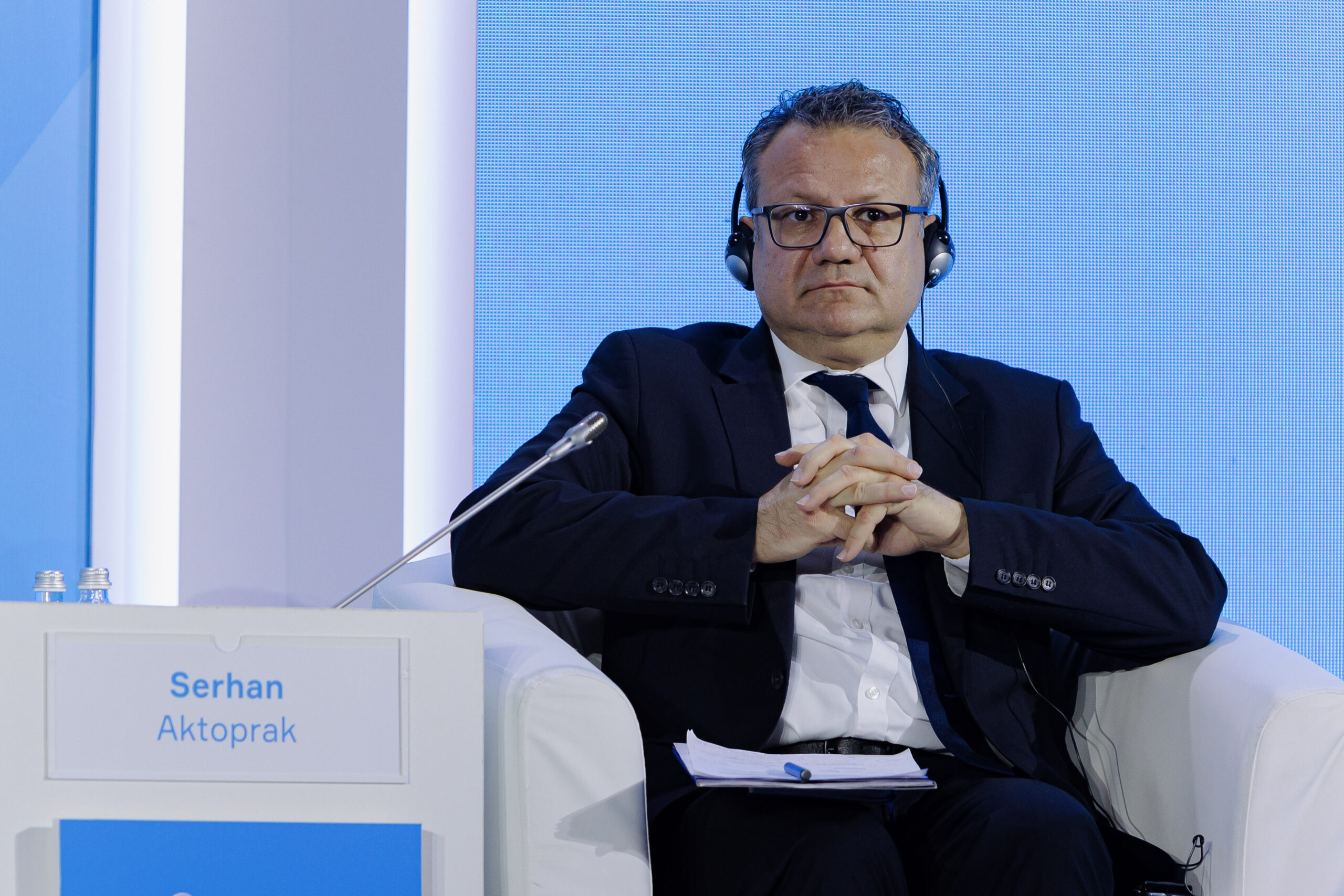
Serhan Aktoprak addressed the panel session, titled Resilient Futures: Demographics, Climate, and Water Nexus, on the second day of the Astana Think Tank Forum in the Kazakh capital. Photo credit: KazISS
“There are over 550,000 migrant workers taking up jobs in various sectors at any given time currently in Kazakhstan, which is 21,000 higher than the fifth round of the assessment that was conducted in January 2025. You basically see just under 5% increase in just under six months,” Aktoprak said.
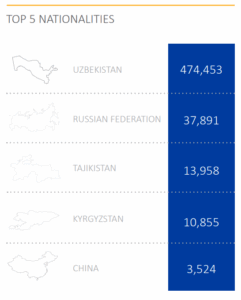
The vast majority of the migrant workers in Kazakhstan is just five nationalities. Photo credit: IOM Baseline Mobility Assessment
The primary countries of origin remain the neighboring states. Uzbekistan accounts for 86%, the Russian Federation – 7%, Tajikistan – 2.5%, the Kyrgyz Republic – 2%, China – 0.6%, and all other countries combined – 2.5%.
International migrant workers highlight various reasons behind moving to Kazakhstan. Primarily, it is about better economic opportunities, better working and living conditions, and proximity.
“Indeed, we see a very high level of flows surrounding Kazakhstan. It has always been a country of destination for migrant workers, but then there are a lot of categories of individuals traveling to Kazakhstan, and also traveling from Kazakhstan,” Aktoprak said.
What is life like for those who have arrived
In addition to the Baseline Mobility Assessment, IOM also conducts the International Migrant Workers Survey. In the latest sixth round of the survey, conducted across eight regions of Kazakhstan, including Almaty, Atyrau, Karagandy, Kyzylorda, Mangystau, North Kazakhstan, Turkistan, and West Kazakhstan, as well as the cities of Almaty, Astana, and Shymkent, 2,115 individuals were interviewed.
“People travel back and forth constantly. 61% of the people, once they are in, go back to their countries for a visit in under six months,” said Aktoprak.
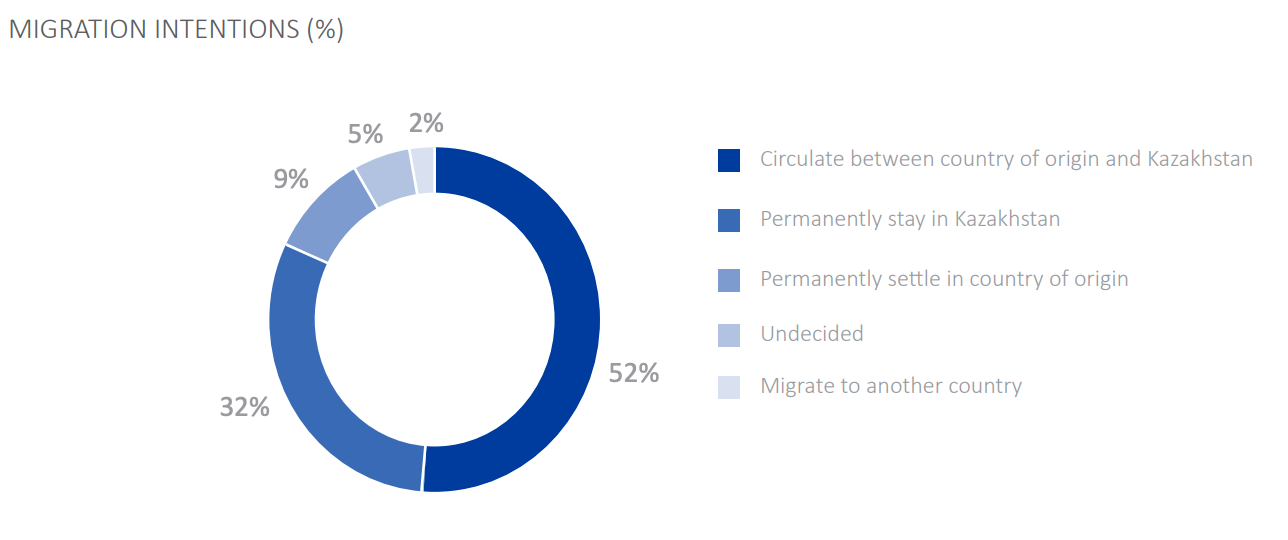
Future migration intensions. Photo credit: IOM International Migrant Workers Survey, 6th Round, Kazakhstan
Construction was the largest sector of employment, accounting for 33% of respondents. It is followed by wholesale and retail trade (19%) and community, social, and personal services (11%).
The survey also found that 27% of respondents had completed upper secondary education, while 40% identified themselves as the primary income earners for their families.
Yet almost half, 44%, said their employment contracts did not contribute to their pension, and 55% reported having no access to paid annual leave. Employment precarity remains widespread, with 27% working without formal contracts.
Reflecting the central role of migrant labor in sustaining household economies across borders, 31% of respondents reported sending money home while in Kazakhstan, transferring an average of $363 per month and paying roughly 1% in service fees. For 42% of respondents, remittances are their families’ main source of income back home.
At least 43% reported sending between 51% and 75% of their earnings home in remittances.
When asked about their well-being, 38% reported being able to meet their needs and save, while another 31% can cover daily expenses, though without savings.
There are also certain gender disparities. On average, male migrant workers earn 17% more than their female counterparts. However, this gap is smaller than in their home countries, where men earned 41% more before migration. Aktoprak said this suggests that migration, while not eliminating inequality, can narrow gender pay disparities.
There is also a trade-off that many migrants face. Skilled professionals often experience downward occupational mobility, taking blue-collar jobs that pay better but come with lower social status. This pattern, observed globally, highlights the complexity of migration: economic gains often coexist with professional deskilling and potential loss of social standing.
“This is not only specific to Kazakhstan, but this is what it is. This goes all over the world. This phenomenon highlights the complexity of migrant integration, where economic gains coexist with professional de-skilling and potential social status loss, unfortunately. It also underscores the role of global labor market inequalities in shaping migration outcomes,” he said.
Internal migration
Turning to internal migration, Kazakhstan has seen a 30% increase compared to 2024, rising from 67,000 to 98,000 people in just the first six months of 2025. Aktoprak outlined that the main drivers include economic opportunities, resettlement programs, education, and improving living conditions, with 5–20% of moves linked to environmental and climate factors.
“What is next for Kazakhstan? In one sentence, I would be able to say that given the increasing dynamics that offer benefits to Kazakhstan and its neighbors in Central Asia, we believe that there is a great opportunity to improve the potential of migration through regular pathways, which would continue generating employment and also higher remittances, which is critical and also one of the producers of regional stability, given the excellent relationship that Kazakhstan enjoys with its neighbors,” Aktoprak said.
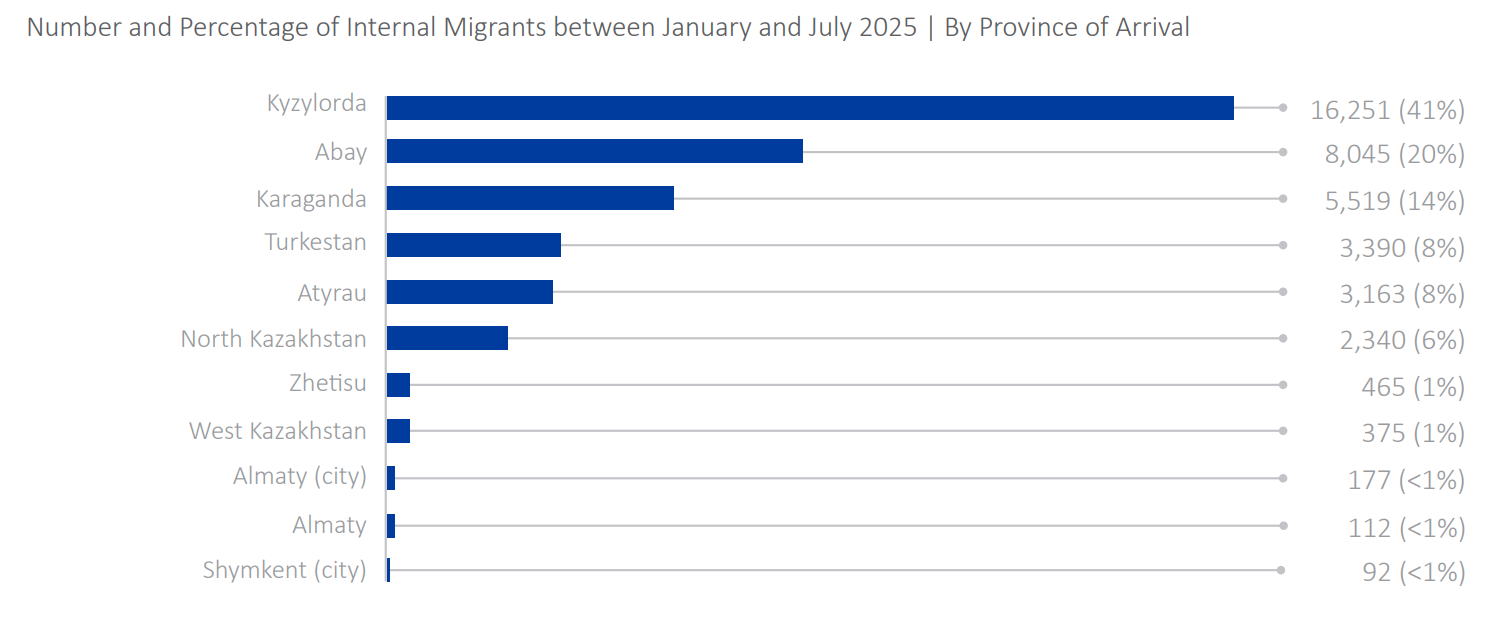
Number and Percentage of Internal Migrants between January and July 2025. Photo credit: IOM International Migrant Workers Survey, 6th Round, Kazakhstan
Visionary leadership
Central Asia and Kazakhstan, in particular, occupy a central position in regional flows of people, goods, and ideas.
Aktoprak highlighted the country’s progress over the years, its vast resources, sustained stability, and also what he described as “visionary leadership.”
At a time when migration is often framed negatively, Kazakhstan’s position is different, said Aktoprak, recalling the meeting between Kazakh President Kassym-Jomart Tokayev and IOM Director General Amy Pope in Astana in May. Back then, Tokayev reaffirmed that Kazakhstan views migration as a driver of sustainable development, provided it is managed in an orderly, safe, and humane manner.
The panel session, titled Resilient Futures: Demographics, Climate, and Water Nexus, also featured discussions on demographic opportunities facing Kazakhstan and Central Asia, as well as the water and climate change nexus.
