
VIENNA – The world is approaching a new record for the longest period without a nuclear test, Comprehensive Nuclear-Test-Ban Treaty Organization’s (CTBTO) Executive Secretary Robert Floyd said at the high-level panel of the Science and Technology conference (SnT2025) on Sept. 9 in Vienna, Austria.
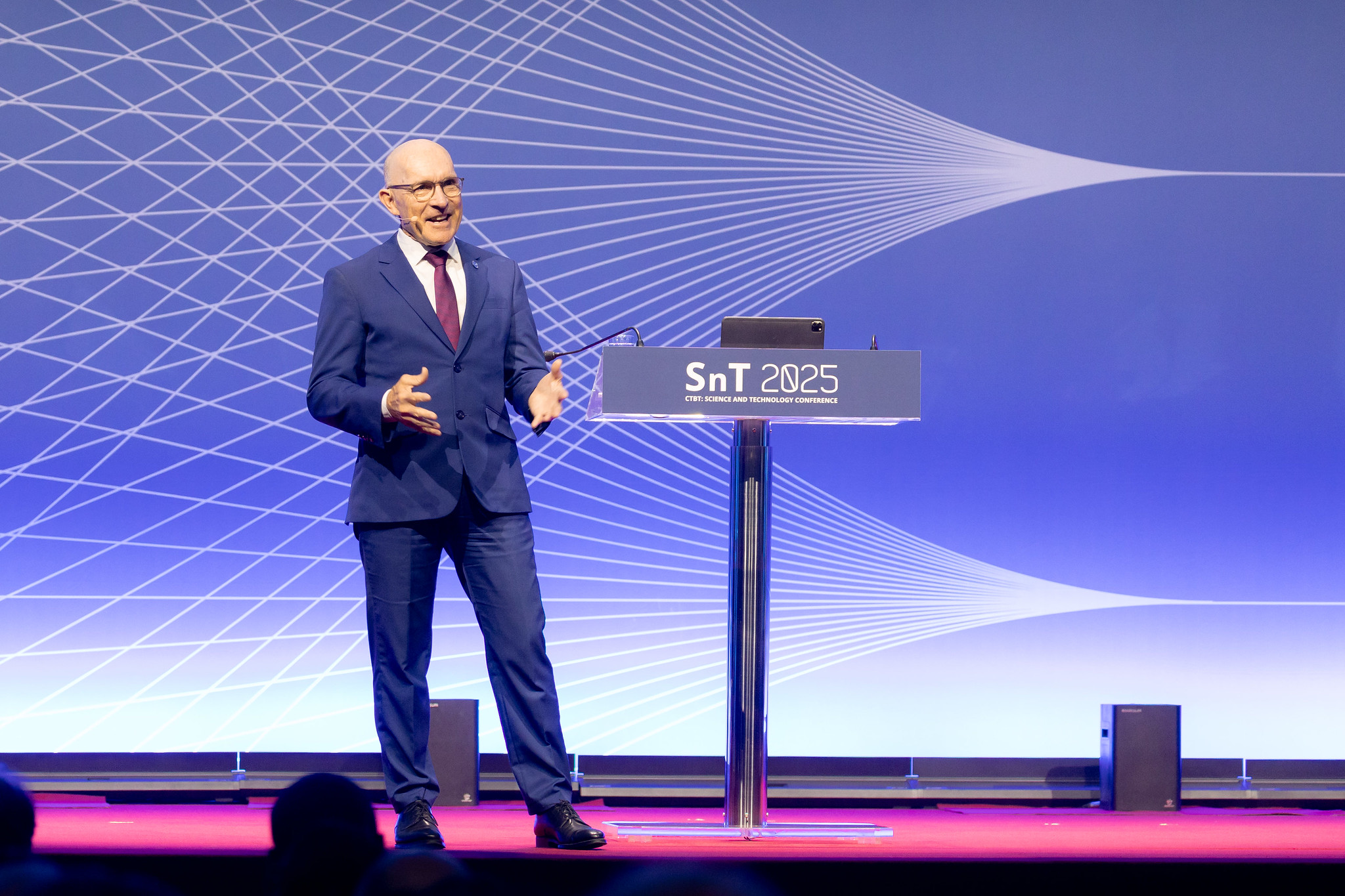
CTBTO Executive Secretary Robert Floyd speaking at SnT2025 conference at Hofburg Palace in Vienna. Photo credit: Anna Rauchenberger/CTBTO SnT2025
If no nuclear tests are conducted by Jan. 14 in 2026, just 18 weeks away, the world will set a new record for the longest period without one single test since the very first Trinity test in New Mexico in 1945, surpassing the current record of eight years and five months.
In his opening speech, Floyd marked the CTBTO’s nearly 30 years of success in achieving a substantial decline in nuclear testing.
“Many of you know the history of how there were over 2,000 nuclear weapon tests before the CTBT was open for signature in 1996,” Floyd said.
“So how can we stop testing once and for all? We can stop it by ruling out testing in secret, by bringing together diplomacy and science in a way never attempted before. Good intentions weren’t enough. The diplomats negotiating the treaty had to assure their national leaders that the system the treaties were set up really would detect all nuclear tests. The scientists knew that these systems had to be both trusted and trustworthy. Without fail, they did their job. These SnT conferences celebrate that unique success,” said Floyd.
He also highlighted the evolution of SnT conferences. Held every two years, SnT conferences gather scientists, technologists, academics, students, and delegates from the CTBTO’s policy-making organs to exchange methods and technologies that have the potential to improve nuclear-test-ban monitoring and on-site inspections.
This year’s eighth edition on Sept. 8-12 attracted the largest level of engagement, with over 2,000 participants. Nearly 900 abstracts were submitted for consideration, representing dozens of disciplines: seismology, medical gas monitoring, infrasound oceanography, machine learning, and data science, among others.
“People want to take part, to explore, to learn, to share ideas using CTBTO data for studying our soil, our climate, our seas, our marine life, the air we breathe, protecting people from natural disasters, all this while getting better and better at our core responsibility – monitoring for nuclear tests,” said Floyd.
An essential component of the CTBT’s implementation is the International Monitoring System (IMS), a global network of over 300 monitoring stations installed to detect nuclear testing anywhere in the world. They provide near-real-time data that can be used beyond nuclear test detection for earthquake monitoring, tsunami warning, and climate studies. In Kazakhstan, these stations are managed by the National Data Center in Almaty.
At SnT2025, researchers from Kazakhstan’s National Nuclear Center will present findings on peaceful underground nuclear explosions at the Azgir Test site in western Kazakhstan conducted in the Soviet time and on the use of the IMS to study high-mountain glaciers in the Tien-Shan region.
