
ASTANA — What happens when thousands of people gather not for competition but for life-saving change? The Jüregımnıñ Jeñımpazy (a champion of my heart) running event held annually in Kazakhstan, serves as a beacon of hope for those awaiting organ and bone marrow transplants.
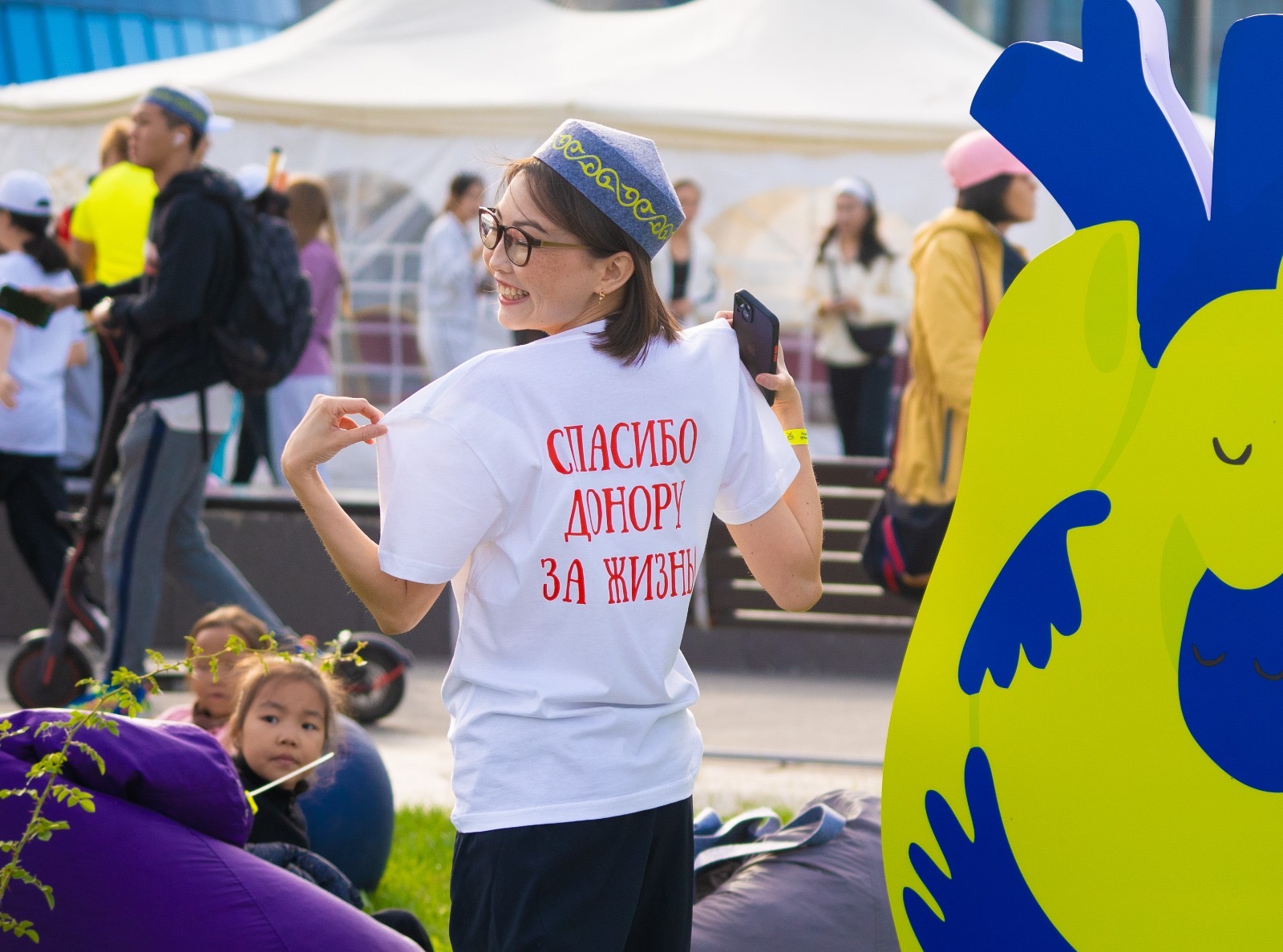
Anar Shaimergenova Wearing a T-shirt Saying “Thank You to the Donor for Life”. Photo credit: Heart Center Foundation
The Astana Times spoke to transplant recipients, doctors involved in the field, and families of patients awaiting transplants, all of whom shared a common thought: this marathon, taking place in Astana on Aug. 10, is a symbol of hope and unity driving collective action and change.
From the waiting list to marathon champion
Among the inspiring stories from the marathon is that of Anar Shaimergenova, a kidney transplant recipient and ambassador for the Heart Foundation, the organizer of the event. Her journey began with a childhood diagnosis of kidney disease, which eventually led to kidney failure by 2018. After years of dialysis (the clinical purification of blood as a substitute for the normal function of the kidney), she was placed on the waiting list for a kidney transplant. When no family member was a match, Shaimergenova turned to the possibility of international treatment, traveling to Belarus for a life-saving transplant.
“I was on dialysis three times a week for four hours each time. At that moment, I had no other option,” Shaimergenova told The Astana Times.
She shared how her journey led her to participate in the marathon, emphasizing the importance of such events for those on the transplant list.
“In 2022, I participated for the first time, just two months after my transplant. I went to support and watch. It was a small race with 500 participants in the botanical park in Astana. Since I was there, they gave me a medal just for participating. In 2023, all my friends ran, and I supported them, sharing a lot of information. I said, ‘In 2024, I will definitely run.’ And I did! I also encouraged everyone to participate,” she said.
Shaimergenova highlighted the importance of raising awareness about posthumous organ donation.
“The normalization of transplantation, especially posthumous donation, happens when people’s mindset changes for the better. The more information is shared, the better. It may seem like just a race, but last year, 4,200 people participated. That means 4,200 people learned that we have a special transplant program that does good,” said Shaimergenova.
“For patients on the waiting list, especially children, it can feel like no one is calling, like everyone has forgotten about them. These events give them hope and show they are not alone in their fight,” she added.
Shaimergenova also highlighted how modern lifestyles, particularly the high consumption of energy drinks, contribute to an increase in heart and kidney failure cases.
“No one can say they will never have kidney failure. For those just learning about organ failure and transplantation, they should take care of themselves, because, unfortunately, anyone can end up on the waiting list,” said Shaimergenova.
“Those on the waiting list should never lose hope, should keep searching for solutions, and should share their stories,” she added.
The challenge of organ donation in Kazakhstan
Organ transplantation in Kazakhstan has made significant strides since the first heart transplant in 2012, led by renowned cardiac surgeon and Kazakhstan’s goodwill ambassador, Yuri Pya. Since then, the country has witnessed a steady increase in successful transplants, including the landmark achievement of the 100th transplant. However, despite advancements, the need for donations remains high, particularly for kidneys, which account for over 90% of transplant cases in the country.

Assel Medressova. Photo credit: Heart Center Foundation
Shaimergenova noted that the biggest challenge facing Kazakhstan’s transplant system is the shortage of donor organs.
“We are making progress, but much more needs to be done in terms of public education. People fear organ donation due to a lack of knowledge and understanding, but we need to continue addressing these concerns transparently and honestly,” she said.
She also noted that the lack of coordination and funding for transplant coordinators is hindering the system’s growth.
“Transplant coordinators play a critical role in educating families and facilitating the donation process, but they often work under difficult conditions and for minimal pay (…) We need to raise awareness and ensure they receive the proper support,” said Shaimergenova.
A system of hope and humanism
Assel Medressova, a cardiac surgeon working at Kazakhstan’s heart center, explained that organ donation is not just a medical procedure, but a powerful story of life and human resilience.
“Every year, patients themselves participate, which shows that organ donation and transplantation are not just medical procedures – they are stories of lives, human strength, hope, and the possibility of a new life. Patients who were once in intensive care, in critical condition, are now running in marathons, living full lives, and actively participating in all areas of life. This is proof that all of it is worthwhile,” she said.
When asked about a specific story that stayed with her, Medressova reflected on the unique nature of every patient’s journey.
“There are many unique transplant stories, and each one has something to share. The subject of transplantation is sacred because someone’s death gives the chance for multiple lives to continue,” she said.

Assel Medressova. Photo credit: Heart Center Foundation
She also emphasized the profound humanism involved in organ donation.
“Those who sign consent to donation, as well as their families, are demonstrating one of the highest acts of humanism. Despite their own grief and emotional turmoil, they find the strength to think about someone else and give them the chance to live,” said Medressova.
Kazakhstan allows both living and posthumous organ donation under a requested consent system, where individuals voluntarily declare their agreement or refusal to post-mortem donation.
Medressova highlighted that most patients seeking transplants have already undergone other procedures, such as artificial heart pumps or valve replacements, and are not only looking for medical improvement but a chance to spend more time with their loved ones.
“For a mother, it is about watching her son grow, not preparing him for her absence by leaving letters to be given to him on each of his birthdays (…) For many, it is a second chance to be with their family, not just thinking about their own health but about the time they can still share with their loved ones,” said Medressova.
Hope amidst uncertainty
For many patients like 15-year-old Emil Sartayev, waiting for a transplant feels like a constant struggle. Sartayev, diagnosed with dilated cardiomyopathy, has been on the waiting list for a heart transplant since 2021. His mother, Ekaterina Sartayeva, shared the emotional toll of waiting.

15-year-old Emil Sartayev and his mom, Ekaterina Sartayeva. Photo credit: Sartayeva’s personal archives
“Every day is different. We do not know if tomorrow will bring the transplant we desperately need. The hardest part is not knowing what will happen next,” she said.
Sartayev’s experience reflects the shared fear of many patients who wait for life-saving organs – the uncertainty of when, or if, a transplant will occur can be emotionally overwhelming.
“For us, this marathon is a reminder that we are not alone. We are grateful for the people who run and support this cause because it shows that society cares,” she said.
Sartayeva also expressed her concerns about the public’s limited understanding of organ donation. She explained how, despite the medical need, many people remain uninformed or fearful of the process.
“When reading comments on posts about organ donation, it is shocking how misinformed people are. We need to show films and tell stories about people who were saved by transplants and are now living long, fulfilling lives,” said Sartayeva.
“I also want to address the mothers (…) Believe in your child, believe in yourself, that you will go through this journey and handle everything. And, of course, believe in miracles. Faith works wonders,” she added.
According to the Heart Center Foundation, as of May 10, there are 4,226 patients in Kazakhstan awaiting organ transplants, including 128 children. By participating in the marathon, people are not just running; they are helping raise awareness, foster a culture of support, and contribute to the development of transplantology in Kazakhstan.
This year, the organizers expect 5,000 participants, including doctors, donor families, transplant recipients, and those still awaiting surgery, business representatives, government officials, and the public. There will be two distances, 1.3 kilometers and 10 kilometers. Training sessions with coaches will continue in the Botanical Garden until Aug. 10, and are free and open to the public.
The race will take place at the Expo area, starting at 7 a.m. Registration and distance selection are available on the organizer’s website. Those not participating in the race are invited to join the event. The festival will feature live music, activities, a food court, a fair, and cardiopulmonary resuscitation training.
