
ASTANA – The Association for the Conservation of Biodiversity of Kazakhstan (ACBK) presented a new illustrated book for children, “Steppe Eagle Kiyeh,” on July 8 in Astana, in an effort to help sustain the species.
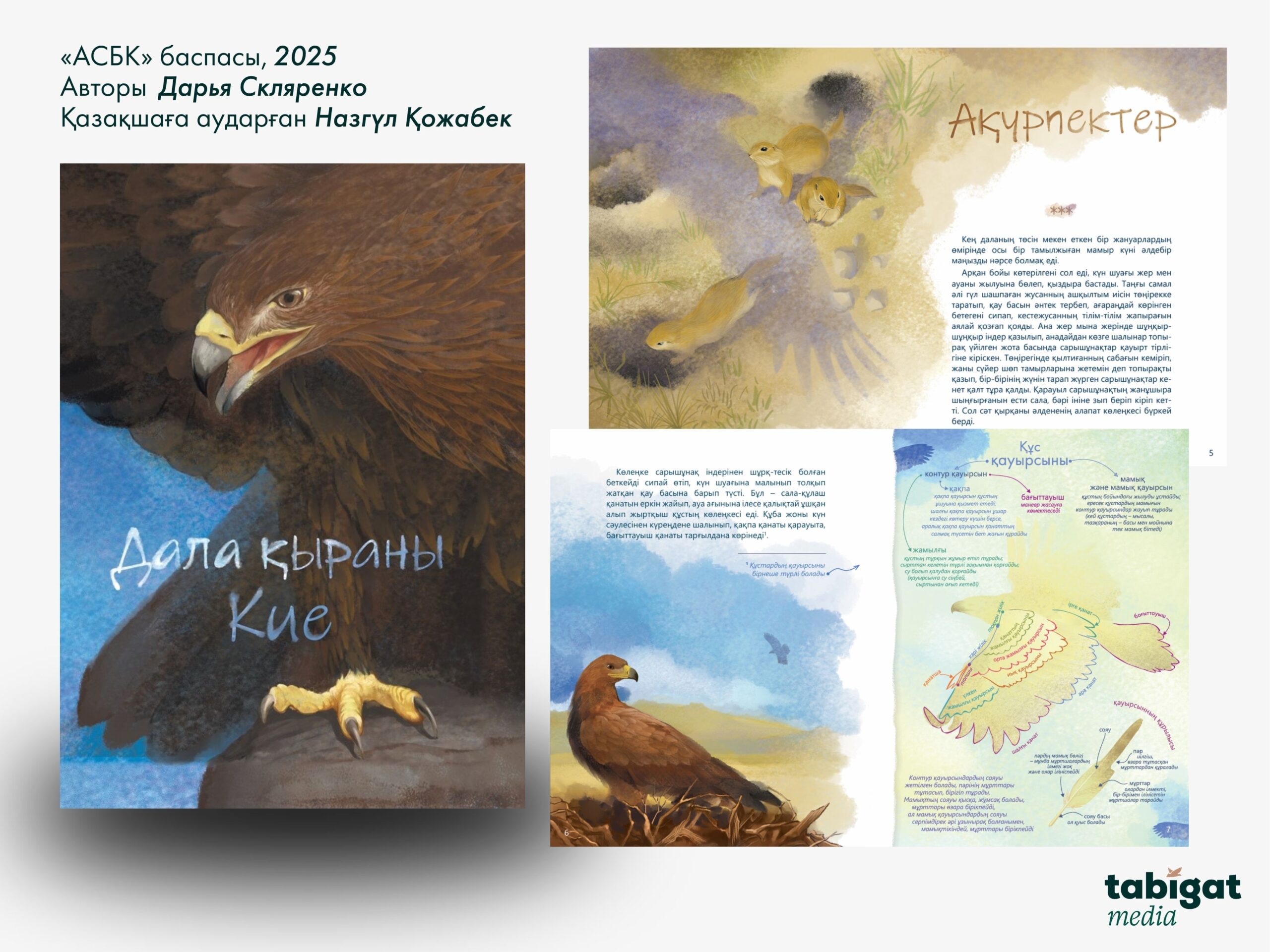
“Steppe Eagle Kiyeh” is published in Kazakh and Russian languages and will be distributed among schools. The book’s spread provided by ACBK.
The steppes of Kazakhstan, covering the central part of the country, are a key region for migrating birds and the nesting place for many rare species, including the steppe eagle.

The book’s author, Darya Sklyarenko, created a fictional narrative with vivid illustrations and detailed information about the biology of the steppe eagle. Photo credit: ACBK press service
The bird typically breeds across Kazakhstan and migrates to Africa during the winter, passing through the Middle East. It typically measures around 65-86 centimeters in length with a 175-260-centimeter wingspan. Kazakhstan, where over 80% of the world’s steppe eagle population nests, holds a special responsibility for the species’ conservation. The steppe eagle is also listed in the country’s Red Book of endangered species.
Represented on Kazakhstan’s national flag, the eagle is one of the country’s cherished symbols, reflecting its rich history. Strong, fearless, and independent, the steppe eagle possesses all the characteristics that make it a suitable subject for a story with educational value.
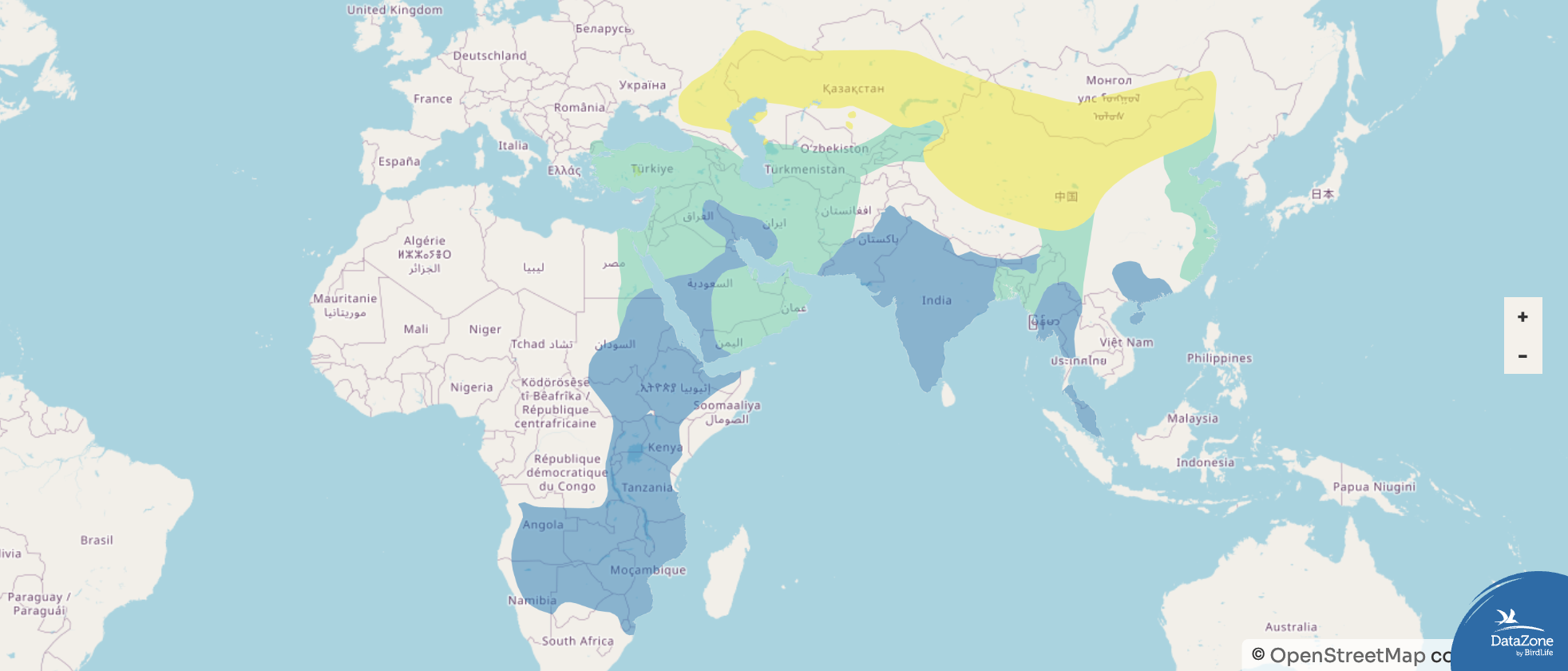
The bird typically breeds across Kazakhstan and migrates to Africa during the winter, passing through the Middle East. Source: datazone.birdlife.org
Based on verified scientific data, the book’s author Darya Sklyarenko created a fictional narrative with vivid illustrations and detailed information about the biology of the steppe eagle, including its diet, behavior, migrations, and modern threats.
According to Vera Voronova, ACBK executive director, the book helps to increase the chances of overcoming risks that threaten the eagles’ survival in nature.
“Unfortunately, the number of steppe eagles continues to decline. Through this book, we want to draw attention to these problems and how we, as a society, can help preserve Kazakhstan’s nature by changing our worldview and our daily activities. We, the ASBK team and our publishing house, sincerely believe that the knowledge we pass on to the younger generation through our books will truly help the next generation of our country to change for a better and more sustainable future,” she said.
Cathy Cottrell, United Kingdom Embassy’s First Secretary and Head of Economics and Climate Change, also emphasized the book’s educational value for both children and adults.
“As a parent myself, I’ve spent many evenings reading stories to my children, stories about animals, faraway places, and the wonders of nature. I know how powerful a good story can be. It sparks curiosity and helps young minds make sense of the world,” said Cottrell.
“This book is the first of its kind in Kazakhstan. It’s a beautifully illustrated, scientifically grounded story for children, yet equally engaging for adults. By distributing it freely to schools and libraries, ACBK is ensuring that this knowledge reaches young people across the country,” she added.
The publication of this book is a social and educational project; therefore, most of the copies will be distributed to schools and libraries.
Dangers for the steppe eagle
The past decade of mass construction of energy infrastructure across Kazakhstan has proven a hindrance for thousands of birds that arrive in the country each year.
ACBK researcher and ornithologist Ruslan Urazaliyev highlighted that small and medium-voltage transmission lines pose a significant threat to the steppe eagles—one that can be effectively mitigated through human intervention.
“You can find dead birds under almost every pole, especially during migration. The picture is not very cheerful. According to scientists’ estimates, more than 35,000 eagles die every year in Kazakhstan. Most of them are steppe eagles,” said Urazaliyev.
The solution is to install bird protection devices. “Special plastic covers are installed on the sections of exposed wires. Plastic is a dielectric material, meaning it does not conduct electricity, which makes it safe for large birds to perch on these structures,” he said.
Led by Voronova, the project, which involves covering power lines with plastic bandage, has already proven to be effective.
“This project took place in the Karagandy Region, where a 28-kilometer low-to-medium voltage power line was selected. Before the project began, during the spring migration, 48 dead birds were found beneath the poles — averaging around one and a half birds per pole. Of those, 45 were steppe eagles. One year after the installation, during the following spring migration, only one dead bird was found,” said Urazaliyev.
Fires pose another major threat to these birds, as they are the only species that nest on the ground. To address this, above-ground nesting platforms can be built to provide them with safer nesting sites.
Alexey Timoshenko, director of the Alty-Sai Ecological Park, explained how they manage the fire problem in the park and the unexpected benefits that have come from their efforts.
“One of the most pressing problems is, of course, uncontrolled steppe fires, which are sometimes caused by humans and sometimes by natural causes, such as lightning. It is precisely the steppe eagle that, for the most part, prefers to build its nests directly on the ground. This, of course, poses a very high risk to the survival of this species in this area. Therefore, we have installed exclusively metal platforms, which rise around two meters above the ground. The nesting platform is one meter by one meter in size,” said Timoshenko.
In the very first year after installation, four years ago, six of the platforms were occupied by steppe eagles.
“I would also like to mention another significant advantage of this project. If you look closely, in the thicket of these branches of the eagle’s nest, you will see that there are Indian sparrow nests around the perimeter. In other words, we wanted to attract steppe eagles but ended up attracting two species,” said Timoshenko. Indian sparrows could build between 9 and 16 nests on each of these eagle nesting platforms.
Recently, the ACBK also unveiled the second edition of its richly illustrated science-popular book, “Steppe Mammals of Kazakhstan.”
