
ROME — The 2026 Winter Olympics opened Feb. 6 in Milan-Cortina, where Kazakhstan’s 36 athletes began competition across multiple disciplines. In the first week, the team secured several top-10 finishes and advanced through key qualification rounds as competition unfolded across Italy.
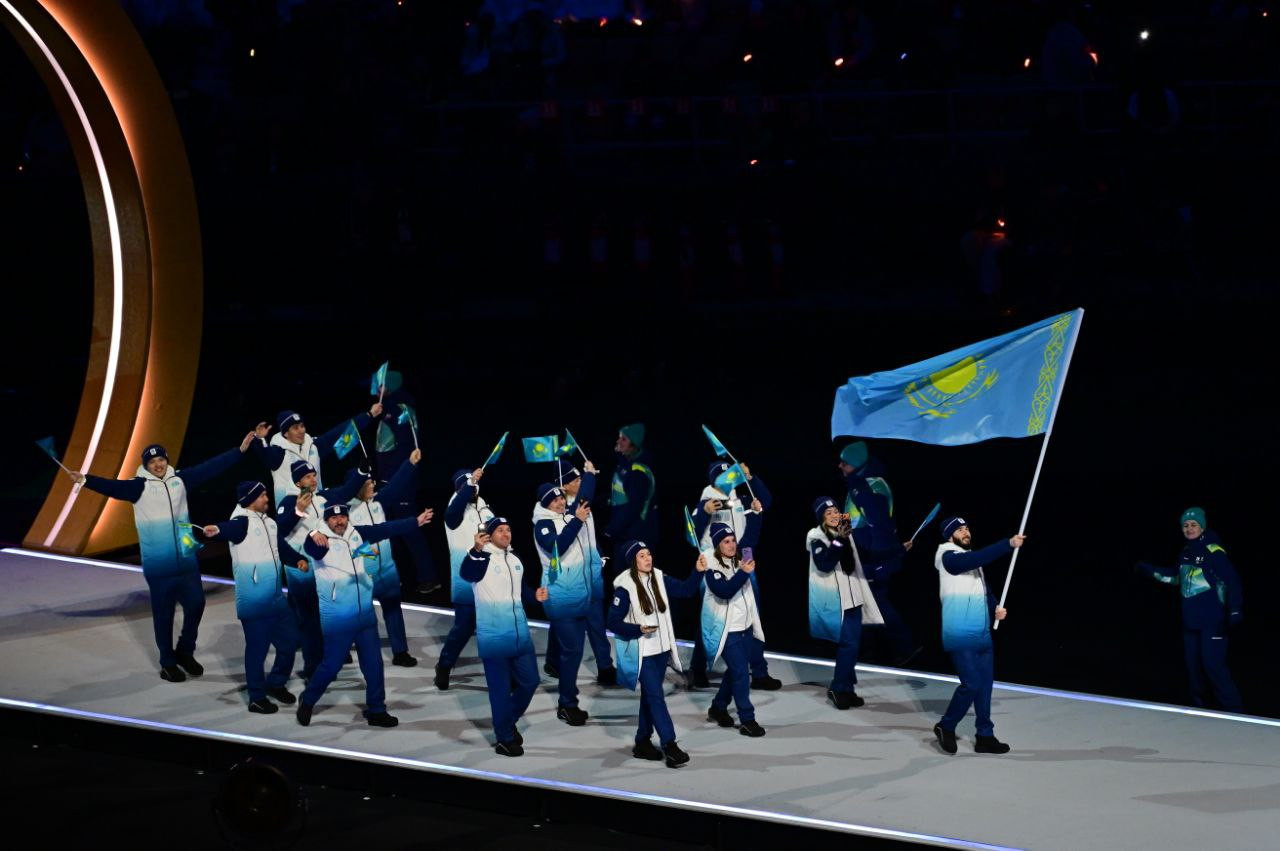
Kazakhstan’s team at the opening ceremony of the 2026 Winter Olympics on Feb. 6. Photo credit: Turar Kazangapov and Sali Sabirov / Kazakhstan’s National Olympic Committee
The first highlight of the games was the grand opening ceremony, built around the Armonia theme, described as a harmony uniting sport, art and innovation. Events were held across Milan, Livigno, Predazzo and Cortina d’Ampezzo, allowing athletes in different clusters to participate simultaneously.
Kazakhstan’s flagbearers were short track speed skater Denis Nikisha in Milan and freestyle mogul skier Ayaulym Amrenova in Livigno, reported Kazakhstan’s National Olympic Committee.
Early momentum on ice and snow
Competition began Feb. 7 with cross-country skiing. In the women’s skiathlon, Ksenia Shalygina placed 53rd, and Nadezhda Stepashkina finished 60th.
Later that day, speed skating delivered one of Kazakhstan’s strongest early results. Nadezhda Morozova placed sixth in the 3,000 meters in 4:01.200, while Elizaveta Golubeva finished 10th in 4:03.300.
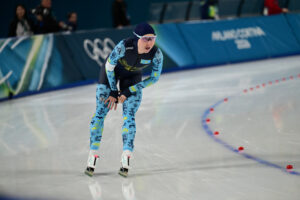
Elizaveta Golubeva. Photo credit: Sali Sabirov / Kazakhstan’s National Olympic Committee
“During the race, I felt that the ice had changed. During warm-up, it was more of a glide, and when we skated, it became viscous. Maybe this is because the temperature rose noticeably, and it got warmer. But I am satisfied with the result,” said Golubeva.
“For the first time in my life, I am not criticizing myself for a performance. During the race, I understood that I was doing everything right and that this is my current ceiling,” she added.
Head coach Aleksandr Panfilov noted that the 3,000 meters is not the skaters’ primary distance, as they specialize in 1,000 and 1,500 meters, making the result a positive sign at the start of the games.
The following day, debutants Nail Bashmakov, 30, and Amirgali Muratbekov, 20, competed in the men’s skiathlon, finishing 49th and 45th. Muratbekov, the youngest athlete on the team, reflected on the responsibility that comes with that status.
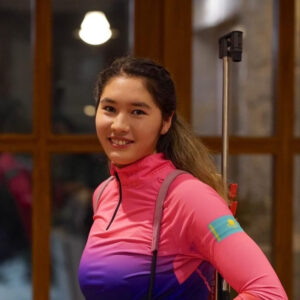
Aisha Rakisheva. Photo credit: Kazakhstan’s National Olympic Committee
“The status of the youngest athlete on the team, of course, adds a certain responsibility, but I would not say that I feel pressure. For me, it is more of an additional motivation,” he said.
On the same day, Kazakhstan’s biathletes took to the course in the mixed relay, where Vladislav Kireyev, Aset Dyussenov, Milana Geneva and Aisha Rakisheva finished 21st. For Rakisheva, the Olympic start marked another step in her recent transition from cross-country skiing to biathlon.
“Here, not only physical strength is important, but also psychology, focus and breath control. It was not a spontaneous decision. I weighed everything carefully for a long time. I like the aesthetics of biathlon and its unpredictability. Until the very last shooting stage, no one knows who will take gold,” said Rakisheva.
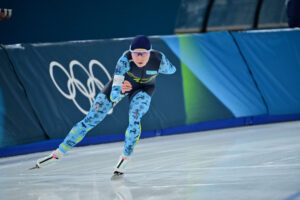
On Feb. 9, speed skating continued with the women’s 1,000 meters. Morozova finished 14th in 1:16.00, Golubeva placed 19th and Kristina Silaeva 28th. Later that day, in the ski jumping qualifications, Daniil Vasilev and Ilya Mizernykh finished 34th and 39th, respectively.
Qualification tests across disciplines
By Feb. 10, cross-country skiers lined up for sprint qualification. Darya Ryazhko placed 55th, Anna Melnik 58th, Stepashkina 63rd and Shalygina 72nd. In the men’s sprint, Vitaliy Pukhkalo finished 75th, Muratbekov 76th and Bashmakov 85th. Silaeva later said nerves affected her Olympic debut, but said she is ready for her main 500-meter event.
Short track events also began that day. Olga Tikhonova and Yana Khan competed in the women’s 500 meters, while Nikisha started in the men’s 1,000 meters before joining Abzal Azhgaliyev, Tikhonova and Khan in the mixed relay quarterfinal. However, their runs concluded at the qualification stage.
“Today was the first competition day in short track. We competed in the mixed relay but did not advance to the next stage. I think it was a kind of test before the individual disciplines. Ahead are still personal starts and we will fight to the end. The Olympics do not end here,” said Azhgaliyev.
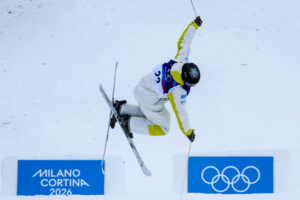
Pavel Kolmakov. Photo credit: Turar Kazangapov / Kazakhstan’s National Olympic Committee
Freestyle moguls provided one of the week’s most promising results. Pavel Kolmakov advanced from the first qualification in ninth place.
“I am very happy. It was a strong run. There were a few minor mistakes, but nothing critical. I gave it my maximum. The competition is still ahead. (…) We will increase the difficulty, make the run even stronger and fight for medals,” said Kolmakov.
In biathlon’s 20-kilometer individual race, Kireyev finished 53rd and Dyussenov 74th.
Women’s moguls qualification saw Anastasia Gorodko finish 12th, Yulia Galysheva 14th and Amrenova 20th, sending all three into the second round. They later secured places in the final but finished 14th, 15th and 18th, falling short of the top eight required to advance to the medal final.
Figure skater Mikhail Shaidorov delivered one of Kazakhstan’s strongest performances of the week, scoring 92.94 points in the short program to place fifth. His free skate is scheduled for Feb. 13.
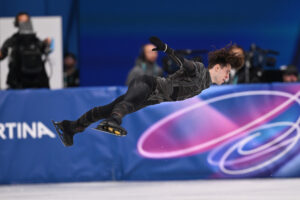
Mikhail Shaidorov. Photo credit: Sail Sabirov / Kazakhstan’s National Olympic Committee
“I was very nervous. This is not a world championship, it is the Olympic Games. I wanted to skate clean, not above my head. I am glad I managed to handle the emotions,” he said.
Nordic combined athlete Chingiz Rakparov scored 87.9 points in the ski jump and later finished 32nd overall. He will also compete on the large hill.
Standings shift as games continue
On Feb. 12, Morozova added another top-10 result, finishing 10th in the 5,000 meters in 7:04.81. The same day in cross-country skiing’s 10 kilometers freestyle, Stepashkina placed 63rd, Shalygina 71st, Ryazhko 75th and Melnik 81st.
Alpine skier Alexandra Skorokhodova finished 25th in the super-G, a high-speed downhill race with widely spaced gates. She is set to compete in slalom and giant slalom, technical races that require navigating tighter gate sequences, with giant slalom allowing faster, longer turns.
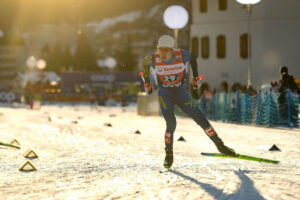
Amirgali Muratbekov. Photo credit: Kazakhstan’s National Olympic Committee
On Feb. 13, biathlon returned with the men’s 10-kilometer sprint, featuring two shooting stages. Vladislav Kireyev finished 51st with two misses, while Aset Dyussenov placed 61st, also recording two misses. Kireyev secured a place in the pursuit race, reserved for the top 60 sprint finishers.
Cross-country skiing also continued that day. Bashmakov, Muratbekov and Pukhkalo competed in the 10-kilometer individual start. Muratbekov placed 43rd in 22:38.2, Pukhkalo finished 57th in 23:25.9, and Bashmakov came in 74th in 24:27.8.
As of now, Norway leads the medal standings with eight gold, three silver, and seven bronze, for a total of 18. Italy ranks second with six gold, three silver and nine bronze medals, also totaling 18, while the United States sits third with four gold, seven silver and three bronze, totaling 14.
These figures reflect results as of Feb. 13. Coverage of Milano-Cortina will continue as events unfold.
