
ASTANA – The country is positioning higher education as the engine of its next economic transformation. Branch campuses of top global universities, new research infrastructure, and cutting-edge technologies are turning the country into a rising regional academic hub.
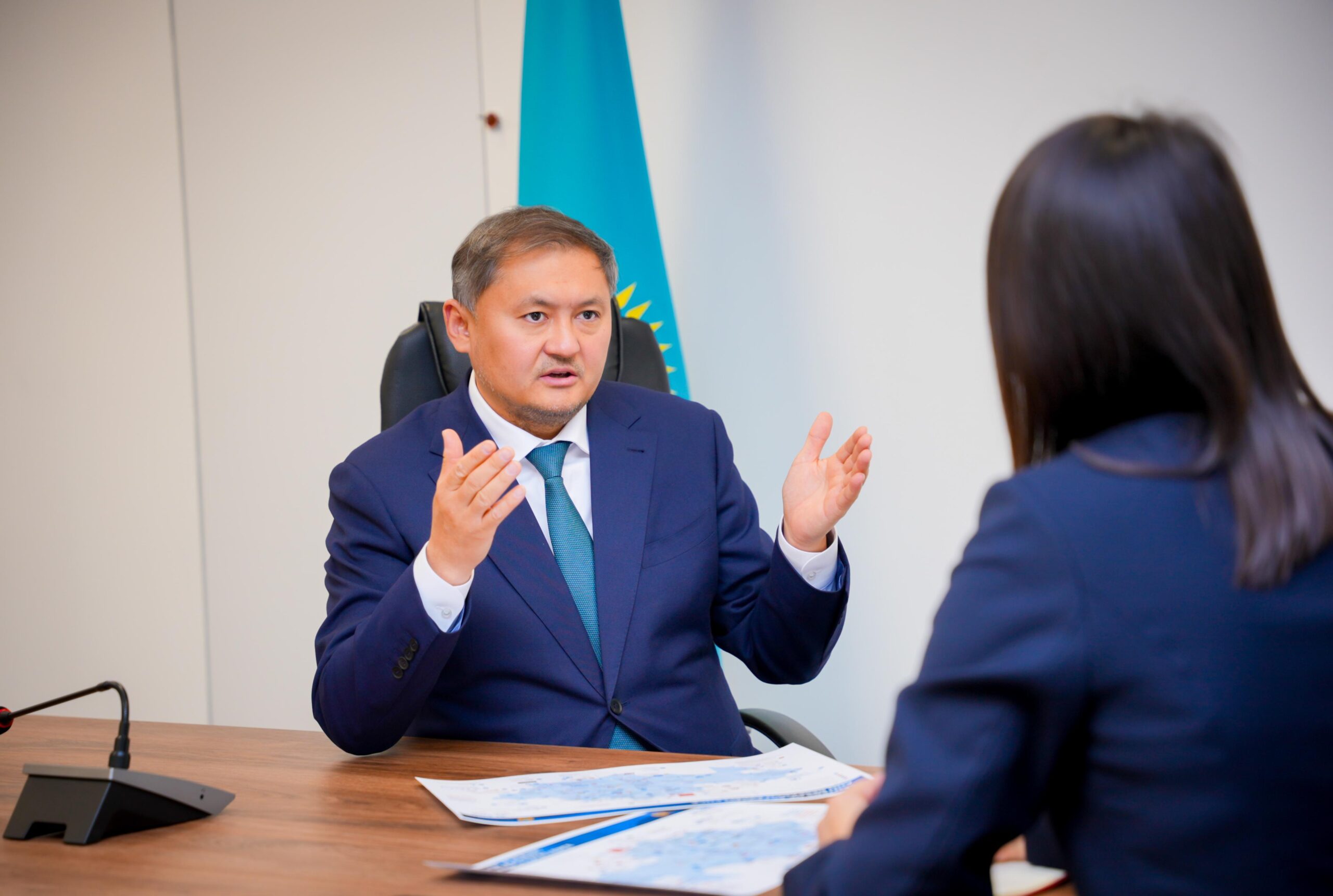
Minister of Science and Higher Education Sayasat Nurbek. Photo credit: Ministry of Science and Higher Education.
“We are creating the conditions for top global universities to open their campuses here and to become part of Kazakhstan’s long-term academic transformation,” Minister of Science and Higher Education Sayasat Nurbek said in an interview.
He stressed that within the next decade, international campuses will become pivotal in shaping the future, driving technology transfer, innovation, global partnerships, and educational diplomacy.
“Over the next decade, the country will not only host international campuses but also leverage them to become a recognized center of knowledge creation, innovation, and educational diplomacy in Central Asia and beyond,” he said.
Top universities building an education hub
The nation is rapidly emerging as a destination for leading global universities. Today, the country is opening branches of 40 foreign institutions. September 2025 marks a milestone as Cardiff University officially inaugurates its Astana campus, becoming the first Russell Group university in Kazakhstan. Branches of the British De Montfort University and Coventry University have already launched campuses in Almaty and Astana, strengthening the country’s international academic landscape.
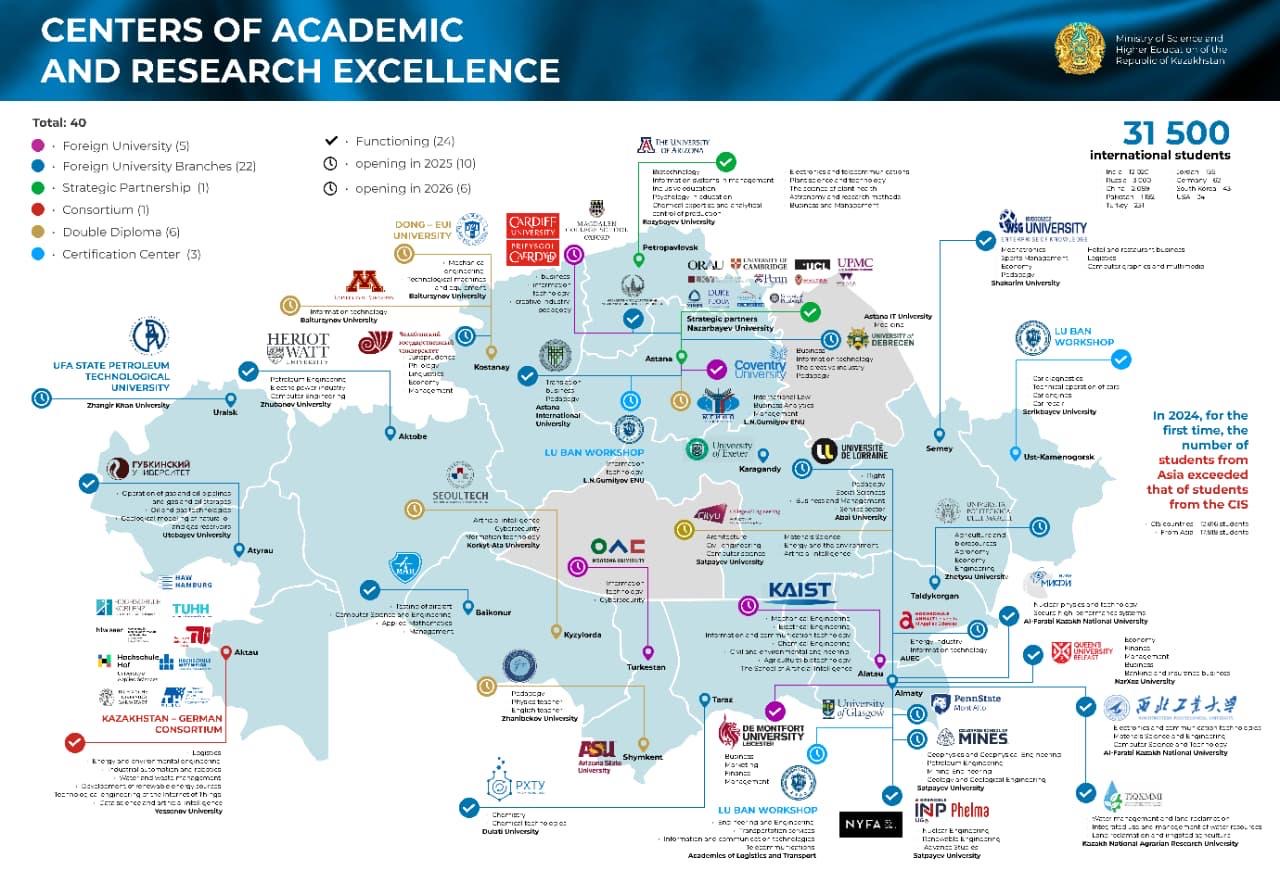
Photo credit: Ministry of Science and Higher Education.
“Regional governments are also fully engaged. For instance, Turkistan provided a building and local grants for Woosong University; North Kazakhstan and Kostanay facilitated partnerships with the University of Arizona, the University of Minnesota, and Dong-Ui University; while Kyzylorda and Shymkent support cooperation with SeoulTech and Gazi University,” he said.
Legal privileges for global universities
Important legislative changes have also been introduced, including simplified registration and licensing procedures. When establishing a branch, the license and global ranking of the parent university are also considered. This ensures that only top universities are allowed to enter Kazakhstan, making the country an attractive destination for international expansion.
Prestigious and affordable world-class education
Branches of foreign universities are transforming access to global education in Kazakhstan and across the region. Most branches focus on engineering and technical fields, aligning with industrial priorities while maintaining the standards of their parent institutions. The result is modern teaching methods, globally recognized diplomas, and expanded opportunities for students without the need to study overseas.
“Branches of foreign universities allow our students to pursue an international education without leaving Kazakhstan. This greatly reduces the financial burden on families and opens world-class programs to a much wider range of young people. In many cases, students complete the first years of study here and then spend one to three semesters at the partner university abroad, gaining valuable international exposure. Importantly, branches are being opened not only in Almaty and Astana, but also in the regions. This brings high-quality education closer to home, ensuring that young people outside the major cities also benefit,” Nurbek said.
Anel Bersimbayeva and Sayasat Nurbek during the interview. Photo credit: Ministry of Science and Higher Education.
Quality assurance has become a cornerstone of the national strategy to expand foreign university branches. To reinforce credibility, Kazakhstan has officially recognized the UK’s Quality Assurance Agency for Higher Education (QAA) as an accreditation body. This allows local and international campuses to be evaluated against the same rigorous standards applied in Europe and worldwide, strengthening confidence in degrees earned in the local schools.
“The UK’s Quality Assurance Agency for Higher Education (QAA) recognition reinforces trust that degrees awarded in Kazakhstan align with international benchmarks and ensures that our institutions are held to the same standards as their global peers. Currently, two higher education institutions, Maqsut Narikbayev University (MNU) and Nazarbayev University (NU), have secured global accreditation from QAA,” Nurbek said.
International and local academic synergy
A mix of international and local academics at the branch campuses fosters knowledge exchange, joint research, and professional development, while ensuring curricula match global standards.
“A defining feature is the strong presence of international professors, who constitute at least 30% of the academic staff in every branch. These experts bring global experience and advanced teaching methods, while local professors are also actively involved. Beyond teaching, faculty members are increasingly engaged in research collaboration. International and local academics work together on joint projects, participate in international grant competitions, and establish new laboratories and startup incubators. This integration strengthens the country’s access to global research networks and accelerates the development of domestic scientific schools in priority fields. Many universities also promote academic mobility: professors rotate between the parent university abroad and its branch in Kazakhstan. This ensures consistency of curricula and teaching quality, while also giving students and researchers direct access to international expertise, research opportunities, and global academic networks,” Nurbek said.
Equally significant, according to the scientific community, is intensifying cooperation with leading industries, forging partnerships with major national companies such as Kazatomprom, ERG, and KazMunayGas, as well as with large agricultural enterprises to tackle pressing economic challenges. In 2024 alone, nine joint sessions brought together more than 400 specialists. These engagements produced over 100 concrete decisions, including the approval of 11 technical specifications jointly developed with Kazakhmys, ERG, and Kazatomprom. By 2025, the share of projects carried out in partnership with industry is projected to reach 20%, further reinforcing the direct connection between science and the country’s economic priorities.
Universities as centers of academic and research excellence
The nation is reshaping its research ecosystem by transforming universities into Centers of Academic and Research Excellence (CAREs). The goal is simple yet ambitious: to link science with real economic needs – from energy and agriculture to digitalization – while embedding the country into global research networks and consortia.
“Universities are expected to generate patents, launch spin-offs, and deepen collaboration with companies in sectors such as mining, energy, agriculture, and IT. This guarantees that scientific results are translated into high-value products and technologies that contribute directly to the economy,” Nurbek commented.
At the crossroads of continents and knowledge
Kazakhstan’s location between Europe and Asia makes it a natural hub for education and research. By attracting students from across Asia, Russia, Africa, and beyond, the country is turning its universities into engines of talent retention, economic growth, and academic tourism.
“The inflow of international students is rising steadily. In 2024, 31,500 students from 93 countries were enrolled, a historical record. International students contribute over 30 billion tenge to the economy. With the target of 150,000 students, the projected contribution is around 1 trillion tenge. To support this goal, the Study in Kazakhstan information campaign is being implemented, featuring major international exhibitions and forums,” Nurbek said.
In 2025, the fairs showcased the country’s educational opportunities in the United Kingdom, Azerbaijan, Pakistan, and China. The initiative will further strengthen international academic presence, with a series of events taking place in the remaining months of 2025 and throughout 2026 in Vietnam, India, Indonesia, the UAE, Qatar, Turkiye, China, Mongolia, and Morocco, among other countries.
Safe and stable study destination
The government has been strengthening campus security while making student well-being an integral part of education. As a result, the country’s higher education sector positions itself as both an affordable and secure study destination.
“Through this comprehensive system — modern infrastructure, health and emergency preparedness, trained security staff, digital monitoring, psychological support services, and strict state oversight — universities provide a safe and supportive environment that meets international standards,” Nurbek added.
As the ministry outlines, higher education institutions are also expected to enhance their global image and “soft power.” The universities are expanding abroad, with branches already established in Bishkek, Chirchik, and Omsk. Alumni associations are being launched internationally to build long-term networks of influence.
The first such association opened in Islamabad, Pakistan, led by Muhammad Iqbal Chaudhry, a distinguished graduate of Al-Farabi Kazakh National University and a senior official at the Organization of Islamic Cooperation (COMSTEС). Similar associations are planned in Russia and other countries. Together, these initiatives create durable academic ties, foster professional networks, and extend Kazakhstan’s role within the international academic community.
Strengthening AI expertise development
Considering a strong emphasis on the development of artificial intelligence expertise by the government, Kazakhstan’s AI-Sana program is driving a rapid scale-up of artificial intelligence training.
Almost 440,000 students have completed AI fundamentals, over 3,000 instructors are certified, and 119 AI agents have already been developed. Coursera has provided 95 universities with 37,000 licenses, resulting in 59,000 certificates. A 42 PFlops supercomputer and mandatory AI courses across 93 universities underscore the scale of the effort.
The aim is clear: to place Kazakhstan alongside the U.S., China, and Finland in the global AI race. Achieving this ambition relies heavily on the role of foreign university branches, which bring global expertise and strengthen the country’s academic capacity.
“With SeoulTech’s support, a Higher School of Artificial Intelligence has been established in Kyzylorda, Woosong University’s campus in Turkestan brings South Korea’s expertise in digitalization, and the New York Film Academy in Kaskelen is integrating AI into the creative industries. Cardiff, Coventry, Woosong, and other universities are becoming anchor partners, strengthening the country’s academic and technological capacity,” Nurbek said.
