
ASTANA – Kazakhstan has started a nationwide human papillomavirus (HPV) immunization campaign in September 2024 as part of broader efforts to curb cervical cancer, a disease that claims the lives of hundreds of thousands of women globally each year despite being one of the most preventable forms of cancer. The Astana Times breaks down the latest figures from Kazakhstan and expert accounts on this issue.
Around 300,000 women die from the disease each year. In Kazakhstan, cervical cancer ranks second among cancers affecting women of all ages. According to the Kazakh Health Ministry, around 1,900 new cases are recorded annually nationwide, with more than 600 deaths attributed to the disease each year.

Globally, cervical cancer is the fourth most common cancer in women. Photo credit: Astana city’s healthcare department
Kuralay Kongrtay, MD, obstetrician-gynecologist and instructor at Nazarbayev University School of Medicine, describes the statistics as alarming. “On average, two women die from the disease every day,” she said in an interview with The Astana Times.
HPV is a widespread sexually transmitted virus that can affect the skin, genitals, anus and throat, and most sexually active people are exposed to it at some point, often without any symptoms, according to the World Health Organization (WHO). In most cases, the body’s immune system clears the virus on its own.
“HPV itself comprises more than 200 different types, or strains. Of these, around 15 are considered highly oncogenic and can cause not only cervical cancer but also other anogenital cancers in both men and women. Research from several Asian countries also links HPV to cancers of the esophagus and the oropharynx,” said Kongrtay, who has devoted more than nine years to researching HPV-related issues.
When infection with certain high-risk HPV types persists, it can lead to cellular changes that may eventually develop into cancer. WHO says the highest incidence and mortality rates are seen in low- and middle-income countries, reflecting unequal access to HPV vaccination, cervical cancer screening and treatment, as well as broader social and economic factors.
HPV rollout in Kazakhstan
Public health experts point to two main pathways for preventing cervical cancer: first and foremost, vaccination against HPV, and early detection through screening.
“A substantial body of research demonstrates the effectiveness of HPV vaccination. Australia, for example, has reduced the incidence of cervical cancer to near zero, largely because it was among the first countries to include HPV vaccination for girls in its national immunization schedule. Long-term prospective studies there have tracked antibody levels in vaccinated cohorts and documented a sharp decline in cervical cancer incidence nationwide,” Kongrtay explained.
The renewed rollout in Kazakhstan follows an earlier attempt to introduce HPV vaccination in 2013, which failed to gain traction, mainly due to widespread vaccine hesitancy.
“Studies conducted between 2015 and 2020 confirmed a high prevalence of HPV in Kazakhstan, serving as a trigger for renewed efforts to introduce vaccination. Following negotiations with the manufacturer, Merck & Co., Kazakhstan was able to secure access to the quadrivalent vaccine in 2024. The country remains on the global waiting list for the nine-valent version,” she said.
Kongrtay explained that the quadrivalent Gardasil vaccine was introduced only in 2024 because there is a single manufacturer worldwide, and demand is exceptionally high. After Kazakhstan halted the vaccine’s introduction in 2013, the country effectively lost its place in the global supply queue.
Overall, Kongrtay said there are three types of HPV vaccines.
“Cervarix protects against two strains — HPV-16 and HPV-18. The quadrivalent Gardasil protects against four types — 6, 11, 16 and 18. The nine-valent vaccine adds five more types: 31, 33, 45, 52 and 58, which have been shown to cause cancer in women and men,” she added.
Countries around the world are aligning their efforts to eliminate cervical cancer with the global 90–70–90 framework, which calls for vaccinating 90% of girls against HPV by age 15, screening 70% of women by ages 35 and 45, and ensuring that 90% of women diagnosed with pre-cancer or invasive cancer receive appropriate treatment.
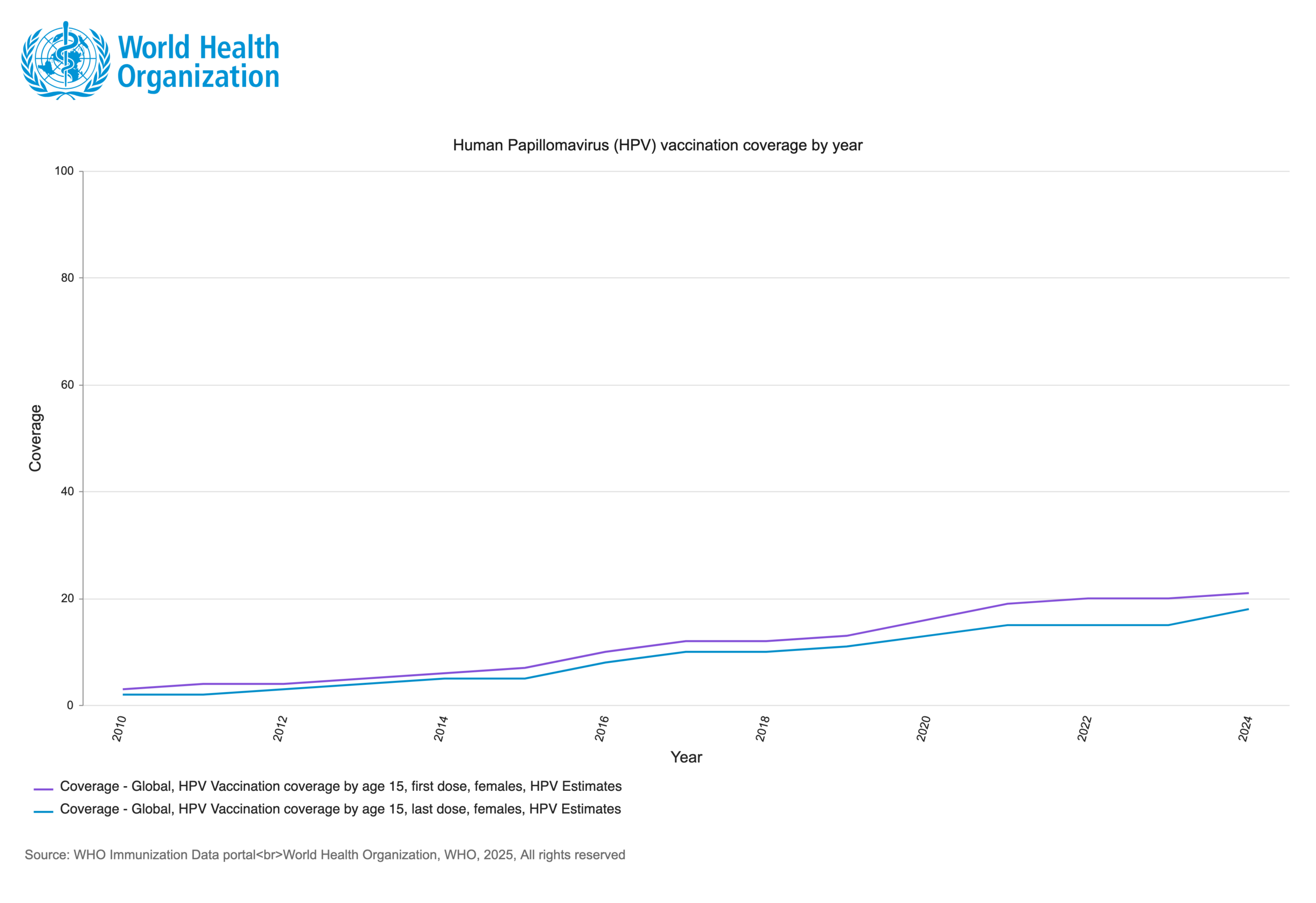
HPV vaccination coverage globally. Photo credit: Source: WHO Immunization Data Portal
Who gets vaccinated
The WHO recommends that countries introduce HPV vaccination by routinely immunizing girls aged 9–14, prior to the start of sexual activity. Older girls and boys are considered secondary target groups. The recommended vaccination schedule calls for two doses for girls aged 9–14 and three doses for those aged 15 and older, as well as for individuals with compromised immune systems.
In Kazakhstan, HPV vaccination is available to 11-year-old girls, and catch-up immunization is available to girls aged 12–13.
“An estimated 174,700 girls would be covered by the program in 2024, with around 160,000 girls targeted for vaccination in each of 2025 and 2026,” the Ministry of Health told The Astana Times in a written comment.
As of Nov. 1, more than 296,600 HPV vaccine doses had been administered nationwide. Of those, 182,800 were first doses, and 113,800 were second doses.
According to SK-Pharmacy, the country’s unified distributor, 349,500 doses of the HPV vaccine were procured in 2024, followed by 301,900 in 2025.
“Around 360,000 doses of the HPV vaccine are planned for procurement in 2026. Vaccine needs for 2027–2028 will be calculated based on projected stock balances and estimated demand for subsequent years,” said the ministry.
Gender-inclusive immunization
At the same time, the ministry is considering adding routine HPV vaccination for 11-year-old boys.
“Globally, 147 countries have incorporated the HPV vaccine into their national immunization programs, reflecting the disease burden and the vaccine’s effectiveness. Of those, 76 countries, including the United States, Canada, Australia, the United Kingdom, Ireland, Switzerland and South Korea, vaccinate both boys and girls against HPV,” said the ministry.
“Vaccination results to date indicate the program is safe and effective, with no adverse events following immunization recorded so far,” it added.
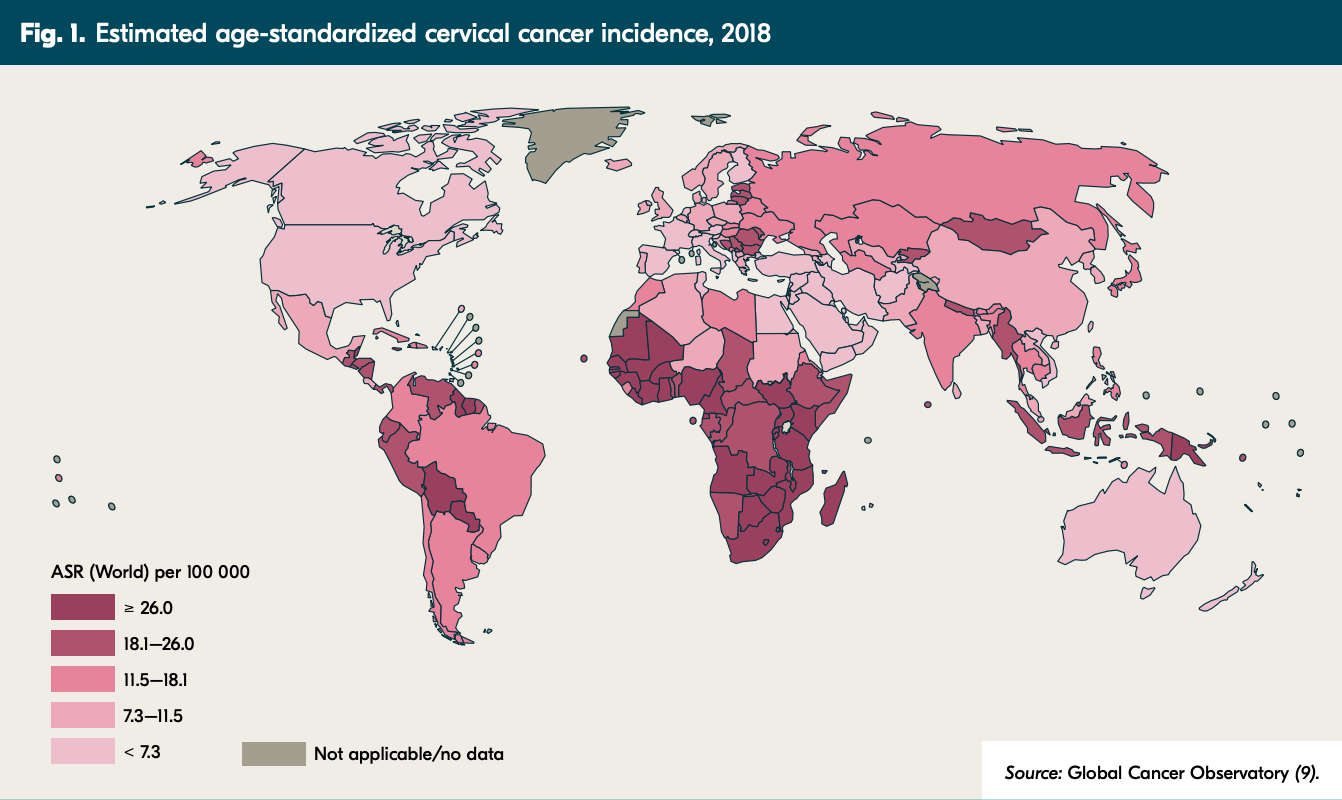
Estimated age-standardized cervical cancer incidence, 2018. Photo credit: WHO
Awareness-raising efforts
Health officials say a key factor in the campaign’s rollout has been the involvement of a broad range of stakeholders, including policymakers, religious leaders, medical professionals and the wider public. Public awareness efforts on HPV vaccination are being implemented under Kazakhstan’s 2024–2025 Roadmap for introducing HPV immunization.
“The campaign has included roundtable discussions with more than 100 influential women, from politicians to bloggers, identified by health officials as opinion leaders and advocates of vaccination. Engagement has also been established with religious representatives to address vaccine safety and importance from a faith-based perspective,” said the ministry.
As part of capacity-building efforts, 160 regional trainers have been trained to serve as vaccination ambassadors, along with more than 1,500 school nurses and 3,000 physicians. Public information materials, including video content, printed and digital brochures, and billboards, have been deployed across 60 cities nationwide.
“A centralized information hub has been launched on the egu.kz website, providing verified information on HPV vaccination and answers to frequently asked questions. The platform operates in coordination with a national call center at 7701 to ensure continuous public support,” the ministry added.
Health authorities said misinformation is being addressed through public briefings, television programs, social media outreach, informational materials and training for healthcare workers in communication skills.
Early detection is key
Early detection through screening is an important part of decreasing cervical cancer incidence. In Kazakhstan, cervical cancer screening is available free of charge for women aged 30 to 74. However, low attendance remains an issue, meaning the cancer is often detected at advanced stages.
“This is despite the fact that Kazakhstan has a relatively well-developed screening program. Women aged 30 and older routinely undergo oncocytology testing, also known as Pap smears. Access remains a challenge in remote and hard-to-reach regions, where many women are unable to visit polyclinics regularly,” Kongrtay explains.
“Like many cancers, cervical cancer often develops without symptoms, making screening critical for early detection. Preventive checkups organized by our healthcare institutions are designed to identify the disease at an early, treatable stage, yet participation remains limited,” she said.
Vaccine hesitancy
Despite the expanded rollout, vaccine hesitancy remains a factor shaping uptake. According to the ministry, as of November, a total of 956 formal refusals of HPV vaccination had been recorded.
“I want to believe that there are many informed parents in our country, especially mothers, who will give their consent to vaccinate their daughters,” Kongrtay said.
Research suggests that public attitudes are only part of the challenge. Experts say vaccine uptake also depends heavily on the preparedness of healthcare providers themselves.
In a 2023 cross-sectional survey of healthcare providers in Almaty conducted ahead of the vaccine’s reintroduction, only 12% of respondents demonstrated adequate knowledge of HPV and its link to cervical cancer, despite being directly responsible for administering vaccinations. The survey, which included more than 1,000 nurses, family doctors and pediatricians, found widespread misconceptions, including beliefs that HPV is transmitted by airborne droplets or causes meningitis.
Attitudes toward HPV vaccination were similarly mixed. Fewer than one-third of respondents (28%) supported including the HPV vaccine in the national immunization schedule, and only 35% said they would recommend it to patients. Some health providers expressed concerns that vaccination could encourage early sexual activity or pose risks such as infertility, views that public health experts say run counter to scientific evidence.
Kazakhstan’s HPV vaccination rollout is still in its early stages. While the impact will not be immediate, Kongrtay noted that the rollout marks a starting point and that steady progress could eventually place Kazakhstan among countries that were able to prevent a disease that remains both widespread and largely avoidable.
