
ASTANA — The Atlantic Council’s Eurasia Center convened visiting policymakers and regional experts on Nov. 7, following the C5+1 Presidential Summit, to discuss the future of United States–Central Asia relations and practical steps to deepen engagement.
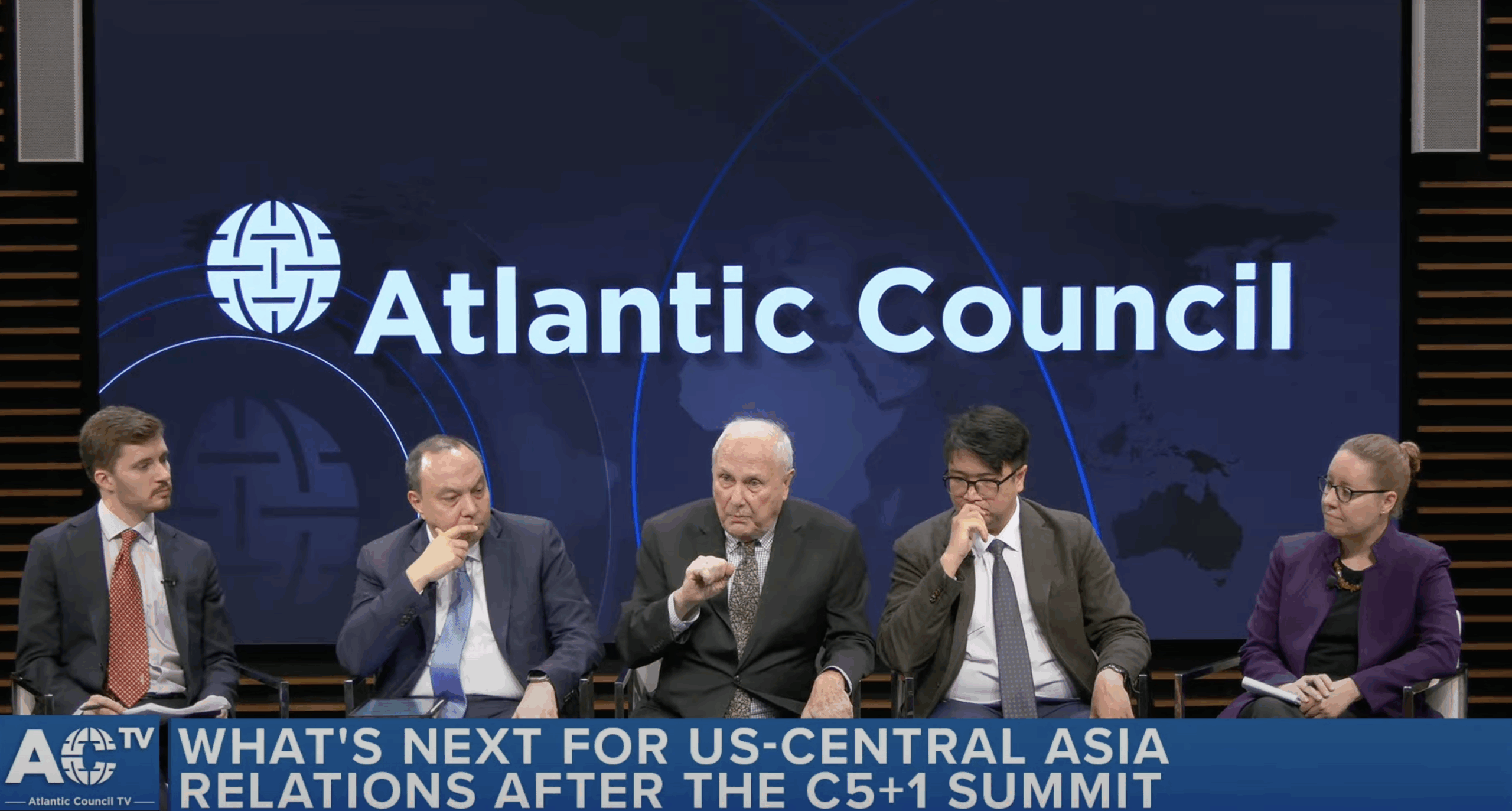
(L-R) Andrew D’Anieri, Eldor Aripov, Frederick Starr, Iskander Akylbayev, Brianne Todd. Photo credit: atlanticcouncil.org
Moderated by the Atlantic Council’s Associate Director of the Eurasia Center Andrew D’Anieri, the discussion emphasized that, on the 10th anniversary of the C5+1 platform, cooperation between the U.S. and Central Asia has become significantly more pragmatic, focused on tangible outcomes rather than symbolism.
Central Asia’s strategic confidence and regional consolidation
Director of the Institute for Strategic and Regional Studies under the President of Uzbekistan Eldor Aripov described the C5+1 platform as a symbol of strong U.S. support for Central Asia’s sovereignty and growing regional unity.
“We in Uzbekistan, and I believe in other Central Asian countries, really consider it a symbol of powerful support from the U.S. for regional consolidation, unity, independence, and the recognition of the region as forming new geo-economic dynamics in Eurasia,” Aripov said.
He emphasized the need for Washington to adopt a strategy that recognizes Central Asia’s intrinsic importance, rather than viewing it only through the lens of Afghanistan, Russia, or China. Reflecting on the region’s transformation, Aripov recalled that not long ago, Central Asia was associated with conflicts and contradictions.
“Now, the situation is completely different. We have consolidated. Central Asia’s borders are open, regional trade is booming, it has increased sixfold over the past seven years and mutual investments have doubled,” he said.
He noted that the region now increasingly speaks “with one voice” in international forums and that other major players, including Japan, the European Union, and China, have also formed their own C5+ formats with the region, showing its growing geopolitical significance.
Aripov projected that by 2050, Central Asia’s population will reach 100 million, with average GDP growth above 5% across all states. Since 2016, the region has attracted over $200 billion in foreign direct investment and holds nearly half of the world’s critical minerals identified by the U.S. Geological Survey.
While Russia and China still account for roughly half of Central Asia’s external trade, Aripov pointed to an increasing presence of alternative powers such as Türkiye, South Korea, Japan, and India as a sign that the region is shifting from dependency to diversification.
“The main challenge for Central Asia is to remain open, connected, and stable, not to become an arena for confrontation among great powers, but rather a platform for cooperation. The U.S. could play a crucial role in strengthening Central Asia’s strategic autonomy by supporting diversified partnerships,” he said.
Business, technology, and human capital: new frontiers of cooperation
Founder and CEO of Xander Group Iskander Akylbayev said the historic summit and the elevated level of dialogue are the results of decades of diplomatic work by Central Asian ambassadors, now complemented by a growing presence of business leaders linking the region to the U.S.
“Looking ahead, logistics is the number one area for cooperation given the vast geography of Kazakhstan, Central Asia, and the U.S.. Kazakhstan’s aviation sector, railways, and the expansion of Boeing’s cooperation with Uzbekistan show how logistics can reshape the Middle Corridor,” he said.
Akylbayev called critical minerals both a challenge and an opportunity.
“For Central Asia, the key is moving from being mere producers of raw materials to refining and adding value within the region,” he said.
He also highlighted the digital frontier as a promising area of partnership. Akylbayev noted that at a recent meeting between the U.S. Chamber of Commerce and Kazakhstan, participants included not only oil industry representatives but also executives from Google, Amazon, and OpenAI, signaling a broader scope of engagement.
Developing human capital, he added, must underpin these new partnerships.
“Joint ventures aren’t only about buying Boeings or locomotives, it’s about maintaining equipment and building long-term technical expertise. We need training centers for engineers and technicians. The business sector doesn’t need endless roundtables; it needs clear, practical business advisory and direct B2B cooperation,” he said.
Akylbayev also mentioned Kazakhstan’s growing academic partnerships, including dual-degree programs with Arizona State University and the Colorado School of Mines, as examples of how educational cooperation supports long-term capacity building.
From regional business integration to security cooperation
S.Frederick Starr, distinguished fellow for Eurasia and Chairman of the Central Asia–Caucasus Institute at the American Foreign Policy Council, said that to make U.S.-Central Asia engagement more effective, Washington should help integrate separate business councils that currently operate country by country.
“Isn’t it time that these separate entities either merge or deeply coordinate? This would be in the interest of both American business and investors, enabling them to operate and invest on a regional basis,” he said.
Starr proposed convening closed-door meetings among chambers of commerce from all Central Asian states and key cities to harmonize approaches and present a coordinated voice to global partners, something that, he noted, does not yet exist.
He also underscored the need to address security directly.
“Let’s not be naïve, security remains crucial,” Starr said, recalling the NATO-linked CENTRASBAT initiative two decades ago, a joint battalion involving Central Asian partners.
“Security must be fully integrated into bilateral discussions, without hesitation or delay,” he said.
