
ASTANA – Christopher Duggan, Ambassador of Canada to Kazakhstan, Kyrgyz Republic, Tajikistan, Turkmenistan, and Uzbekistan, describes the relationship with Kazakhstan as deeply constructive and values-aligned, noting strong convergence on multilateralism and shared global priorities, from peace and security to climate and economic resilience.
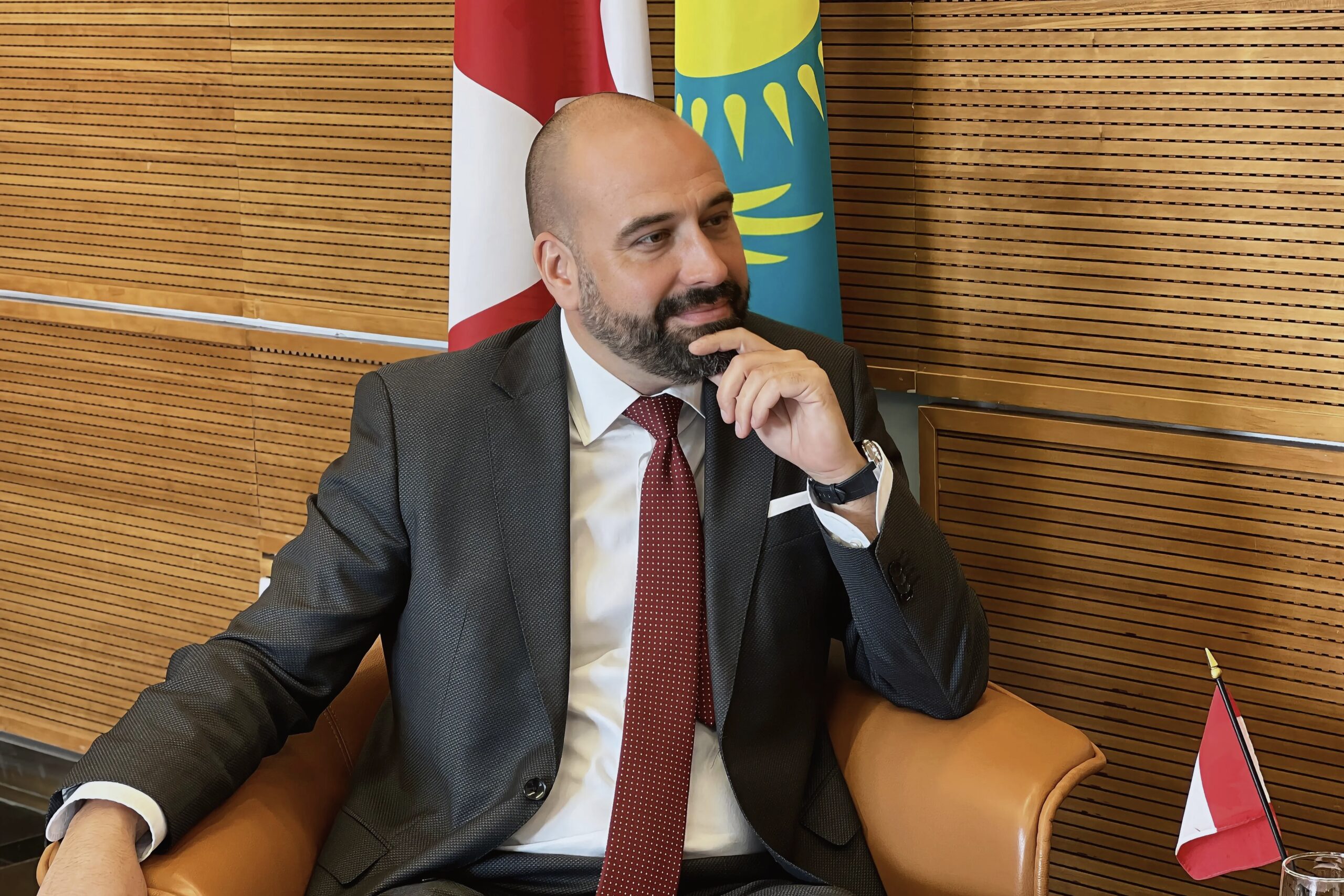
Christopher Duggan, Ambassador of Canada to Kazakhstan, Kyrgyz Republic, Tajikistan, Turkmenistan, and Uzbekistan. Photo credit: The Astana Times
In an interview with The Astana Times, he reflects on his priorities in the role, the most promising areas of cooperation with Kazakhstan, and what it means to serve as ambassador at this geopolitical moment.
“This is my fifth posting, and first one as an ambassador,” said Duggan, who was a director general at the Department of National Defense before his appointment in Kazakhstan.
“My background, as you mentioned, is quite diverse. I think that served me well as I move on and do other postings, because I think it is essential to understand the geopolitical realities that shape every country’s reality – having that understanding of a diversity of views, looking at how I can identify common objectives, common priorities, and how we can work together to advance them,” said the ambassador.
Reflecting on how his diverse international background informs his work in Kazakhstan, the ambassador said it is imperative to be open-minded, flexible, and adaptable, and to be able to “communicate across language barriers and different cultures.”
“It is also really important for me to identify key partners, build key contacts, so that we can indeed work together to find out those common viewpoints and those common objectives,” he added.
Canada’s foreign policy priorities
Ambassador Duggan said Canadian foreign policy under the newly formed government is now centered on three core priorities: defense and security, economic resilience, and the promotion of Canada’s democratic and environmental values.
“We are taking a renewed approach to our own defense and security, investing in our armed forces, investing in our national defense, because we can see in the world there are shifting powers that are happening. There are geopolitical realities that we need to be prepared to respond to. This is the reality,” he said.
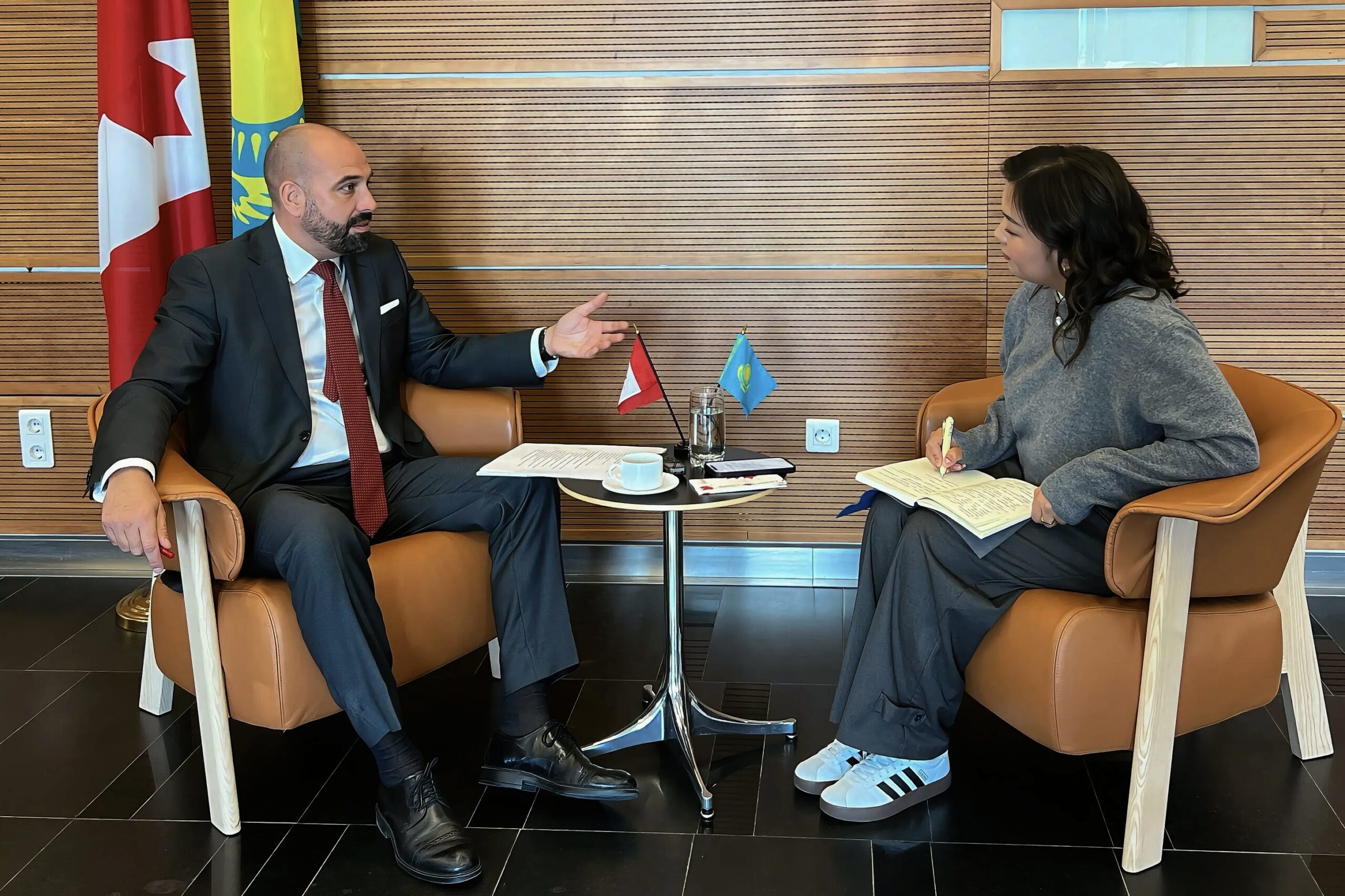
Christopher Duggan spoke to The Astana Times correspondent Assel Satubaldina.Photo credit: The Astana Times
The second pillar is economic resilience, entailing efforts to diversify trade, secure supply chains, and safeguard the rules-based international order.
“We are looking at diversifying trade relationships, which is a key aspect of what I am doing here in Central Asia. Certainly, we are looking at reinforcing global supply chains, the free flow of goods, because I think we can all recognize that the rules-based international order that we have all benefited from is under increasing stress. Canada is a trading nation, so we have relied on a rules-based international system for our prosperity and the prosperity of our partners,” he explained.
The third pillar is rooted in Canada’s core values, Duggan said, highlighting democracy, pluralism, and multiculturalism.
When asked how that translates to Kazakhstan, the ambassador described the bilateral relationship as constructive and values-aligned, with strong convergence on multilateralism. The two countries’ diplomatic ties go back to 1992.
“We engage in multilateral institutions. (…) One of the bedrocks of Kazakhstan’s foreign policy is what is known as a multi-vector foreign policy, but also engaging with the UN and other multilateral bodies. We also feel the same way, we also want to effectively engage multilateral bodies,” he said.
Deepening economic ties
Economically, Canada is looking to deepen trade and investment, particularly in the extractive industry, agriculture, and IT. On the regional level, given Duggan’s mandate over all five Central Asian states, the focus extends to peace and security, counterterrorism, water management, clean energy, and conflict prevention.
“The multilateral trading system is really important for us. That is very important for Kazakhstan as well,” he said. “We are looking at a new chapter of international cooperation. Based on that, I see a lot of potential to grow the relations with Kazakhstan and the region.”
According to the Kazakh Bureau of National Statistics, bilateral trade between January and August reached $310.1 million, with Kazakh exports accounting for $221.5 million. This is up from $264.2 million in trade over the same period last year.
In 2024, bilateral trade hit $509.8 million. The ambassador acknowledged that the economic relationship is substantial but far from reaching its full potential.
“We can do more, but already we are starting at a base which is significant economically. We have $6.1 billion of foreign direct investment in Kazakhstan, which is primarily focused on extractive industries,” he said.
Industrial machinery, equipment and parts, and electronic and electrical equipment dominate Canadian exports to Kazakhstan. Kazakh exports to Canada, meanwhile, are driven primarily by uranium and gold.
Canadian companies have long been involved in uranium, oil and gas, copper, and gold projects in the country. One of the biggest companies is Cameco Corporation, which owns 40% of the Inkai deposit in the Turkistan Region. The company has invested more than $500 million in the economy, CEO Tim Gitzel said during talks with President Kassym-Jomart Tokayev in September in New York.
According to Ambassador Duggan, agriculture remains an area with substantial potential. He noted profound structural similarities between the two countries, including harsh winters, vast open land, and remote communities.
There is a long agricultural connection dating back to the 1950s, when Kazakh agronomists adopted Canadian innovations in soil conservation and crop rotation. That cooperation, he said, is still relevant today.
While Canadian machinery exports are growing, Duggan believes that sector, along with sustainable mining and value-added agriculture, is ripe for expansion. However, he stressed that stronger dialogue and more active engagement will be crucial.
“The list goes on, but it is my objective and my role to not only look at building on existing relationships, but to identify new opportunities and provide almost like a matchmaking. What does Canada need? What does Kazakhstan need? How can our industries and our commercial relations be increased to have a situation where we are both benefiting?” Duggan explained.
Recent technical support in legislation
Ambassador Duggan pointed to the recent legislation that criminalized stalking as a “great success” story of bilateral cooperation that goes far beyond economics.
He explained that through Canada’s Technical Assistance Partnership program, Canadian legal experts collaborated closely with Kazakh counterparts, including from government, judiciary, and civil society, to identify gaps, draft reforms, and bring them up to international standards.
The law signed by President Tokayev in July introduces criminal liability for stalking and forced marriage, and amends multiple codes, including the Criminal Code and the Family Code. Under the law, stalking is now defined as an offense, punishable by fines, community service, or detention.
“This is an issue that I think both Kazakhstan and Canada should feel proud of, because the reality is domestic violence is a situation that affects every country. This was a great success,” he said.
“It required a lot of consultations with Kazakh experts and their counterparts; legal experts and civil society were also involved in this. It was a pretty holistic approach that ultimately led to the development and passing of this legislation, which was signed into law by the President,” he said.
Canada’s G7 presidency
Canada assumed the presidency of the G7 on Jan. 1, 2025, its seventh time leading the group, and hosted the G7 Leaders’ Summit in Kananaskis, Alberta, in June.
When asked how that resonates with Central Asia, the ambassador emphasized that the region is far from outside its field of strategic attention.
“However, there are common concerns that within the G7 context resonate within Central Asia, and Kazakhstan, in particular, talking about issues related to global peace and security, issues related to climate change, and economic growth,” said the ambassador.
He noted that as the G7 increasingly focuses on energy security, resilience to geopolitical shocks, and the digital transition, Central Asia inevitably rises on the agenda. Critical minerals are a clear example.
“One of the key issues that is becoming an increasing interest and focus is looking at critical minerals in terms of a clean energy transition. Critical minerals are essential to help support that transition. Kazakhstan has a wealth of geology that contributes to global supply chains and the global supply of critical minerals,” said Duggan.
With the challenging international order, he said the G7’s relevance will depend not only on how its members coordinate among themselves, but also on how actively they engage partners beyond the group.
“We don’t exist in a bubble. Our well-being depends on our relationships and our partnerships,” he added.
Promising frontier
Education also offers significant potential for bilateral cooperation, the ambassador said, highlighting demographics as one of the most striking differences between Canada and Kazakhstan. “You have a very young population here. Our population is getting older,” he said.
“As I look at Kazakhstan and other countries in the region, I see it as a great opportunity. The vibrancy, the energy of the youth, is one that provides a great opportunity. But with that opportunity, you need to have adequate resources. You need to have adequate educational opportunities, skills, and, by extension, employment. There is a great potential for increased educational cooperation between Canada and Kazakhstan,” Duggan explained.
The ambassador mentioned a high school in Kazakhstan that now offers a joint Kazakh-Canadian diploma program. The first cohort graduated earlier this year, said Duggan, expressing his admiration at the global mindset students have.
Canada is now exploring joint master’s and PhD programs between Canadian and Kazakh universities, as well as greater collaboration in technical and digital skills, particularly cybersecurity, digital security, and AI, areas where Canadian institutions are expanding engagement in Central Asia.
“Part of the challenge I have is that Kazakhstan and Central Asia are really far away from Canada. Canadians don’t necessarily understand the region or Kazakhstan, and people can make generalizations and without fully understanding all the opportunities that exist,” he said.
Part of his mandate, he said, is not only to represent Canada in Kazakhstan, but to communicate Kazakhstan back to Canada, ensuring Canadian policymakers and businesses see the region as it truly is, rather than through outdated assumptions.
The ambassador stressed that promoting Canada’s identity abroad is an essential part of his mission. “I am a proud Canadian, I am a patriot, and I am happy to do it,” he said.
