
ASTANA – International humanitarian law (IHL) should be reinforced to protect civilians and ensure accountability in war, said government officials, humanitarian organizations, and International Committee of the Red Cross (ICRC) representatives at a conference titled the Global Initiative to Galvanize Political Commitment to IHL in Astana on Oct. 7.
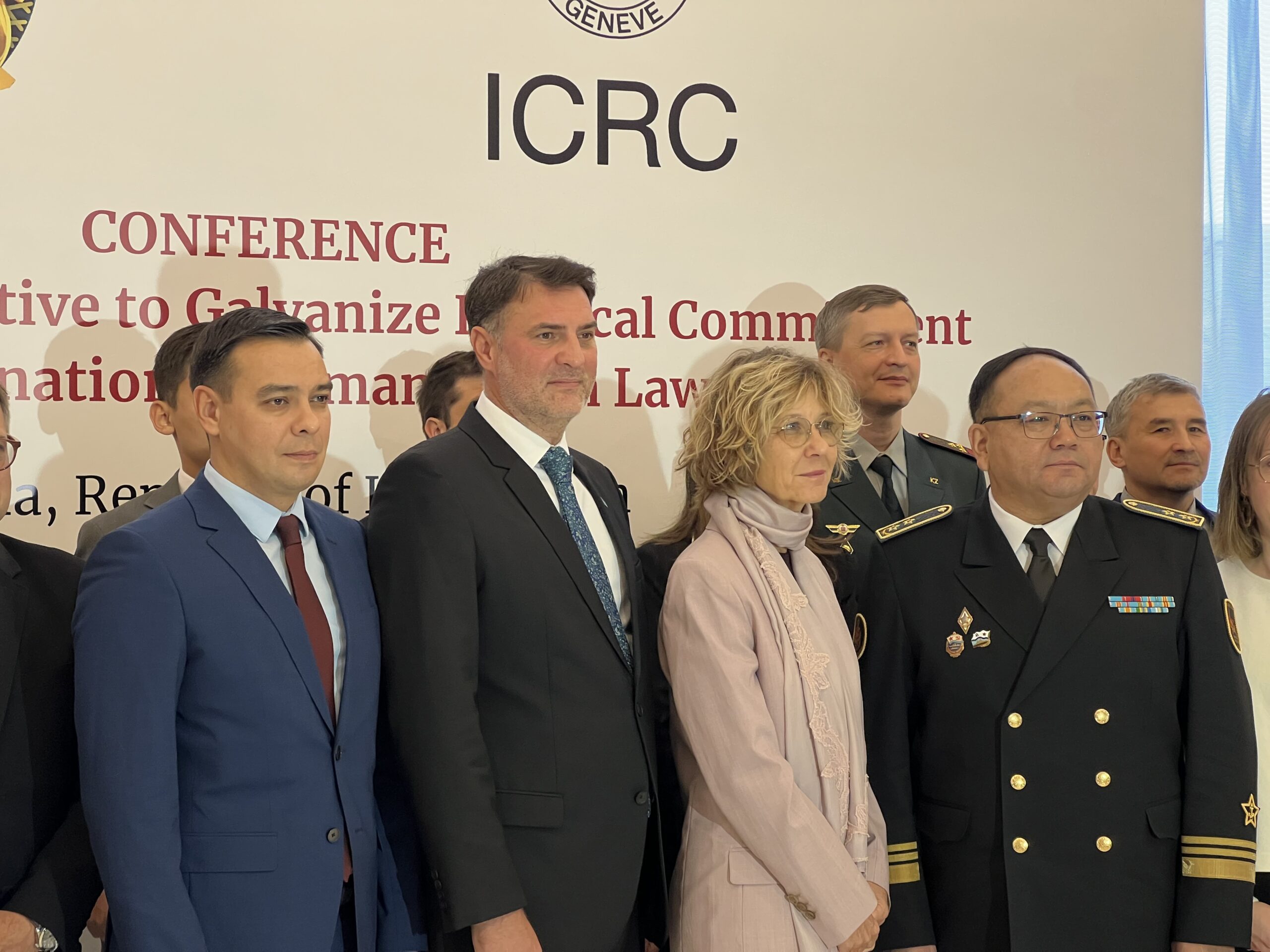
From left to right: Artur Lastayev, Stanislav Vassilenko, Biljana Milosevic, Serik Burambayev. Photo credit: Nagima Abuova / The Astana Times
“As the 21st century enters its third decade and the United Nations marks its 80th anniversary, the global humanitarian crisis remains immense. Therefore, we reaffirm our strong commitment to upholding international humanitarian law, learning the lessons of World War II, and protecting human dignity, inspiration, and justice in all conflicts,” said Stanislav Vassilenko, Ambassador-at-Large of the Kazakh Foreign Ministry.
“The very philosophy of many of the rules contained in the Geneva Conventions is aimed first and foremost at prevention. Violations of IHL undermine this commitment in the first place,” he said.
Vassilenko highlighted Kazakhstan’s role in mediating between Armenia and Azerbaijan, its involvement in the Astana process on Syria, and its contributions to UN peacekeeping missions.
“Kazakhstan believes this Global Initiative is vital in addressing the serious and growing deficit in respect for international humanitarian law, so painfully visible in many armed conflicts,” he added.
Addressing new challenges
Kazakhstan’s Human Rights Commissioner Artur Lastayev said that IHL is increasingly strained by modern technologies, such as drones, cyber weapons, and artificial intelligence (AI).
“Fundamental norms developed more than seven decades ago are now being seriously challenged and undermined. The effectiveness of international justice is declining, while joint control mechanisms are often paralyzed by geopolitical considerations,” he said.
To address these gaps, Lastayev called for practical measures, including national IHL committees, independent monitoring, training for armed forces, and stronger protections for war victims. He added that Kazakhstan’s peace initiatives, from Karabakh to Syria and dialogue on Russia-Ukraine, reflect its commitment to humanitarian principles.
“Kazakhstan is a peace-loving nation that has consistently pursued an active foreign policy promoting IHL. Our country was among the six initiators of the Global Initiative to strengthen respect for IHL at the diplomatic level. Kazakhstan has also initiated a global high-level meeting on preserving humanity during armed conflicts, scheduled to take place next year,” said Lastayev.
“Since independence, our nation has chosen diplomacy, dialogue, and mutual respect among nations as the foundation of its foreign policy,” he added.
Humanitarian perspective
Biljana Milosevic, head of the ICRC Regional Delegation in Central Asia, highlighted that weak compliance with the Geneva Conventions leaves civilians most vulnerable.
Biljana Milosevic and Anne Quintin. Photo credit: Nagima Abuova / The Astana Times
“While there is widespread agreement on the importance of the Geneva Conventions, compliance with basic humanitarian standards remains alarmingly poor in today’s war zones. (…) Hospitals and health workers are attacked, infrastructure is destroyed, humanitarian access is delayed or denied, and civilians are left to bear the consequences,” she said.
She emphasized that humanitarian work itself is facing growing risks, including disinformation campaigns and increasing restrictions that make it more challenging for aid workers to operate independently and impartially.
“International humanitarian law is not optional. The Geneva Conventions are not negotiable. They provide a universal framework designed to protect human dignity even in the worst of circumstances,” said Milosevic.
Milosevic noted that the Global Initiative seeks to mobilize political will rather than create a new compliance mechanism, complementing existing frameworks through practical action and shared responsibility. On the sidelines of the UN General Assembly, the ICRC and founding states issued a call for action and announced a global high-level meeting on upholding humanity in war in 2026.
“The Global Initiative aims to re-center IHL within international relations and state responsibility, reinforcing its role as the guiding framework for protecting civilians, the wounded, detainees, and humanitarian personnel in armed conflicts. It seeks to mobilize political will to ensure that IHL is not only upheld in principle, but implemented effectively and consistently on the ground,” she said.
Defense Ministry and peacekeeping
From left to right: Stanislav Vassilenko, Artur Lastayev, Serik Burambayev and Biljana Milosevic. Photo credit: Nagima Abuova / The Astana Times
Kazakhstan’s Deputy Defense Minister and Vice Admiral Serik Burambayev reaffirmed the Geneva Conventions as the foundation of international legal responsibility. He recalled President Kassym-Jomart Tokayev’s recent call at the UN General Assembly for parties in conflict to protect civilians and allow humanitarian aid.
“In this context, it is especially important to highlight the role of the ICRC, a unique organization that, guided by the principles of humanity, impartiality, neutrality, and independence, has for more than a century and a half served as a guardian of universal humanitarian values within the framework of its mandate,” he said.
Burambayev also pointed to Kazakhstan’s partnership with the ICRC on IHL training for armed forces and its expanding contributions to UN peacekeeping, with 156 troops currently serving in six operations across Africa and the Middle East.
The initiative’s local and global priorities
Aigul Kumasheva, vice president of the Red Crescent Society of Kazakhstan, described the organization’s 88-year history as the only national humanitarian body formally recognized under the Geneva Conventions.
“We support government initiatives and complement them with our own resources, volunteer networks, and educational programs. Our task is to bring humanitarian values to society and to ensure that knowledge of IHL becomes part of the general culture,” she said.
Kumasheva noted ongoing cooperation with the ICRC and the launch of online IHL courses, which are open to the public.
Anne Quintin, head of the Global IHL initiative, outlined the Global Initiative’s workstreams, including preventing violations, protecting medical facilities, addressing cyber warfare, and strengthening national committees. She emphasized that the effort is not about creating new laws, but about ensuring effective implementation at the domestic level.
“We face a choice of either continuing down a spiral of increasing violations or correcting course to ensure that IHL fulfills its purpose of protecting humanity during war. Respect for IHL is under threat,” said Quintin, highlighting an additional challenge of IHL’s misuse.
“It is applied so permissively that it is used to justify, rather than prevent violence. This is one of the most dangerous risks to IHL today, and one that this initiative seeks to address,” she said.
Quintin noted that the problem lies not with the IHL itself, but with its application, which requires renewed political will. The initiative, supported by six founding states (Kazakhstan, Brazil, China, France, Jordan and South Africa) and joined by 90 more, aims to make IHL a political priority, elevate compliance beyond legal frameworks, and encourage states to invest in domestic mechanisms such as training, accountability structures, and national IHL committees.
She detailed seven thematic workstreams, including prevention of violations, strengthening national IHL committees, linking IHL to peace, protecting medical facilities, addressing cyber warfare, and adapting rules for naval warfare, led by more than 27 states worldwide.
