
ALMATY – Kazakhstan is strengthening its biodiversity conservation policies through new reintroduction projects, population monitoring of rare species, and updates to its Red Book of endangered animals.
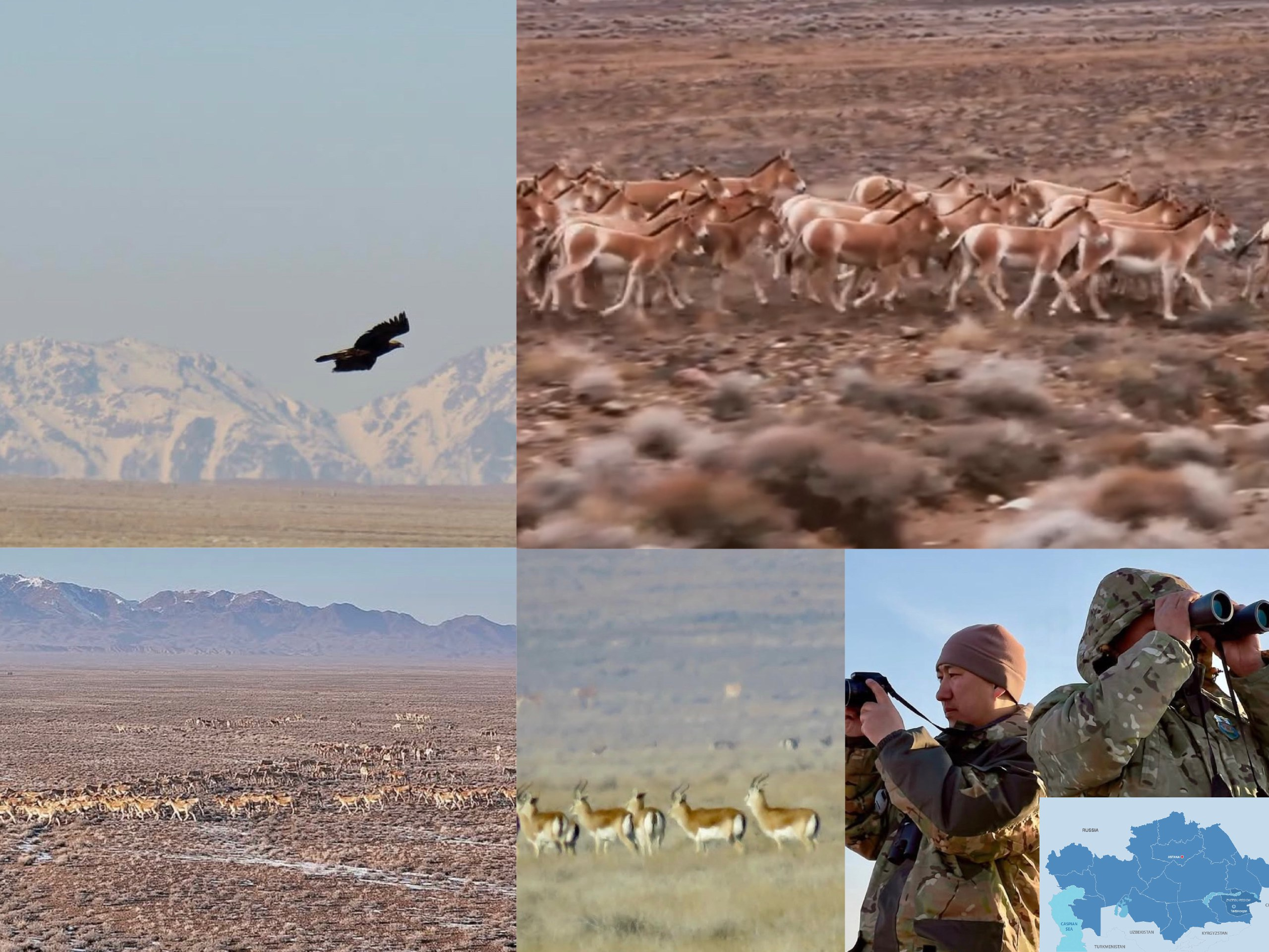
Photo credit: Altyn-Emel National Park Click to see the map in full size. The map is designed by The Astana Times.
It was announced by Vice Minister of Ecology and Natural Resources Nurken Sharbiyev at a Sept. 30 meeting of the Senate Committee on Agrarian Issues, Nature Management, and Rural Development.
According to him, recent initiatives range from releasing kulan herds into the steppe to reintroducing Przewalski’s horses and restoring tiger habitats.
A new group of endangered kulans was released in the Altyn Dala reserve in Kostanay Region after a year of adaptation at the Ungulate Reintroduction Center. Some kulans were fitted with GPS collars and solar-powered ear tags, with early tracking showing movements of up to 26 kilometers per day as they explore the steppe.
“These kulans are pioneers of a future population,” said Albert Salemgareev, senior expert at the Association for the Conservation of Biodiversity of Kazakhstan (ACBK).
In coming years, around 100 kulans are expected to be resettled to form a sustainable herd.
Przewalski’s horses brought back
The Ministry of Ecology and Natural Resources is advancing the reintroduction of the Przewalski’s horse, extinct in the wild since the late 1960s. In 2024–2025, 14 horses were transferred from Prague Zoo to the Altyn Dala reserve.
“The historic range of the Przewalski’s horse once covered nine regions of Kazakhstan. By 2029, 40 horses are planned to be brought into the country,” said Sharbiyev.
Snow leopard numbers double
Conservation programs have also yielded success for the snow leopard. Populations have grown from a critical low of 80–100 individuals in the 1990s to approximately 189 today.
This increase follows the creation of 3.6 million hectares of protected areas, satellite tagging of 11 leopards, and strict habitat protection measures.
Restoring tiger habitats
As part of the tiger restoration program, the Ile-Balkhash reserve was established, covering 415,000 hectares. Between 2018 and 2024, 205 Bukhara deer and more than 100 kulans were introduced to restore prey density.
Two tigers arrived from the Netherlands in 2024 for captive breeding, and three to four more are expected from Russia in 2026.
Updated Red Book species list
Kazakhstan plans to revise its Red Book of rare and endangered species. Based on the Institute of Zoology’s recommendations and IUCN criteria, 21 invertebrate species will be removed due to population recovery, while 11 new species will be added, including birds, reptiles and the reed cat.
Currently, Kazakhstan is home to 835 vertebrate species and about 100,000 invertebrates. Of these, 227 species are listed as rare or endangered.
Conservation and national balance
Alongside rare species protection, Kazakhstan faces growing numbers of predators such as wolves and bears, especially in the East Kazakhstan Region. Local reports cite livestock attacks in rural areas.
“There is a licensed system for regulating populations. Hunting associations receive quotas annually based on monitoring. Next year, quotas may be increased due to population growth,” Sharbiyev said.
The boar population alone reaches 4,500, with annual growth of 50%.
Officials emphasize that restoring rare species like kulans, Przewalski’s horses, snow leopards, and tigers contributes to the ecological balance of Kazakhstan’s unique steppe ecosystems. At the same time, careful regulation of growing predator populations is seen as essential to protecting both wildlife and rural livelihoods.
