
ASTANA – Giuseppe Verdi’s “Rigoletto”, one of the most renowned works in the classical opera repertoire, will premiere at the country’s main theatrical venue, Astana Opera, on Oct. 3–5.
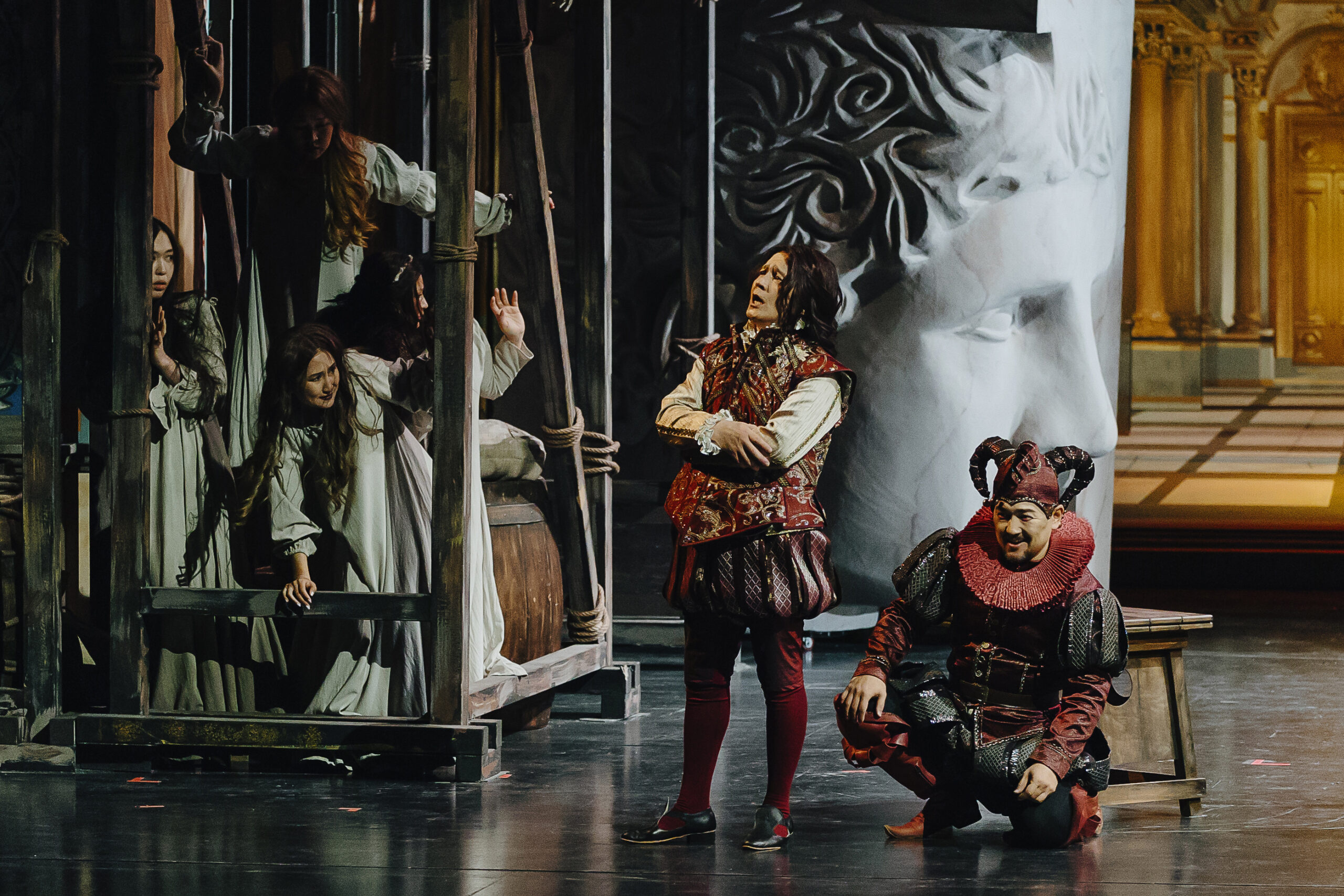
Photo credit: Astana Opera press service.
A media preview and press conference dedicated to the premiere took place on Oct. 1 at the opera house. The event gathered Astana Opera’s general management, creative team, and representatives of the production, along with cultural figures from Kazakhstan, France, and Italy, who shared insights into the preparations and features of the new staging.
Opening the meeting, Astana Opera’s General Director Alexandr Sovostyanov emphasized the opera house’s philosophy behind major premieres, reported Astana Opera house.
“Some time ago, we made a decision: to bring together everything that is best in the world of opera within our opera house. Today, we have the opportunity to invite the finest stage directors, set and costume designers, and the most sought-after conductors. And this production of ‘Rigoletto’ is precisely of that calibre,” he noted, expressing gratitude to the Ministry of Culture and Information for supporting the opera house.
The production’s musical director, Principal Conductor Alan Buribayev, underlined the scale and emotional depth of Verdi’s work.
“Verdi is the embodiment of opera itself. It may seem we already have experience performing his works, yet each of his scores is a sincere creation, ‘written in blood.’ To perform ‘Rigoletto’ means to live through the story of a father gripped by fear for his daughter, because he exists in a sick society. His duality, his paranoia, are very difficult to convey. This is music that cannot be performed indifferently; it erupted from Verdi’s soul like a volcanic explosion,” he said.
French stage director Arnaud Bernard explained his choice of a classical approach for the production, as “Rigoletto” will be performed at Astana Opera for the first time.
“It is important to have a strong interpretation, for the story to be clear and to respect the plot very precisely. The story of Rigoletto is not an easy piece to stage for many reasons. Stylistically speaking, I wanted an image that is violent, but classical at the same time, inspired by the Renaissance era paintings, and the way candlelight is depicted on them. And we will be seeing not the palace of the Duke of Mantua directly, but the back view of the palace. I wanted to emphasize the idea that sometimes, things happen not in the palaces, but behind the scenes, which is actually how Verdi wrote it. My other idea was to create a very fluid, very cinematic performance, without stopping for set changes quite so many times,” Bernard noted.
He added that Renaissance art provided key inspiration for the production.
“A very famous painting, ‘La Tempesta’ by Giorgione, is the inspiration for the tempest scene in the last act. Or another celebrated artwork, ‘Il Sarto’ by Moroni, for the costumes, because it is very Renaissance with the cut and the shape, very austere, very simple, and very straightlaced. For the lighting we used Caravaggio, for example. These outstanding pieces of classical art work very well with my style and with ‘Rigoletto’, and we have good, strong production,” he said.
Speaking on the challenges of embodying the title role, baritone Talgat Mussabayev noted the importance of Bernard’s direction.
“The character of Rigoletto is very complex, as it has many colours – joy and suffering alike. A great help for us, singers, is working with a stage director who sets us such tasks. We have already collaborated with Arnaud on ‘L’Elisir d’Amore’, and we established an excellent creative rapport, which helps us immediately understand the direction we should take,” Mussabayev said.
