
ALMATY – The World Forum of Central Securities Depositories (WFC2025) opened in Almaty on Sept. 24, marking a landmark event for Kazakhstan and Central Asia. The forum, hosted by the Kazakhstan Central Securities Depository (KCSD), gathered over 250 experts from more than 50 countries, representing 80 financial institutions, to discuss the future of post-trade infrastructure.
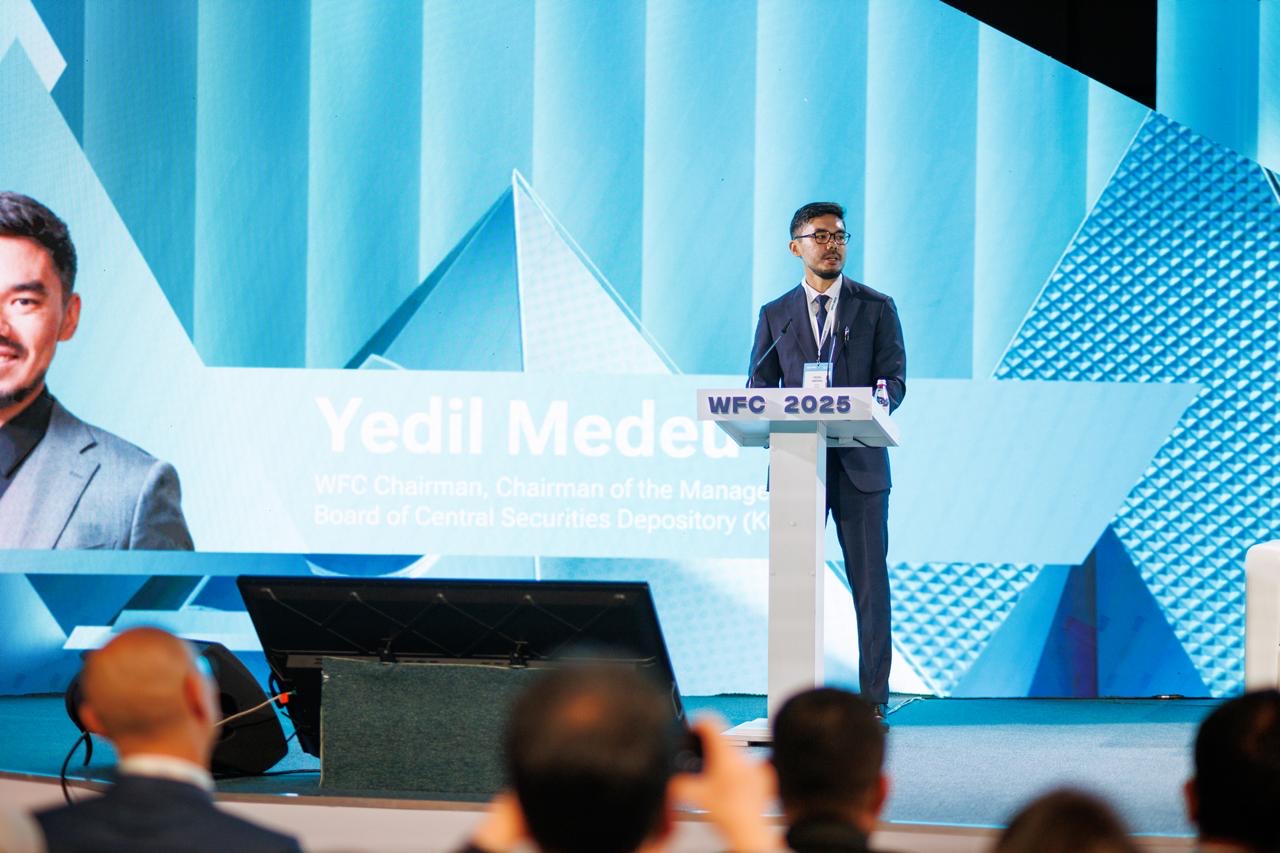
KCSD Chairman and WFC Chairman Yedil Medeu. Photo credit: WFC2025
KCSD expands global connections
Opening the forum, KCSD Chairman and WFC Chairman Yedil Medeu stressed that many risks once anticipated, from geopolitical turbulence to rapid technological change, have already materialized since WFC 2023. He emphasized KCSD’s response to this environment.
“Our response in KCSD to geopolitical unpredictability and growing regional fragmentation has been to build an autonomous regional infrastructure -anchored in independent, direct CSD-to-CSD links. This is not a slogan; it is a practical approach that strengthens resilience, accelerates settlement, and broadens investor access,” he said.
Medeu highlighted KCSD’s recent achievements, including correspondent links across Europe, the Caucasus, Central Asia, and the Middle East. At WFC 2025, KCSD signed reciprocal account agreements with Türkiye’s Central Depository (MKK) and is finalizing connections with Tajikistan and Azerbaijan. Cooperation with Middle Eastern markets through First Abu Dhabi Bank is also underway, with plans to expand to Southeast Asia in 2026.
“Each new link is not only additional access; it is a template that can be scaled to other market pairs. These are the building blocks of the global interoperability we all call for,” he noted.
At the same time, Medeu cautioned that fragmentation threatens global markets if settlement systems are not aligned.
“The real challenge is not which CSD comes out ahead, but preserving a single pool of liquidity while ensuring choice for market participants,” he said.
He urged the industry to adopt common standards for trade matching and settlement deadlines, adding that “when everyone speaks one language, pre-matching is straightforward”.
He also advocated for “thin, open, non-exclusive links” to expand access while maintaining a single source of truth for ownership.
On digital transformation, Medeu underlined the need to balance innovation with financial stability, separating activities to avoid contagion risks. He stressed that automation should be prioritized where possible, with AI introduced cautiously.
“One area in which we are looking very carefully to implement AI is compliance,” he added.
Forum focuses on innovation and market reform
Kazakhstan Stock Exchange (KASE) Chairman Adil Mukhamejanov highlighted the crucial role of CSDs in global finance.
“Worldwide, you ensure security, transparency, and efficiency. Investor and issuer trust depends directly on your resilience, innovation, and leadership. That is why this forum is so important,” he said.
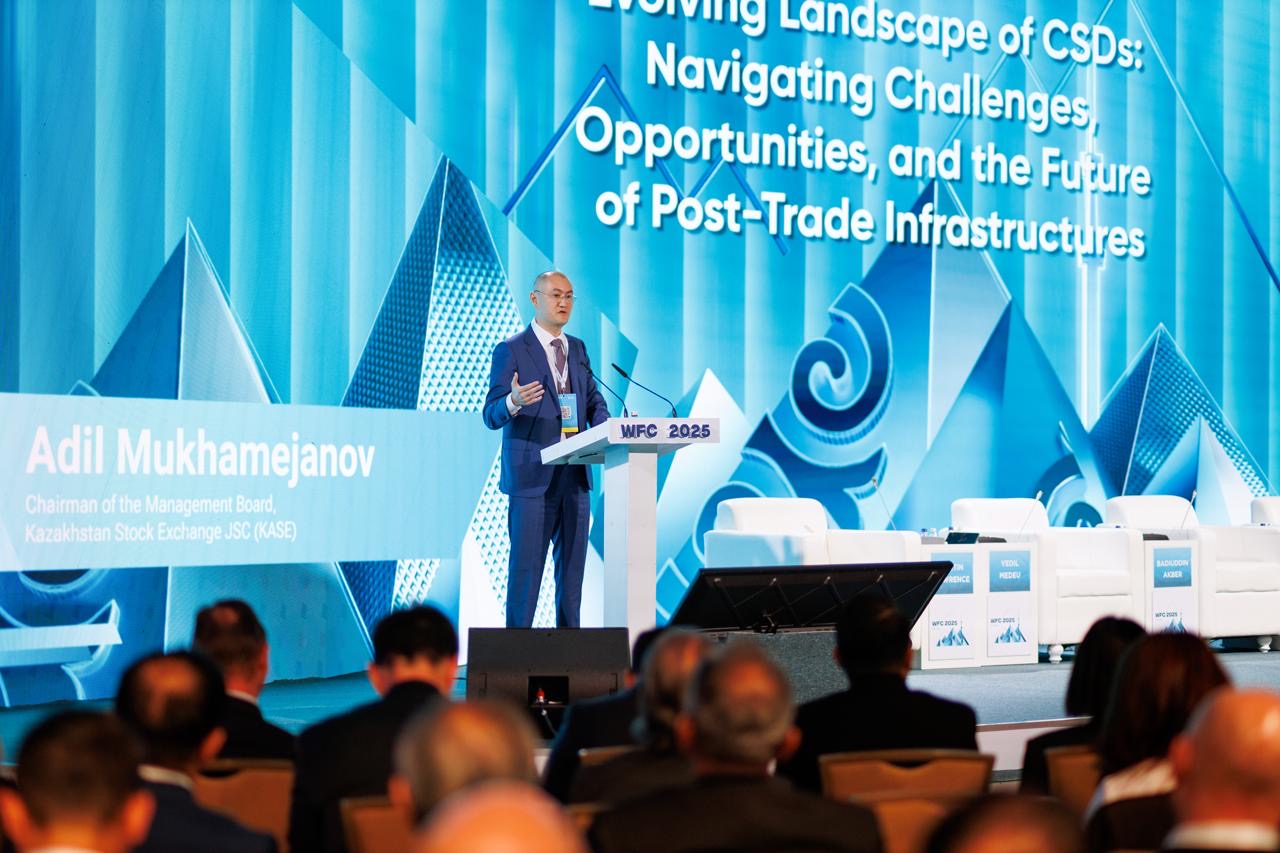
Kazakhstan Stock Exchange (KASE) Chairman Adil Mukhamejanov. Photo credit: WFC2025
Other speakers echoed these themes. Martin Lawrence, chief customer officer at ValueExchange, noted that 76% of firms are still working on T+1 settlement projects.
“We like to think of North American T+1 as being in the rear-view mirror, but it is not – it is still driving significant change, and now Europe and Asia are moving to follow,” he said.
He stressed that T+1 is only a “stepping stone toward atomic settlement,” pointing to two forces reshaping markets: tokenized assets, expected to reach $16 trillion by 2030, and generative AI, with 86% of firms running pilots by next year.
“We must ensure that AI adoption keeps systems resilient and assets safe,” he said.
This year’s WFC theme, The Evolution of Central Securities Depositories: Challenges, Opportunities, and the Future of Post-Trade Infrastructure, highlights regulatory change, settlement efficiency, cybersecurity, AI, blockchain, and global interoperability, with The Astana Times serving as the forum’s media partner.
