
ASTANA – The drive to climb runs deep in human nature, and for some, it does not fade with age. In an interview with The Astana Times, Dina Shabdukarimova reflects on her motivation to climb Khan Tengri, the highest point of the Tien Shan mountain range, and what it takes to conquer such a formidable mountain.
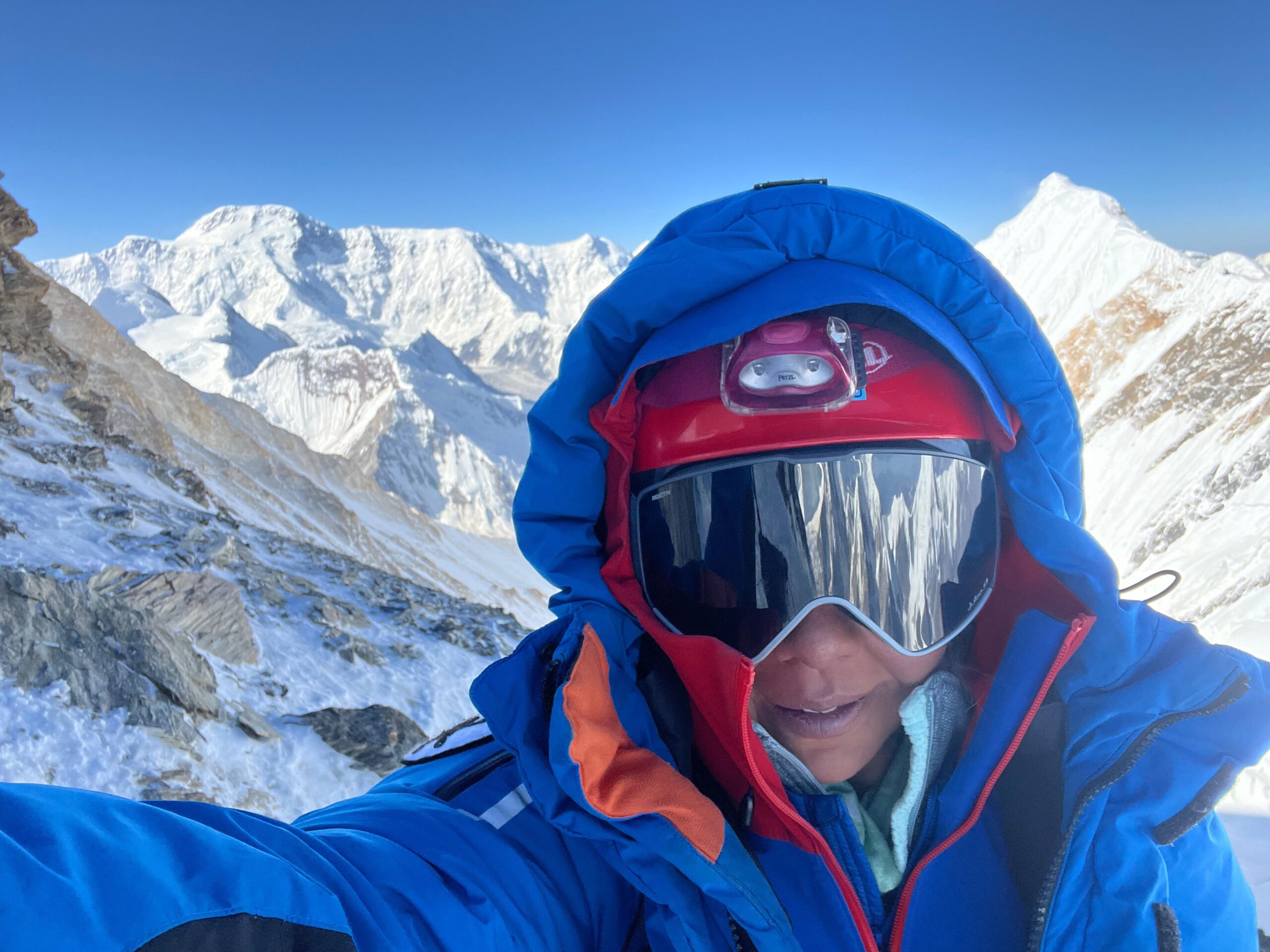
Shabdukarimova on one of the acclimatization outings on Khan Tengri, with the highest point in the Tien Shan, Victory (Pobeda) Peak (7,439 meters), in the background. Photo is the courtesy of Dina Shabdukarimova.
Khan Tengri is a pyramidal peak in the Tian Shan mountain range, located on the border between Kazakhstan and the Kyrgyz Republic. Rising to 6,995 meters or 7,010 meters with the ice cap, it offers awe-inspiring mountain views at every turn. Its name translates from Mongolian as lord of the sky.
Climbing Khan Tengri in August last year was an exhilarating experience for Shabdukarimova – one of the few in her life that has allowed her to see the world from a new perspective.
“I am a native Almaty resident, so naturally, mountain heights are in my blood,” Shabdukarimova said.
“I was actually born when my mom was at a [running] race on Koktobe, and she went into premature labor – a crazy woman, and she gave birth to a daughter just like her,” she said, smiling.
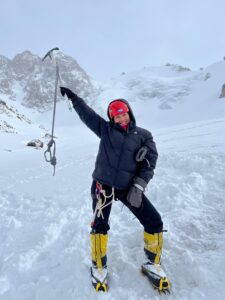
Shabdukarimova on one of her first snowy lesson, where they learned to apply various equipment at the Manshuk Mametova glacier. Photo is the courtesy of Dina Shabdukarimova.
A mechanical engineer by degree, Shabdukarimova worked as a design engineer in the oil industry for many years. After building a successful career, she craved something more. She joined a mountaineering school, not with plans to pursue a new profession but to follow what her heart told.
As part of the mountaineering school, Shabdukarimova visited the North Inylchek base camp located at the north foot of the Khan Tengri. The camp serves as a starting point for ascents to Khan Tengri and other peaks. She said she loved everything about that place: the sky, the stillness, the vast unknown.
“Oh my god, it just blows you away. You arrive there and just cry, cry, cry from happiness, from the monumentality and vastness of these mountains, from how powerful the energy is, from how quickly your mind clears. It’s impossible to put into words, you have to be there,” Shabdukarimova said.
Preparing for the summit: acclimation
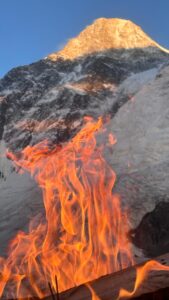
“We were sitting in the Northern Inylchek base camp on one of our rest days, watching the peak at sunset. It was burning at that moment, just like this hot campfire.” Photo is the courtesy of Dina Shabdukarimova.
People may experience the discomfort of altitude sickness once up in the mountains. Symptoms might include headache, nausea, disrupted sleep, and in severe cases, it can lead to brain and lung swelling or even death. Weeks of training and acclimation on the lower levels of the mountain are required to survive the area above 7,000 meters, where the air is particularly thin.
Shabdukarimova said she was among the lucky ones who quickly acclimated to high altitudes. “In general, for me, the altitude starts only at 6,500 [meters]; everything below 6,500, well, I don’t feel anything at all, and I smoke and drink,” she added.
She said she believes her mindset made it easier to adapt to high altitudes. “And here I am at the very beginning of this adventure: I told myself that I wouldn’t have any altitude sickness, and I didn’t have,” Shabdukarimova said.
The climbing
The expedition consisted of 15 climbers and five accompanying guides. The group included people from Poland, Canada, Spain, Italy, Russia, Ukraine, and Belarus.
They climbed in a so-called Himalayan style, which involves setting up multiple camps along the route. Climbers ascend and descend several times to acclimatize before making a final push to the summit. This method is common on very high peaks such as Everest and can take weeks or even months.
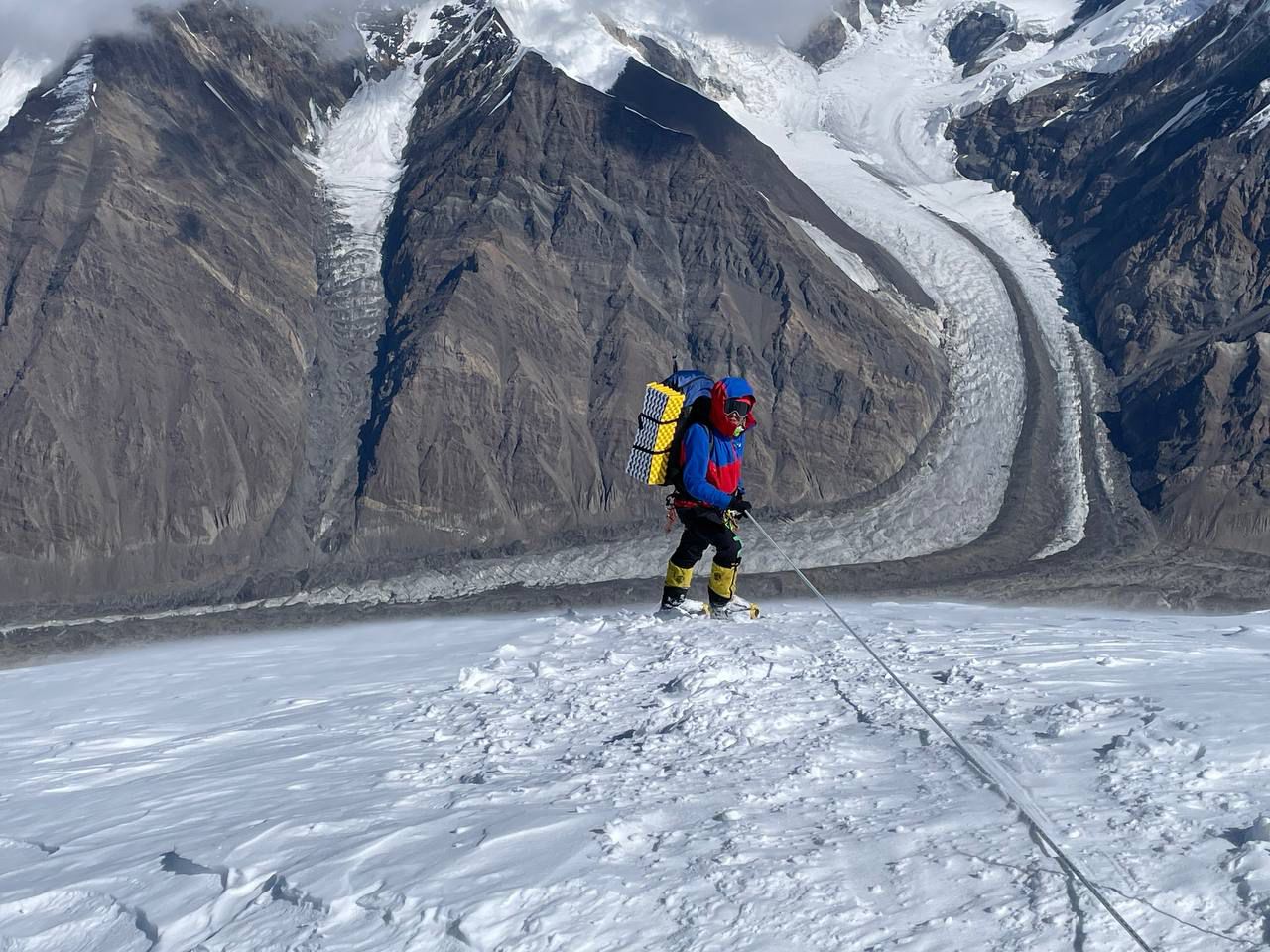
One of the acclimatization outings somewhere under the Khan Tengri. Photo is the courtesy of Dina Shabdukarimova.
Adverse weather conditions had kept them confined to their tents at base camp, ultimately preventing them from completing their mission.
“Our expedition guide devised a very proper plan for acclimatization and ascent. But, unfortunately, we weren’t lucky with the weather. The entire last season, the weather at Khan Tengri was terrible. There were storms, hurricanes, avalanches, snowfalls – constantly bad weather,” Shabdukarimova said.
Finally, clearer weather allowed only three people from the whole group to try the ascent. “I felt great, although the weather was terrible. We set out at midnight to storm the mountain, and we had 12 hours to do it,” she said.
Approaching the peak, more than 6,600 meters above sea level, the scene shifted from calm to heavy wind and snow in what she described as “snowy hell.”
“By the time I reached almost 6,700 meters, the wind was 55-60-65 meters per second. It was such that it knocks you off your feet, meaning you couldn’t stand anymore. For example, I weigh 50 kilograms, plus I had a backpack weighing 10-15 kilograms, so with 70 kilograms, the wind was already too much to stand. I was constantly being tossed around on the rope, so I couldn’t move anymore,” Shabdukarimova said.
Being a single woman to stand near the Khan Tengri peak, just shy of 300 meters, was a powerful moment for Shabdukarimova to realize her strength and the strength of dozens of Kazakh women in alpinism who have yet to discover their full potential.
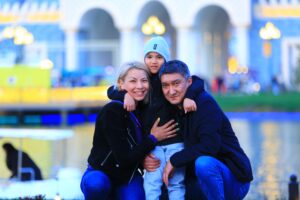
Shabdukarimova with her husband and son. Photo is the courtesy of Dina Shabdukarimova.
“At that moment, it seemed to me that I heard the voice of my little child, he was six years old, and he was in kindergarten at that time. As if he were saying, ‘Mommy, how are you?’ Of course, I must have imagined it all. I was out there for a while, and there are a lot of sounds in general,” Shabdukarimova said.
“But at that time, there was a feeling that someone was watching me. In general, there was a constant feeling that someone was walking behind you. But honestly, it didn’t scare me; I felt very good because I understood that these were the spirits of my fellow alpinists who had died there, and they were just helping me,” she said.
Somehow, Shabdukarimova endured the long, grueling ascent. Weakened by the altitude and the weather, she decided to turn back at the right time. She decided to go down so she could come up again and tell the tale.
“It just so happened that I didn’t reach the summit by 330 meters; I stopped at an altitude of 6,660 meters. I believe that I did the right thing, made the right choice, realized all my possibilities, my strengths,” she said.
“I know that somehow a person knows their limits, and those who claim not to know are just being a bit disingenuous. They tell themselves, ‘I’ll just go, whatever happens.’ So if a person is already telling themselves that they will go no matter what, they know they might die. But they are risking both their lives and the lives of other people who will later have to save them. Not everyone can stop in time,” Shabdukarimova said.
Although she did not reach the top, Shabdukarimova set a precedent for many Kazakh women who had rarely ventured so far. Now, she is preparing to return.
She also aims to become the first Kazakh woman to earn the Snow Leopard title, awarded to climbers who summit all five 7,000-meter peaks of the Pamirs and Tien Shan.
Witnessing death
Alongside the unparalleled passion to summit the highest peaks, many people have died. Shabdukarimova’s group also witnessed the fall of a climber.
“When we went on an expedition, four people died. (…) I later returned there for rescue operations. But, honestly, at that moment, when you’re on your expedition, you… I don’t know how others might feel, but you don’t care, to the point that you don’t react the way you should, the way people are used to reacting to death,” Shabdukarimova said.
“There, every drop of strength is vital; you need to go up, then go down. And yes, you see that the person is dead, but you understand that you are alone right now and can’t do anything. In the mountains, the higher you go, the more people you need to bring down the body of one injured person. That is, for one injured person, you need 10 strong, healthy, rested men,” she said.
For some people, the experience is so strong that they are willing to endure suffering for that inhuman place—even to the point of losing everything.
“And these glassy eyes, they’re terrifying. I saw four people like that at the Khan, and two of them died. It’s when a person, a climber, walks past you looking at that peak with glassy eyes, and they absolutely don’t care if they come back. They just want to go there; they only see the peak,” said Shabdukarimova.
What is it all for?
Each alpinist, once in a while, thinks of reasons for this constant pursuit of verticality. When asked why she wants to endure all the hardships, Shabdukarimova said the answer is still unclear. Probably, what unites people with this passion is an almost pathological urge to climb for climbing’s sake and the feeling of unity in the most dangerous situations.
“In mountaineering, there is a concept called ‘a rope team.’ It’s when you’re connected through one harness; it’s like a net, you put it on and tie the rope into it. And essentially, that’s all that holds our lives together. I hold your life, and you hold mine, and we are trudging somewhere for something. I don’t even know why. In this snowy hell: icy, rocky, cold, windy,” Shabdukarimova said.
“And what’s the point of all this? It’s just unclear; I can’t even answer this for myself, even for a second,” she concluded.
Now Shabdukarimova works as a mountain guide and leads a mountaineering club.
