
ASTANA – This year, Kazakhstan commemorates 210 years since the birth of Tattimbet Kazangapuly and 205 years since the birth of Dauletkerey Shygaiuly – the leading figures of two separate kui (musical compositions on dombra) genres performed on dombra: tokpe kui and shertpe kui.
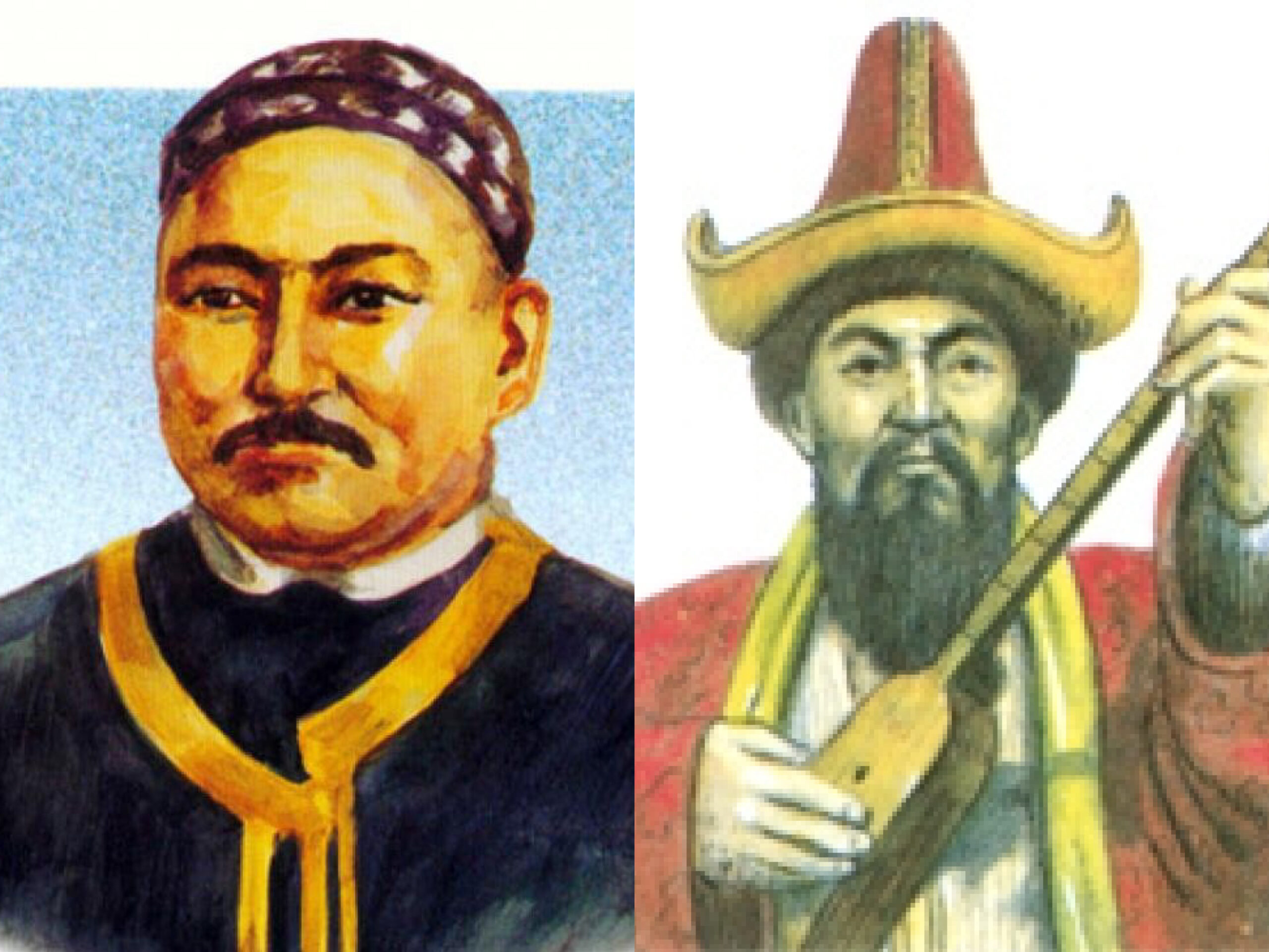
(l-R) Tattimbet Kazangapuly, Dauletkerey Shygaiuly. Photo credit; E-history.kz
Tattimbet was a master of the shertpe kui style, known for its lyrical melodies often played on two alternating strings. Dauletkerey, on the contrary, embraced a more rhythmic, energetic and upbeat tokpe kui genre. Tokpe kuis are traditionally performed in western Kazakhstan, while shertpe kuis are more prevalent in the central and southern regions of the country.
The 19th century was a turbulent time for Kazakh society, marked by Russian colonization, the abolition of the khan rule, and reforms that disrupted traditional structures and provoked mass resistance. Amid this upheaval, great musicians and thinkers emerged; among them are Tattimbet and Dauletkerey, whose works reflected resilience and feelings of the people.
Tattimbet – the master of shertpe kui
Born in 1815, Tattimbet came from a distinguished heritage. Among his ancestors and relatives were well-known figures of the Kazakh steppe: political and public figures, judges, warriors, singers, and musicians. The atmosphere of his immediate family and environment played a key role in shaping his character, values, and worldview as a future composer.
From a young age, Tattimbet established himself as a mature kuishi (performer of kuis) with an extensive repertoire. Surrounded by many prominent people of that time, Tattimbet was known for his originality, talent, charm, refined taste, sharp wit, and aristocratic demeanor. As a bright and original seré (singer and improviser), the young man created a festive mood wherever he appeared and was the people’s favorite.
Tattimbet composed over 40 kuis, each marked by its own distinct theme.
Despite the apparent simplicity of shertpe kui, the musical language of Tattimbet’s compositions is based on individual, distinctive means of expression and reveals the complexity of his unique performance style. The pinnacle of his work is the kui “Kokeykesti” (Pressing), written in his later years. It became a profound reflection of the Kazakh people’s spiritual depth and artistic heritage.
In 1855, Tattimbet represented Kazakh musical art at the coronation of Alexander II in St. Petersburg, captivating audiences with his dombra performance and earning a silver medal. His music was deeply inspired by the natural beauty of his homeland, the vast and poetic steppes of Saryarka.
Dauletkerey – the master of tokpe kui
Dauletkerey was born in 1820 in western Kazakhstan into a noble family. His father, Shuga, was a sultan of the Bokey Horde, fluent in Russian and deeply interested in Russian culture. From an early age, Dauletkerey was taught the principles of leadership and justice. He initially tried to govern local clans, but his sensitive nature soon led him to see how power could harden the human spirit.
One of the most educated figures of his time, Dauletkerey received a classical Muslim education and was fluent in Arabic and Farsi, which drew him toward refined, expressive chamber music.
“In terms of the number of innovations in Kazakh music, Dauletkerey is rightly compared to Abai. The novelty and freshness of his music were largely determined by the foreign cultural influences that we find in his kuis from different periods. Rhythmic-intonational complexes of European genres and echoes of Turkmen music are just a small part of what can be noticed in his kui even with the ‘naked eye,’” wrote musicologists Rena Zhumanova and Tikhon Maksimchev in their article in the Spiritual Values journal.
He left a rich and diverse legacy of around 40 kuis. One of Dauletkerey’s notable kuis is “Kerogly” (in Turkic, Koroglu translates to son of the blind man), composed during his visit to the Turkmen steppes. Inspired by the “Koroglu” epic, it is a story celebrated across the Middle East and Central Asia.
A common comparison in Kazakh musical history is the contrast between Dauletkerey’s introspective style and the bold, heroic spirit of his contemporary Kurmangazy Sagyrbaiuly. The extroverted rebel Kurmangazy and the thoughtful aristocrat Dauletkerey represent two distinct yet equally powerful expressions of western Kazakhstan’s tokpe tradition.
