
When we think of Astana, the first thing that comes to mind is the high-level visits of politicians and international summits. It’s a city of strategy, diplomacy, and national ambition. But beneath that polished, political surface lies something quieter — yet just as powerful: a city that creates space for dreams. As Astana celebrates its birthday on July 6, we take a closer look at the people who shape the city’s creative soul — artists, thinkers, and quiet visionaries who prove that this capital is more than glass and steel.
This is the third part of the series.
ASTANA — Looking for the next voice in this story of Astana’s creative spirit, I didn’t have to go far. Sometimes, the most compelling stories are just across the newsroom. Aibarshyn Akhmetkali, journalist, theater guide, and quietly fierce creative, is one of those people who makes you realize the city is not just a place to live, but a space where becoming happens.

Photo illustration created by Fatima Kemelova.
Originally from Almaty, she associates that city with her childhood. “Almaty will always be where I come from. Where my childhood memories live.” But it’s Astana, she said, that became the city of her adulthood, her choices, her growth, and her creative awakening. She came here as a university student, studying economics, but something in her always leaned toward literature, the arts, and stories.
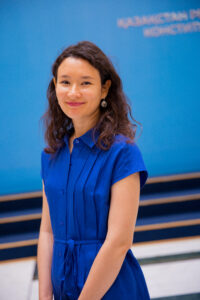
Aibarshyn Akhmetkali. Photo courtesy of the author
“While I was at Nazarbayev University, I took literature classes on the side. I liked them. But I didn’t fully accept that side of myself back then. I still thought I needed to ‘do the responsible thing,’” she said.
After graduation, she took a job in auditing. It was practical. Stable. Sensible. But it also nearly crushed her.
“In just two years, that job showed me everything I wasn’t. I hit a wall. It was very clear I had to change something,” Akhmetkali said.
And she did. She made a sharp pivot, first into journalism and then into more expansive creative spaces. But the leap wasn’t part of a master plan. It was a quiet shift, one small brave choice at a time.
“When I joined The Astana Times, I didn’t expect to stay. But it turned out to be the thread that led me where I needed to go. I started to feel that I love to write. And now, I say it confidently: I do love it. And that’s where I began to discover my voice and the paths where I could express it,” she said.
But her creativity doesn’t stop at the written word. On weekends, she moonlights as a guide in the Theater Guide project, taking audiences behind the curtains of Astana’s theaters, not just literally but emotionally.
“I talk to people about theater, how it works, what happens backstage, how to interpret what we see in ballet and opera. It’s my other voice, the spoken one. That role made me fall in love with the city in a new way. You can’t guide others through a place unless you truly know it. Or love it,” Akhmetkali said.
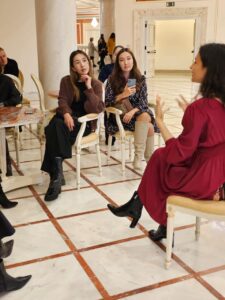
Theater and public speaking have always been among Akhmetkali’s passions, leading her to take on the role of a theater guide. Photo courtesy of the author
She added, “Just listen to any guide — you’ll know instantly whether they love the city they’re speaking about. Their eyes give them away.”
Astana’s youth, its very lack of centuries-old theaters or baroque façades, might be seen by some as a creative disadvantage. But to Akhmetkali, it’s an invitation.
“In Europe or Russia, theaters are steeped in history. In Astana, many are barely 15 years old. But look at what’s been created in that short time, it’s incredible. I’ve seen it up close. I’ve met the people who work behind the scenes, and their dedication and craft are truly impressive. They’ve woven their labor into the soul of the city. And I got to witness that,” she said.
And just as she witnessed the city being built, quietly, the city was also watching her.
“I think the city became a witness to my becoming. I associate it with growth: personal, professional, even spiritual. It gave me a kind of inner freedom. I became an adult here. A woman. A writer. A speaker. Someone who’s learning how to stand fully in who she is,” Akhmetkali shared.
That sense of freedom, she explained, is also physically embedded in the geography itself.
“When I first came here, my university felt like it was on the edge of the world. My dorm room window looked out onto nothing but an endless field. And sunset. And wind. You could feel the steppe, you could feel space. In winter, the wind would howl against the walls, but something was grounding in that vastness,” she recalled.
“Even now, when the city is more developed, that sense of openness of wild, empty beauty still lingers. And that… that does something to a person,” she added.
Astana has its critics, let’s be honest, people who say it was built too quickly, or lacks a soul. But Akhmetkali disagrees.
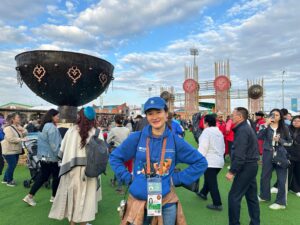
Field-work at the fifth World Nomad Games in 2024. Photo courtesy of the author
“If you only look at what’s on the surface, yes, you’ll see a lot of glass and steel. But that’s not the whole story. Some buildings here carry genuine love and effort. You can feel it. This city doesn’t hand you its soul on a platter; you have to dig a little. But once you do, there’s so much to find,” she said.
She’s found it in the people, too.
“I stayed here after graduation because of the people. That’s what makes a city. What I love about Astana is that it’s filled with people from every corner of Kazakhstan — from the south, north, east, and west. Everyone brings something. And somehow, it all fits,” she said.
When I asked about her future, Akhmetkali reflected on it with honesty. She’s not sure if she’ll stay forever. Almaty still calls to her, too. But she doesn’t speak of leaving as an escape — more as a continuation.
“I’m curious what it would be like to live in Almaty now as the person I’ve become. But even if I go, Astana will always be where I grew up, creatively and emotionally. It was my beginning,” she said.
The city, she says, has only just begun as well. “Astana is still an embryo. Everything is ahead,” she said. And then she concluded with something I want to leave untouched, exactly as she put it, because maybe it’s the most accurate portrait of this city so far:
“But I think wherever you live in Kazakhstan, maybe even in the world, if you come to Astana, you will definitely find your community, your place in life, your home. So I think for anyone who knows how to find something meaningful in any city, Astana definitely won’t disappoint. It’s open to everyone.”
P.S.
Astana is a city of wind, wide skies, and quiet strength. It doesn’t hand you beauty — you carve it out. But in doing so, you become part of its story. For some, it’s a place to begin again. For others, a space to build, create, and grow. It may not offer centuries of history, but it offers something else: a future, unwritten, still warm in your hands.
That’s why the city feels alive. Because it doesn’t just house our dreams, it shares them. It watches us grow. It dares us to keep going. And it believes in what we’re becoming, even when we don’t yet.
This is the city we love.
The city that made us believe we can be more than we are.
The city that dreams with us.
Editor’s note: In the first story of our Astana: City That Dreams With Us series, we met Kuralay Yeshmuratova — a legendary puppeteer whose faith in children, art, and the spirit of the city helped shape a cultural home in Astana. In the second, we followed designer Natalya Zamyatina, whose atelier offers not just fashion, but healing and hope.
