
ASTANA – Kazakh films are gaining a growing audience across Central Asia, as the country’s film industry builds on a preserved production base and a new generation of trained professionals to secure a place on the global cinematic map.
According to Kazakhstan’s Ministry of Culture and Information, domestic films earned more than 22 billion tenge ($42.5 million) at the box office in 2024. In November 2025, the Kazakh film Auru, which explores large-scale fraud schemes, led the national box office despite a 21+ age rating.
Professionalism sets Kazakhstan apart
The Central Asian film market remains a challenging environment, where traditional social norms and deference to authority often shape creative expression. Kazakh filmmakers felt this pressure most strongly in the 1990s and early 2000s, when directors were criticized for presenting images of the country that differed from official narratives.
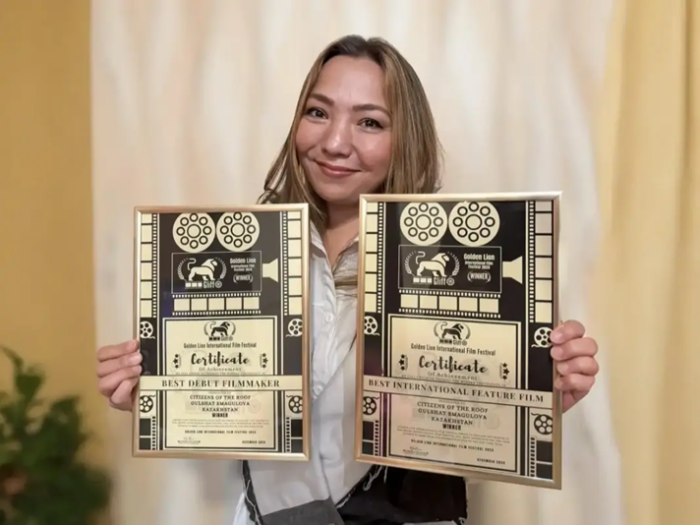
Gulshat Smagulova director of “Citizens of the Roof” movie, which won two awards at the 2024 Golden Lion International Film Festival. Photo credit: Smagulova’s Instagram page
Over time, however, independent Kazakh cinema gained wider acceptance. Contemporary films increasingly feature morally complex characters and tackle difficult social themes. Local audiences have become more receptive, even as directors continue to defend their artistic freedom.
“In Tajikistan, Kazakh cinema is well known. It may not yet be mainstream, but professionals closely follow developments in Kazakhstan’s film industry,” said Sanоat Azizova, a Tajik film scholar.
According to Azizova, Kazakhstan’s key advantage lies in its ability to build not just young cinema, but young professional cinema.
“Cinema is a profession, and without training, it is difficult to achieve quality. Amateur films quickly reveal gaps. Professionals think frame by frame, the director sees the film in advance, and the editor conveys that vision. Kazakhstan has managed to establish this kind of professional production,” she said.
She noted that while professional filmmaking remains uneven across Central Asia, the Kyrgyz Republic and Uzbekistan have also made progress.
“Kazakhstan sets the highest bar. Cinema is a collective art, and it succeeds only when every element is professional. Even a talented director cannot create a strong film alone,” Azizova said.
Kazakhstan’s presence is also notable at international festivals. Azizova cited Gulshat Smagulova’s debut feature “Citizens of the Roof,” screened recently in Dushanbe, as a standout.
“The way she approached a social theme was both unconventional and deeply classical. It was very powerful,” she said.
What audiences watch: from comedy to crime
Interest in Kazakh films is also reflected in streaming data, according to Elena Brodskaya, director of international content development at Yandex. She said Kazakh films perform particularly well in the Kyrgyz Republic and Uzbekistan.

“Darling, You Won’t Believe It” film poster. Photo credit: kinopoisk.ru
“In these countries, lighter genres such as comedy are in high demand. Projects such as “Zamanback” and “Taptym-au seni” resonate especially well in Uzbekistan,” Brodskaya said.
Kazakh films are also attracting audiences in Russia, where crime dramas and socially grounded stories perform strongly.
“Metrics show that Russian viewers generate a large share of views for Kazakh films,” Brodskaya said, noting that comedies are less transferable due to language and local humor.
Streaming platforms are testing Kazakh and Central Asian content in more distant markets as well.
“I showed Arab colleagues the Kyrgyz film “Paradise Under the Feet of Mothers.” Its shared cultural themes, such as faith, pilgrimage and collective experience, struck a strong emotional chord. Projects rooted in universal human values can resonate far beyond the region,” she said.
In Uzbekistan, experts confirm the popularity of Kazakh comedies, particularly the “Kelinka Sabina” franchise. Over time, attention has expanded to more experimental works by the ArtDealers collective.
Films such as “Darling, You Won’t Believe It” and “Die, But Remember” stand out for their unconventional style and dark humor, blending elements of slasher films and post-irony, said Uzbek screenwriter and film scholar Elmira Khasanova.
She also highlighted the work of director Adilkhan Yerzhanov, including “The Gentle Indifference of the World” and “Goliath,” which combine neo-noir aesthetics with Western and mythological elements.
Not all observers agree that Kazakh cinema has reached a broad audience everywhere. Uzbek journalist and screenwriter Muyassar Maksudova noted that awareness remains limited among the general public, citing a shortage of cinemas and film critics.
A strong connection in the Kyrgyz Republic
In the Kyrgyz Republic, however, Kazakh cinema enjoys strong recognition. According to Kyrgyz film scholar and director Sultan Usunvaliyev, audiences easily relate to Kazakh stories because of shared values and social realities.
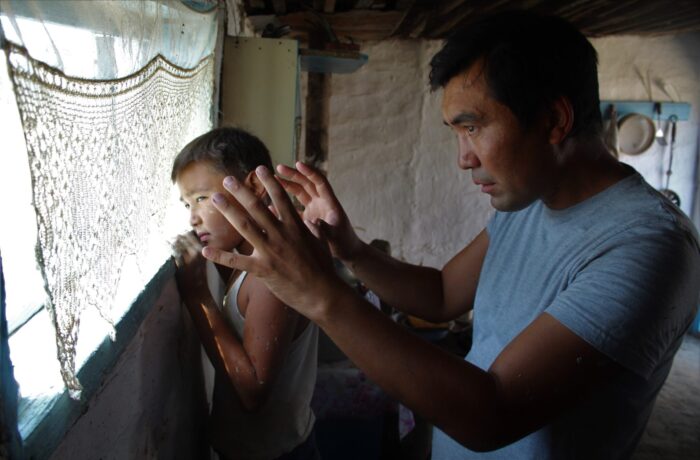
Director Askhat Kuchinchirekov worked for three years on his debut film “Bauyryna Salu”, starring Yersultan Yermakov. Photo credit: kazakhcinema.kz.
“These stories reflect common problems, everyday relationships, comedy and tragedy. They require no explanation for us,” he said.
He highlighted films such as “Bauyryna salu” by Askhat Kuchincherekov and “Abel” by Yelzat Yeskendir as particularly resonant films.
Usunvaliyev said Kazakh cinema’s responsiveness to contemporary realities is its greatest strength, even as filmmakers across Central Asia face long-term creative and structural challenges.
The article was originally published in Tengrinews.
