
ALMATY – Kazakhstan’s Deputy Prime Minister and Minister of Artificial Intelligence and Digital Development Zhaslan Madiyev has joined the newly established AI for Good Global Commission, a high-level international body created by the International Telecommunication Union (ITU) to shape practical approaches to the development and governance of artificial intelligence.
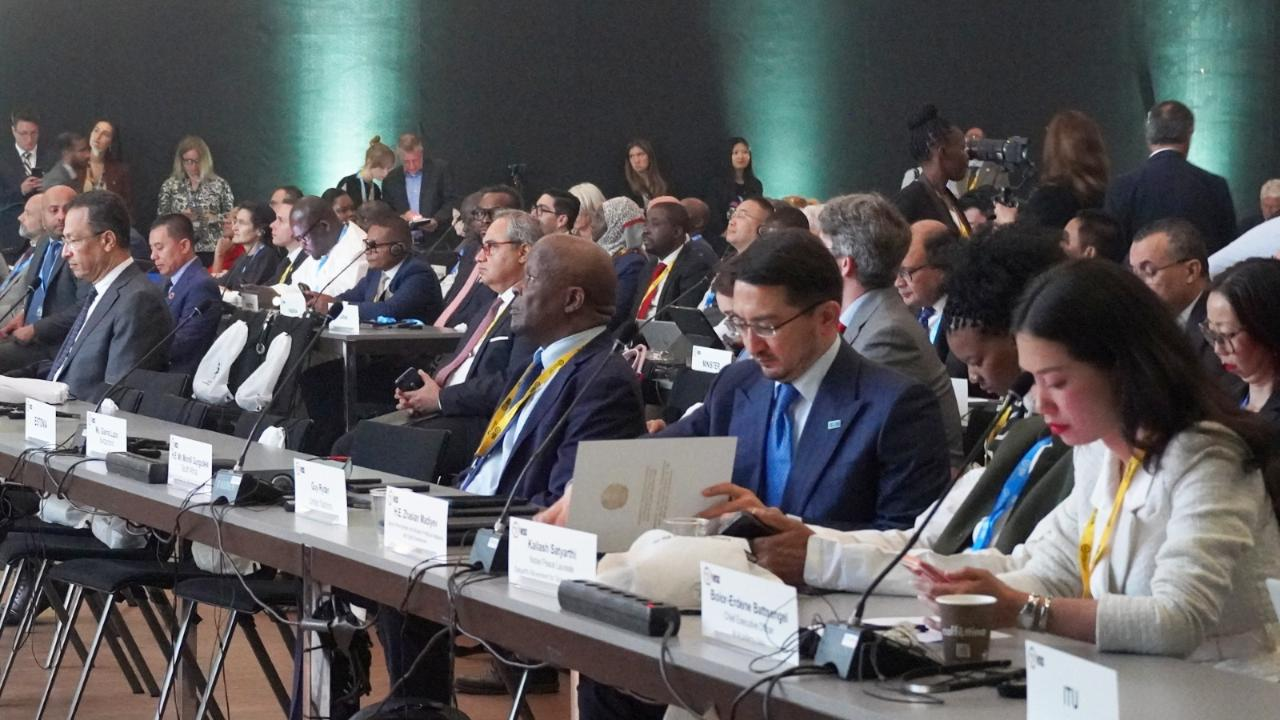
Kazakhstan’s Deputy Prime Minister and Minister of Artificial Intelligence and Digital Development Zhaslan Madiyev has joined the newly established AI for Good Global Commission. Photo credit: Ministry of AI and Digital Development.
Madiyev joined the commission at the invitation of the ITU, becoming one of its founding members. The commission brings together more than 40 heads of state, leaders of international organizations, and executives from some of the world’s largest technology companies, reported the ministry’s press service on July 8.
The commission is co-chaired by Rwandan President Paul Kagame and Marc Benioff, founder and chief executive officer of Salesforce, while Secretary-General of the ITU Doreen Bogdan-Martin serves as deputy chair.
Other members include Estonian President Alar Karis, Icelandic President Halla Tómasdóttir, Estonian President Alar Karis, Icelandic President Halla Tómasdóttir, Microsoft President Brad Smith, NVIDIA Founder and CEO Jensen Huang, Amazon CEO Andy Jassy, World Trade Organization Director-General Ngozi Okonjo-Iweala, and other global leaders.
The commission held its inaugural meeting on July 8 during the AI for Good Global Summit in Geneva. Participants discussed international cooperation on AI, the development of trustworthy AI, efforts to reduce the digital divide, and expanding access to advanced technologies.
According to the ministry, Kazakhstan’s participation in the commission reflects the country’s growing role in shaping the global agenda on artificial intelligence. The commission is expected to serve as a platform for developing practical solutions to promote trusted AI, narrow digital inequalities, and expand countries’ access to emerging technologies.
