
ASTANA – President Kassym-Jomart Tokayev’s recent visit to Brussels was a reinforcement of Kazakhstan’s strategic partnership with the European Union, EU Ambassador to Kazakhstan Aleška Simkić told journalists on July 3. She pointed to continued cooperation on transport, critical raw materials, digitalization, trade, education and people-to-people ties.
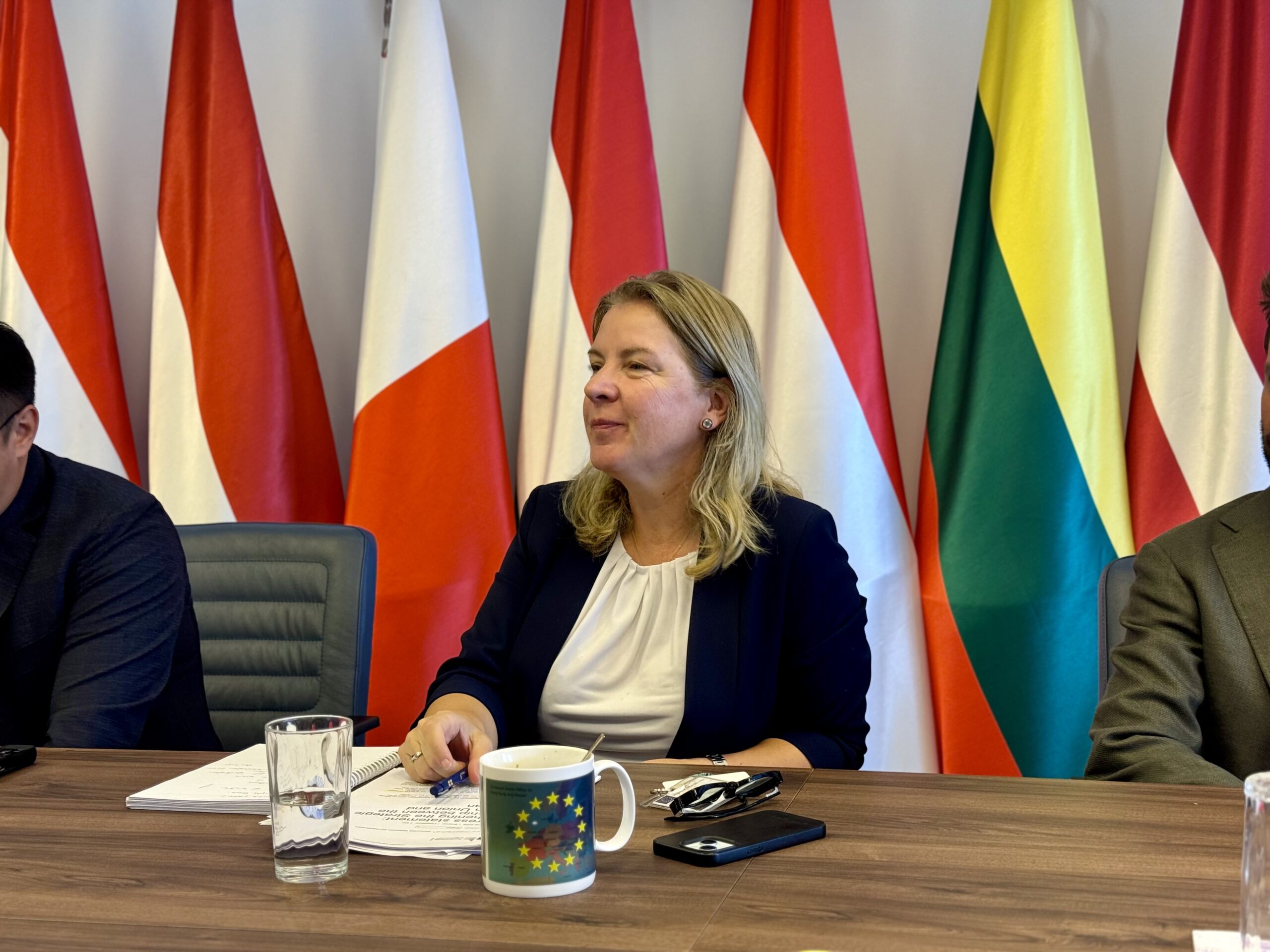
EU Ambassador to Kazakhstan Aleška Simkić. Photo credit: The Astana Times/ Assel Satubaldina
“President Tokayev also met with businesses that are very interested in working in Kazakhstan. It was a very successful meeting. Most of those participated in the business roundtable were companies that already work or already have signed some agreements with Kazakhstan,” she told journalists during a briefing at the EU Delegation building in Astana.
Visa facilitation and readmission agreement
On visa facilitation and readmission agreement, she said there is no fixed timeline yet, as the process still needs approval and confirmation on the EU side. Simkić said she hoped it would happen “sooner rather than later,” but cautioned that EU procedures could take several months.
“Now it [the agreement] has to go back to the member states of the European Union. They are the ones who are competent for visa issuing. It is not the commission. The commission was just given the mandate to negotiate the basic visa facilitation agreement. It has to go back to them [member states] for them to approve it and to confirm it,” she explained, addressing a visa issue that remains of strong interest to Kazakh journalists and the wider public.
“It is very difficult for me to talk about the timeline, because it is not in our hands,” said Simkić.
When entered into force, Simkić said the general visa application procedure would remain in place, meaning Kazakh citizens would still need to apply for a visa through the embassy of the EU country where they plan to spend most of their time.
“What will be easier is the timeline should be shorter, the cost should be lower. The documents that you have to provide will be equal no matter which embassy you ask for the visa,” she added.
She also noted the agreement would create more opportunities for applicants to receive multiple-entry visas as part of the so-called cascade system. Under this system, applicants who first receive a shorter-term visa may have a better chance of obtaining a longer-term visa in future applications.
Laboratory for critical raw materials
Critical raw materials remain a strategic area of cooperation between Kazakhstan and the EU, with one of the key agreements focused on the planned construction of a laboratory for critical raw materials in Kazakhstan.
In Brussels, the European Bank for Reconstruction and Development and the Kazakh government concluded a memorandum of understanding to support the feasibility study aimed at building an internationally accredited chemical-analytical laboratory for critical raw materials in Astana. Simkić noted this initiative was first voiced by President Tokayev during the EU-Central Asia Summit in Samarkand in April 2025.
These kinds of chemical and analytical laboratories play a key role in testing substances, including critical raw materials, to ensure their safety and quality.
“The idea is not only to extract critically important raw materials, but properly analyze them here in Kazakhstan. What was signed in Brussels was with the EBRD and the French company Bureau Veritas, which will do a feasibility study about how and where to build this particular laboratory,” Simkić said.
Deal with Airbus
Another major outcome of the visit was an agreement with Airbus, which Simkić described as one of the most economically significant deals reached during the visit.
The deal was made between Kazakhstan’s Air Astana and Airbus and represents the largest direct aircraft order in the nation’s history.
Valued at more than seven billion euros (US$8 billion), the order covers up to 50 Airbus A320neo Family aircraft, including 25 firm orders and 25 purchase options, according to Samruk Kazyna Sovereign Wealth Fund, which owns a 41% stake in Air Astana.
Upgrade of the Kazakh roads
Under the EU’s Global Gateway initiative, the European Investment Bank will provide a 150 million euro (US$171.8 million) framework loan to Kazakhstan’s national road operator QazAvtoZhol aimed at upgrading the road infrastructure.
“It is very important for the Trans-Caspian Transport Corridor. They identified which roads are important, mostly they are in the southwestern part of Kazakhstan, meaning linking other Central Asian countries on the Trans-Caspian route,” said the ambassador.
The upgrade will cover roughly 1,370 kilometres of roads across central and southern Kazakhstan, according to the EIB.
Aviation agreement
The signing of a horizontal aviation agreement, whose negotiations lasted for more than 15 years, is one of the key outcomes of the visit. Aimed at improving air connectivity between the two sides, the agreement allows any eligible EU airline to operate flights between Kazakhstan and the 17 EU member states that do already have bilateral air services agreements with Kazakhstan permitting such services.
Austria, Belgium, Bulgaria, Cyprus, Czech Republic, Germany, Denmark, Estonia, Finland, France, Hungary, Lithuania, Luxembourg, Latvia, the Netherlands, Poland, and Sweden already have bilateral air services arrangements with Kazakhstan and will be covered by this horizontal aviation agreement.
Building on momentum
Simkić said the main message of Tokayev’s Brussels visit was that it built on recent high-level engagement between Kazakhstan and the EU, including European Council President António Costa’s visit to Kazakhstan in December and visits by several European leaders over the past year.
Simkić said European Commission President Ursula von der Leyen is not expected to visit Kazakhstan this year, but noted that President Tokayev has repeatedly invited her to the country. The last visit by a European Commission president to Kazakhstan took place in 2012, when José Manuel Barroso held the post, she said, adding that “it is about time” for another such visit.
