
ASTANA – President Kassym-Jomart Tokayev held talks with European Council President António Costa and European Commission President Ursula von der Leyen on June 23, focusing on strengthening Kazakhstan-EU strategic partnership in trade, investment, transport connectivity, and energy cooperation.
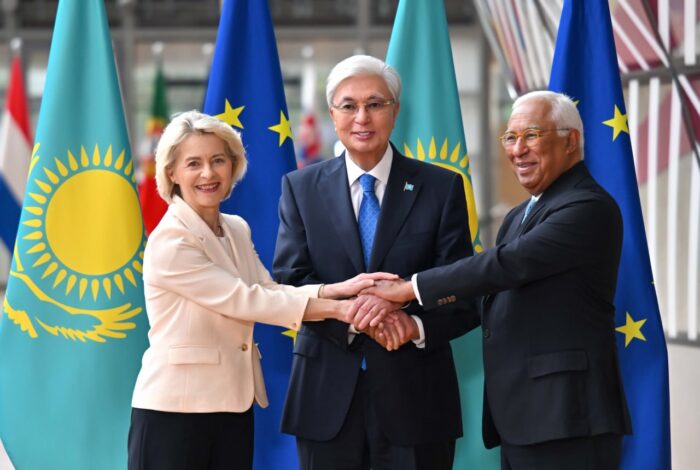
European Commission President Ursula von der Leyen, President Kassym-Jomart Tokayev, and European Council President António Costa in Brussels. Photo credit: Akorda.
The meeting covered key areas including critical raw materials, transport and logistics, digital transformation, energy cooperation, and climate policy. The officials also reviewed prospects for expanding cooperation under the Enhanced Partnership and Cooperation Agreement (EPCA) and the EU’s Global Gateway strategy.
Tokayev emphasized Kazakhstan’s role as a reliable partner to the European Union and underlined the importance of maintaining strong political dialogue and expanding economic engagement, Akorda reported.
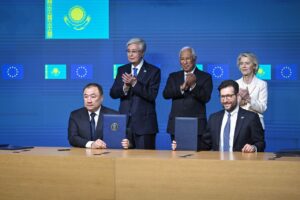
Officials attend a signing ceremony of bilateral agreements between Kazakhstan and the European Union in Brussels. Photo credit: Akorda.
“Our relations, based on mutual trust and respect, have acquired a truly strategic character. I came to Brussels with a clear goal: to deepen our multifaceted cooperation in all areas of mutual interest,” he said.
European leaders highlighted Kazakhstan’s strategic position as a link between Europe and Asia and reaffirmed the EU’s interest in deepening cooperation in connectivity, innovation, and sustainable development.
Joint statement
Following the talks, the officials adopted a joint statement reaffirming the strategic nature of Kazakhstan-EU relations and their commitment to expanding cooperation across multiple sectors.
Both sides stressed the importance of transport connectivity, energy security, and resilient supply chains, and confirmed continued cooperation under the EPCA framework.
They reaffirmed the EU’s position as Kazakhstan’s leading trade and investment partner. They agreed to improve the investment climate while expanding cooperation in critical raw materials, energy, transport, digitalization, and new technologies.
The statement highlighted the strategic role of the Trans-Caspian International Transport Route, known as the Middle Corridor, and welcomed progress in transport connectivity under the Global Gateway initiative.
The leaders also welcomed the forthcoming conclusion of negotiations on visa facilitation and readmission agreements, as well as the signing of a horizontal aviation agreement, to strengthen mobility and people-to-people contacts.
Cooperation in critical raw materials, batteries, and green hydrogen value chains was reaffirmed, alongside the energy partnership, including Kazakhstan’s role as a key supplier of oil and uranium to the EU, as well as prospects for renewable energy and nuclear cooperation.
They welcomed strengthened engagement with the European Investment Bank (EIB) and the European Bank for Reconstruction and Development (EBRD), including new financing for transport connectivity and laboratory infrastructure in Kazakhstan. The Air Astana-Airbus agreement for up to 50 aircraft was also noted as a major example of economic cooperation.
The officials reaffirmed their commitment to climate action, green transition, and expanded cooperation in education, research, and innovation under Erasmus+ and Horizon Europe.
The EU also welcomed Kazakhstan’s ongoing political reforms and continued dialogue on governance, rule of law, and anti-corruption.
The statement underlined shared commitment to international peace, multilateralism, and nuclear non-proliferation. It noted support for regional cooperation in Central Asia following the elevation of Central Asia-EU relations to a strategic partnership.
In the presence of officials, a signing ceremony was held for five agreements, including cooperation on air services, an order of up to 50 Airbus aircraft for Air Astana, transport digitalization projects with the EBRD, EIB financing for road rehabilitation along the Middle Corridor, and a feasibility study for a center of excellence in minerals and metals.
