
ASTANA – As Kazakhstan pushes to become a regional aviation hub, Airbus is deepening its presence across multiple sectors, from passenger aircraft to military transport and space technology.

Roman Blachshishin, head of Airbus in Kazakhstan. Photo credit: The Astana Times
Speaking with The Astana Times on the sidelines of the Central Asia Aviation Summit in the capital last week, Roman Blachshishin, head of Airbus in Kazakhstan, said the country has become a strategic market for the European manufacturer.
Solid presence
Airbus boasts a robust presence in Kazakhstan. According to the company’s data, in commercial aviation alone, around 60 Airbus aircraft are in service, operated primarily by Air Astana and its low-cost carrier FlyArystan. The group’s recent agreement for additional A320neo family jets would add to an existing backlog of 25 aircraft.
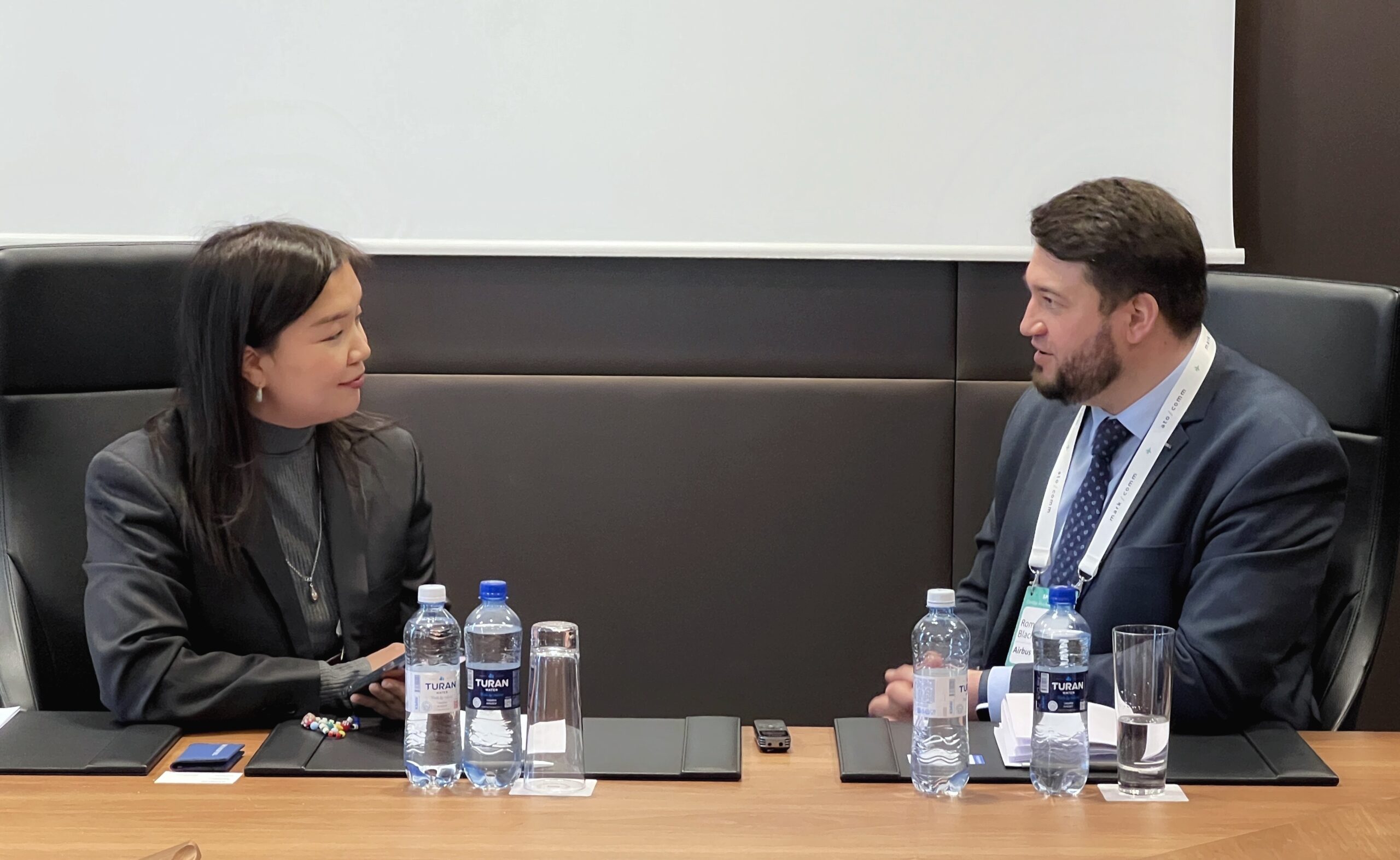
Roman Blachshishin and Assel Satubaldina during a conversation. Photo credit: The Astana Times
In defense and space, Kazakhstan operates 13 Airbus aircraft, including one A400M and 12 C295 aircraft, alongside two satellites currently in orbit. Airbus Helicopters, meanwhile, has roughly 60 aircraft in service across the country.
In commercial aviation, Airbus aircraft continue to gain ground, underscored by recent orders from Air Astana and broader fleet growth in the country.
Airbus has also built a long-term partnership in the helicopter sector, including a joint venture with Kazakhstan Engineering established to support Kazakhstan’s efforts to improve emergency medical services.
“What we offered was not just the helicopter, but to develop the helicopter ecosystem. That’s why the joint venture was created to support maintenance and training needs, and it is now here in Astana,” Blachshishin said.
A similar model has been applied in space technology. Airbus helped establish a satellite joint venture in the capital, providing training to local specialists.
“It was created in order to provide Kazakhstan with knowledge and skills. Moreover, Airbus used to be selected as a partner to develop the so-called local space infrastructure. Here we speak about the satellite assembly integration test center,” Blachshishin said.
“Right now, Ghalam, our joint venture [with Kazakhstan Garysh Sapary], is actually developing on its own a new satellite program of Kazakhstan, which is called KazEOSat-MR. It is a medium-resolution Earth observation satellite. They are going to assemble and test them in this new facility,” he said.
Partnership with Air Astana
The growth of Kazakhstan’s aviation market reflects both rising domestic demand and a broader ambition to position the country as a regional hub.
“Kazakhstan has a target to reach, I believe, 26 million passengers in Kazakhstan. You can do this, obviously, should you have more aircraft,” he said.
At the same time, Air Astana is increasingly leveraging its geographic position “at the heart of Eurasia” to connect long-haul destinations. In March, the company announced its large-scale fleet modernization following the signing of a memorandum of understanding for up to 50 A320neo family aircraft, including 25 firm orders and 25 purchase options, in what would become the largest deal in its history and a key step in its fleet modernization strategy.
A320 remains the world’s most popular single-aisle aircraft with more than 19,000 orders globally.
“The motto of Air Astana is we are in the heart of Eurasia. With our products like A321 neo long range, they can reach these destinations like London or Tokyo, which is supposed to be later this year,” Blachshishin said. “Our products are matching the domestic and international long-range needs.”
Airbus sees extended-range narrow-body aircraft as a key driver of airline growth, particularly models such as the A321neo long-range and its newer extra-long-range variant. These aircraft, he noted, allow carriers to expand routes without the cost and complexity of introducing entirely new fleets.
“There is a commonality within the A320 family. That’s why it is not a matter of introducing a new type of aircraft. With the same crews and maintenance organization, you have new capabilities,” he said.
According to Blachshishin, the direct flight from Almaty to London, one of the longest narrow-body routes globally, at more than nine and a half hours, illustrates how these aircraft are redefining long-haul travel.
Heavy-lift assets
At the same time, Airbus’ engagement in Kazakhstan is extending beyond commercial fleets, moving into heavier, more strategic segments of aviation. In December 2024, the company delivered the first Airbus A400M to support the nation’s tactical and strategic airlift operations.
The A400M’s design is built for conditions where conventional aircraft struggle to operate. It can operate from unpaved and remote airstrips, a feature particularly relevant for military logistics and humanitarian missions. According to the company’s website, the aircraft can land on short, narrow runways, including strips under 800 meters in length and as narrow as 20 meters wide.
“First of all, we are proud of such a selection. A400M is a unique transport aircraft that combines tactical and strategic capabilities. It is a state-of-the-art aircraft. We are proud that it is used by Kazakhstan to strengthen its role on the international arena, in particular, to develop its peacekeeping missions and humanitarian missions,” Blachshishin said.
He noted that Kazakh peacekeepers deployed to the Golan Heights relied on the aircraft. It was also used to deliver humanitarian aid, including recent missions to Afghanistan.
“We are proud that this kind of asset is really contributing to these targets,” he added.
Airbus plans to deliver 870 aircraft globally in 2026, said Blachshishin, acknowledging that supply chain disruptions remain one of the biggest challenges facing the aviation industry, though the situation is gradually improving.
“What we see is that demand is there. Obviously, the supply chain, which was just discussed, impacts the delivery possibilities. But Airbus at the top has a huge backlog. That’s why the companies need to plan in advance the future fleet growth,” he said.
