
ASTANA – Commercial agreements worth over $12 billion were signed in Brussels, underscoring the growing economic partnership between Kazakhstan and the European Union, President Kassym-Jomart Tokayev said on June 23 in Brussels.
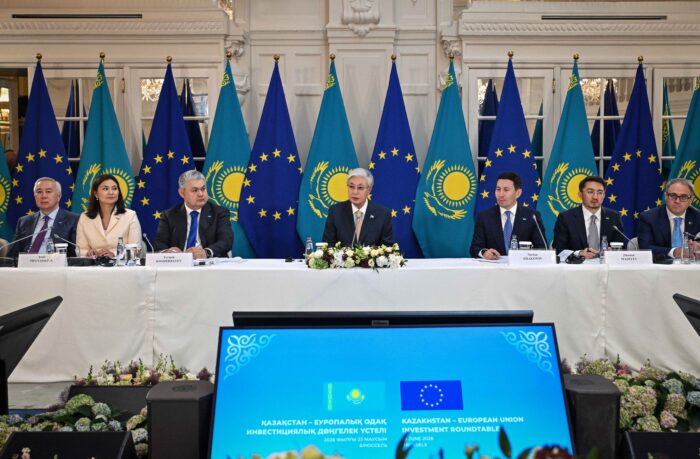
The European Union is Kazakhstan’s largest trade and investment partner. Photo credit: akorda.kz
Addressing the Kazakhstan-EU business roundtable as part of his official visit, Tokayev said the deals serve as evidence that Kazakhstan-EU cooperation is moving beyond conceptual discussions toward concrete action and reflect the strategic nature of the partnership.
Tokayev said Kazakhstan was ready to deepen long-term cooperation with the European Union across sectors ranging from transport, critical minerals and energy to high-tech agriculture, artificial intelligence and finance.
“Today, the European Union is our largest trade and investment partner, accounting for nearly half of all foreign direct investment attracted to Kazakhstan. Bilateral trade exceeded $45 billion last year alone,” said Tokayev.
Around 4,000 European companies operate in Kazakhstan.
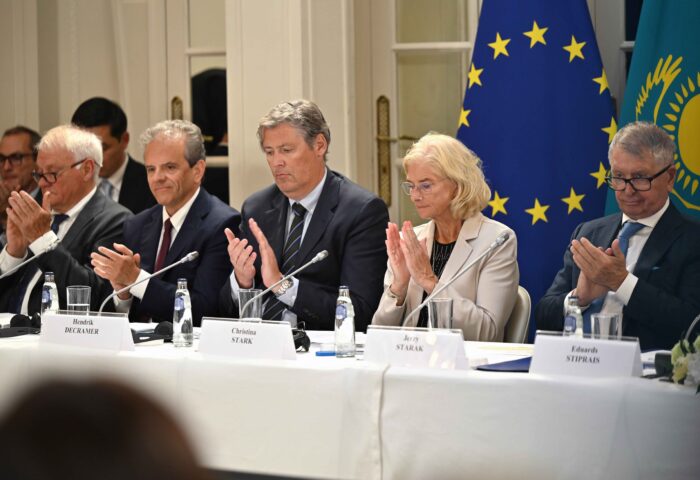
Around 4,000 European companies operate in Kazakhstan. Photo credit: akorda.kz
“Many of them, including Airbus, Polpharma Group, Air Liquide Group, Škoda Group and Alstom, have been reliable partners for decades. We are also pleased to welcome a new generation of European investors, including Roca Group, Inditex, Maersk, Dewulf and Damen Shipyards Group,” Tokayev said.
Tokayev highlighted Kazakhstan’s solid economic performance over the years and spoke about the reforms the country has taken to support that growth.
“Above all, we offer trust and a long-term commitment to our shared success. In return, we look forward to greater engagement from our European partners in high-return investment projects. We also welcome a stronger role for European financial institutions in supporting Kazakhstan’s sustainable economic development and initiatives aimed at enhancing regional connectivity,” said Tokayev.
Logistics and transport
Tokayev also outlined key areas for future cooperation, highlighting Kazakhstan’s ambition to become a regional logistics hub linking Europe with Central Asia, China, the Caucasus and the Middle East.
“We are making substantial investments in infrastructure, including the construction of thousands of kilometers of new railways and the development of the Trans-Caspian International Transport Route. These efforts align naturally with the European Union’s Global Gateway strategy, transforming the Middle Corridor into a key and resilient route for secure Eurasian connectivity,” said Tokayev.
The upgrades produced tangible results, he added. Over the past six years, cargo volumes along this route have increased fivefold, from 800,000 tons to 4.1 million tons annually.
“Our goal is to raise its capacity to 10 million tons,” he added. “Reaching this milestone will further strengthen our position as a vital artery in global logistics.”
According to Tokayev, Kazakhstan has invested more than $35 billion in transport and logistics infrastructure over the past 15 years to sustain this momentum.
The president also welcomed the signing of nearly $1 billion worth of agreements in the logistics infrastructure sector. These agreements are between the Development Bank of Kazakhstan and the European Investment Bank, as well as a consortium of banks comprising Commerzbank, JPMorgan Chase Bank and Standard Chartered Bank, backed by guarantees from the Multilateral Investment Guarantee Agency.
Reliable partner for critical raw materials
Tokayev said Kazakhstan is ready to serve as a reliable partner for Europe in the supply of critical raw materials, including by supplying 21 of the 34 critical raw materials included on the EU’s list.
“To fully unlock this potential, we propose an offtake-based cooperation model that would support the development of domestic processing industries and higher value-added manufacturing. A key outcome of this partnership will be the establishment of a Regional Rare Earth Research Center,” he said.
Alongside substantial reserves of oil, gas and coal, Kazakhstan is also developing projects with uranium and green hydrogen.
“Kazakhstan also possesses significant untapped reserves of lithium, nickel, vanadium and cobalt. Ultimately, we offer our partners a pragmatic formula: investments and technology in exchange for access to strategic resources, fully aligned with European standards,” he said.
Tokayev said Kazakhstan remains committed to strengthening its role as a reliable energy partner for Europe, noting that nearly 13% of the EU’s crude oil imports last year came from Kazakhstan.
He said Astana would continue working with European partners to expand energy supplies and bolster regional energy security, while maintaining the stable operation of the Caspian Pipeline Consortium as a strategic priority.
Global food security
Tokayev said addressing global food security is one of Kazakhstan’s key national priorities, with the country, which is among the world’s largest holders of agricultural land, aiming to transform its agricultural sector into a modern, high-tech industry.
He invited European partners to expand cooperation in areas including livestock production, grain seed breeding, precision agriculture and soil fertility enhancement.
Boosting partnership in artificial intelligence
Tokayev also sees significant opportunities to partner with the EU in the field of artificial intelligence. Kazakhstan sees AI as a major driver of future growth and is positioning itself to benefit from the technology’s rapid global expansion.
Citing Goldman Sachs estimates that AI could add more than $7 trillion to the global economy, he said Kazakhstan has set a strategic goal of becoming a fully digital state.
“Kazakhstan became the first country in the region to launch two supercomputers powered by NVIDIA, a global leader in technological innovation. We have also launched the Data Center Valley project, which is rapidly attracting global capital and major technology companies,” Tokayev said.
He also highlighted the launch of the TUMO and Tomorrow School programs at the Alem.ai International Center, aimed at improving digital skills, modernizing educational infrastructure and introducing personalized learning approaches for future generations.
Tokayev also pointed to the development of the Alatau City, which was granted a special legal status, as a flagship project designed to support the growth of the crypto industry, innovation and high-tech businesses.
As part of his visit, Tokayev also met with European Council President António Costa and European Commission President Ursula von der Leye.
