
ASTANA – Kazakhstan hosts the Spring Meeting of the Berne Union, the world’s largest association of export credit and investment insurers, for the first time in the CIS region on May 11-14. The forum has brought global financial institutions, insurers, and export credit agencies to Astana amid growing international interest in Central Asia’s trade routes, critical minerals and investment potential.
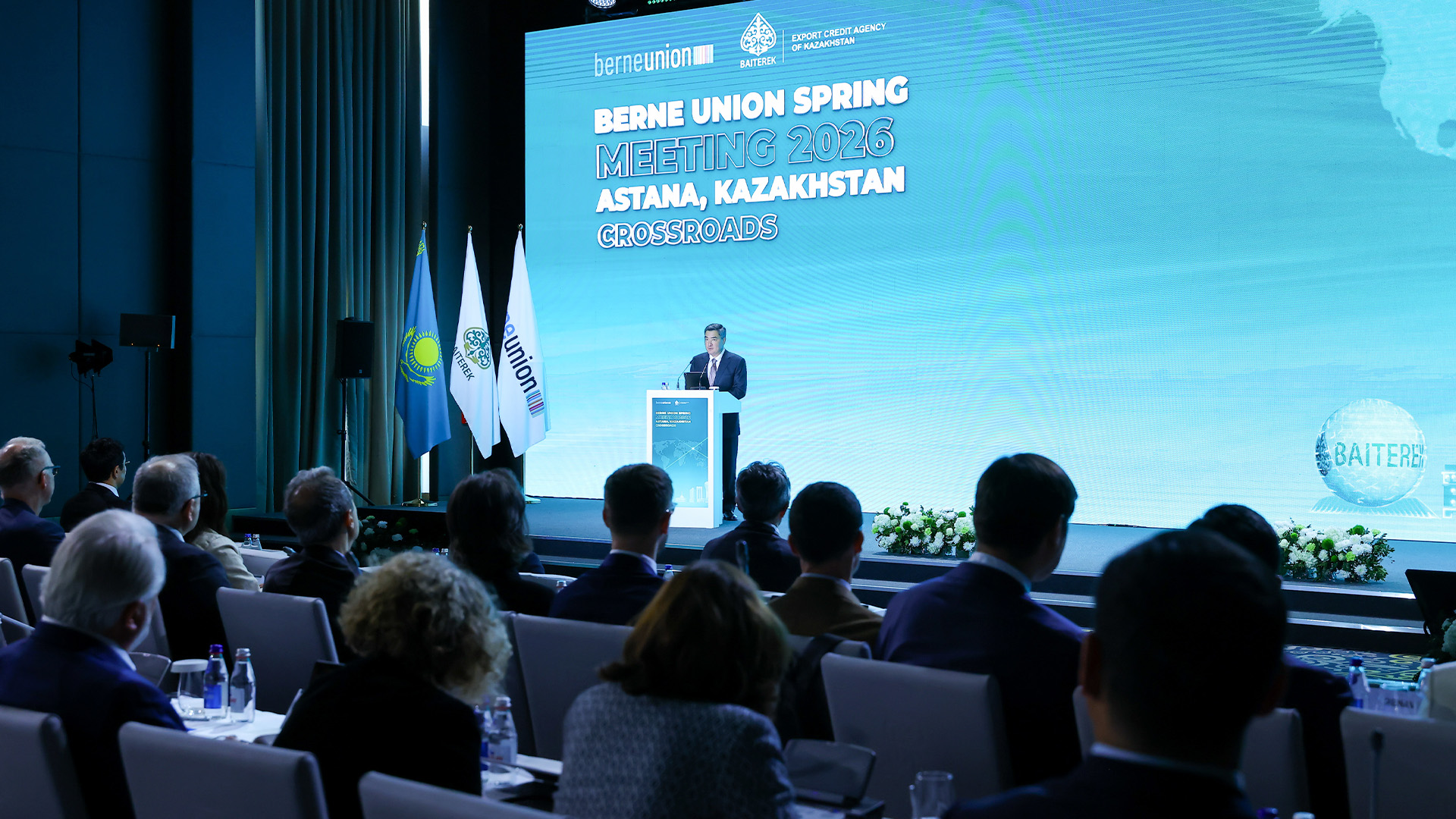
Prime Minister Olzhas Bektenov during the Spring Meeting of the Berne Union on May 12. Photo credit: primeminister.kz
Speaking at the opening session on May 12, Prime Minister Olzhas Bektenov said the forum reflects Kazakhstan’s growing role in global trade, investment and logistics.
Bektenov noted that strengthening the country’s investment attractiveness is closely tied to the development of international trade, transport connectivity and export potential, key areas of focus for Berne Union members.
“Today, Kazakhstan, as the largest economy in Central Asia, continues the structural transformation of its national economy. Foreign direct investment in Kazakhstan increased by 14.4% to $20.5 billion, while investment in fixed assets rose 13% to a record $43.5 billion. The country’s foreign trade turnover reached $144 billion in 2025, while exports now cover 127 countries and nearly 4,000 product categories,” he said.
The theme of this year’s meeting, “Crossroads,” reflects efforts to develop new approaches to supporting global trade flows and economic stability amid geopolitical uncertainty.
The country is seeking to expand non-resource exports and strengthen its position as a regional trade and logistics hub. Authorities have adopted a trade policy strategy through 2030 and continue to expand free trade agreements with international partners, including the United Arab Emirates, Mongolia and Indonesia.
Bektenov also highlighted the growing role of the Trans-Caspian International Transport Route, where major infrastructure projects are underway to strengthen transcontinental trade connectivity.
According to Bektenov, Kazakhstan is also introducing measures to attract international talent and investors, including the launch of a special Altyn Visa regime for investors and highly qualified specialists.
He also emphasized Kazakhstan’s ambitions in digital transformation and artificial intelligence, while pointing to the role of the Astana International Financial Center as a platform for green, Islamic and innovative finance operating under English common law principles.
“Particular attention is being placed by the head of state on advancing artificial intelligence and transforming Kazakhstan into a fully-fledged digital nation. The nationwide Digital Qazaqhstan Strategy is being adopted to accelerate the development of this sector,” Bektenov said.
The union sees the country’s strong potential
Discussing Kazakhstan’s investment potential, the President of the Berne Union, Yuichiro Akita described the country as strategically important due to its growing economy, geopolitical position and natural resources.
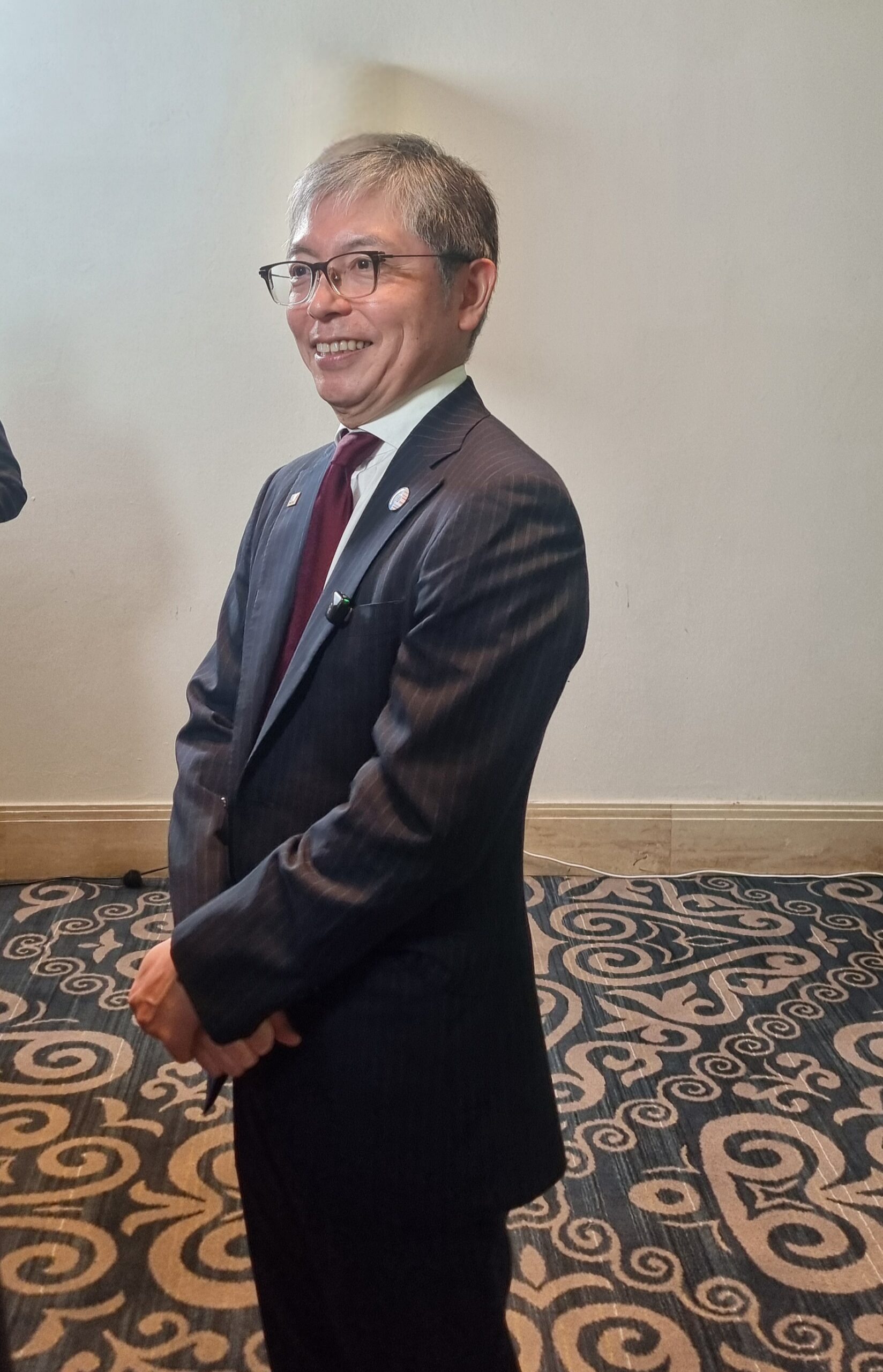
President of the Berne Union, Yuichiro Akita described Kazakhstan as strategically important due to its growing economy, geopolitical position and natural resources. Photo credit: The Astana Times
“Kazakhstan is in a very important geopolitical location, and many international investors are looking for opportunities here. This is the right timing to hold such an event,” Akita said.
He noted that global investors are increasingly focused on energy security and critical minerals amid ongoing geopolitical instability and market volatility.
“We are facing very challenging geopolitical conditions, but at the same time, there is a growing demand for resources the world urgently needs. Kazakhstan possesses many of those resources,” he said.
Akita highlighted that stronger cooperation between governments, export credit agencies and private investors will be essential to making major infrastructure and mining projects financially viable.
According to Akita, political risk insurance and public-private partnerships are becoming increasingly important tools for supporting long-term investments, particularly in sectors exposed to geopolitical and market risks.
He noted that while critical minerals and mining remain strategically important globally, volatility in commodity prices and geopolitical uncertainty have made some projects more difficult to finance and insure.
“The challenge today is not necessarily that projects are impossible to insure, but that it has become harder to make them bankable and attractive for investors,” Akita said.
He also emphasized the role of Kazakhstan’s export credit institutions and the Baiterek National Investment Holding in supporting international investment projects.
By the end of 2025, Berne Union members collectively provided around $3.7 trillion in insurance protection annually, covering approximately 13% of global cross-border trade.
The forum brings together around 240 delegates from more than 70 countries, including representatives of major international organizations and export credit agencies such as Bpifrance, Credendo, Euler Hermes, SACE, SINOSURE and the Export-Import Bank of the United States.
