
ALMATY — Kazakhstan has provided all populated areas with access to drinking water by the end of 2025, Vice Minister of Industry and Construction Kuandyk Kazhkenov reported at a Jan. 13 government meeting on water supply and sanitation.
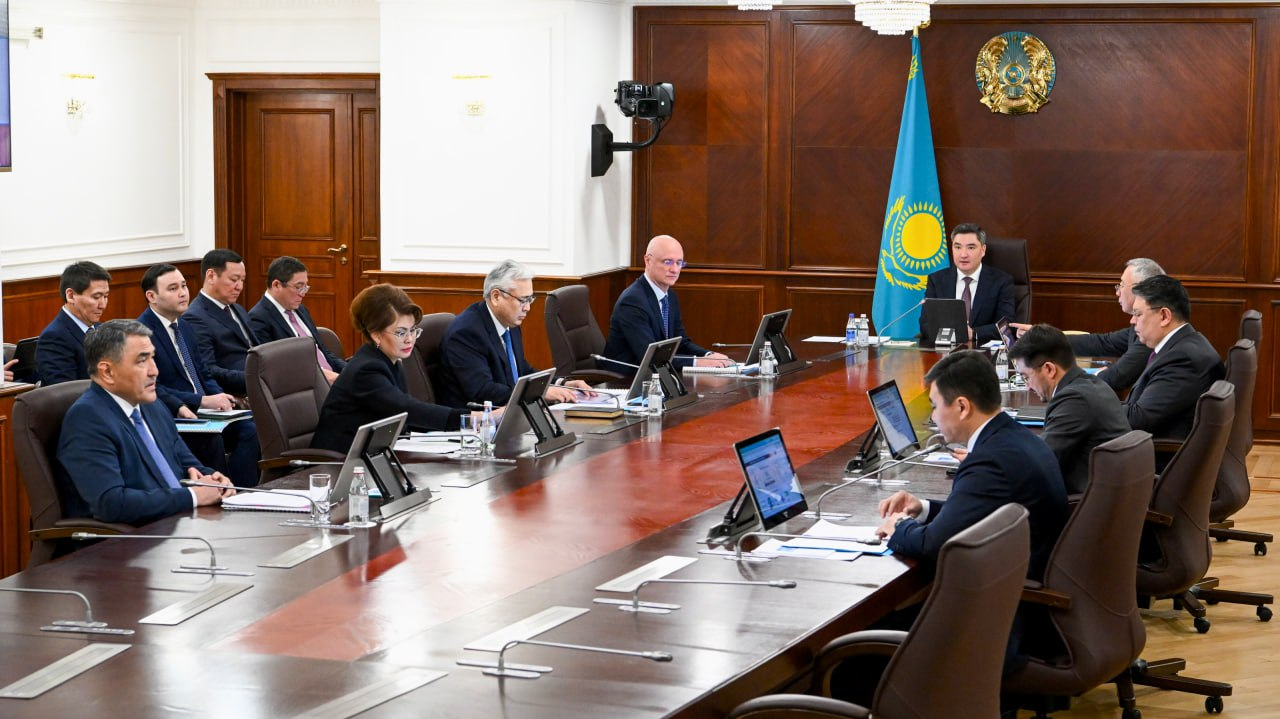
The Kazakh government holds a meeting to assess water supply, wastewater systems, and digital solutions for infrastucture modernization. Photo credit: Prime Minister’s press service.
According to Kazhkenov, 835 billion tenge (approximately US$1.78 billion) was allocated from the budget to finance more than 1,600 water infrastructure projects, including 132 billion tenge (US$281 million) drawn from returned assets through the Special State Fund.
“All settlements, 90 cities and 6,087 villages, with a total population of 7.5 million people, are now provided with drinking water,” he said.
Modernization and investment through 2030
As part of the national project for the Modernization of the Energy and Utilities Sector, Kazakhstan plans to attract 1.9 trillion tenge (US$4.04 billion) in investments for water supply and wastewater systems.
According to Kazhkenov, the project includes upgrading 5,000 kilometers of water pipelines, 2,800 kilometers of sewer networks, and wastewater treatment facilities in 45 cities.
By 2030, the government also aims to reduce the wear level of water supply networks to 33% and wastewater systems to 41%.
A Technical Operator institute has been introduced to improve planning and oversight, ensuring expert review of project designs, prioritization of domestically produced materials, and continuous monitoring of implementation.
Wastewater treatment facilities expansion
Kazhkenov also reported that one of the sector’s persistent challenges remains aging wastewater treatment plants, many of which were built more than 50 years ago. He emphasized that facilities in Aktau and Lenger have been commissioned, while new plants in Atyrau, Kyzylorda, Karkaraly, and Karazhal are set to come online by the end of the year.
In total, 45 wastewater treatment projects are planned and financed through a mix of international financial institution loans, bond financing via Baiterek Holding, public-private partnerships, and targeted budget transfers, including projects supported by the European Bank for Reconstruction and Development and the Asian Development Bank.
