
Editor’s Note: In the run-up to the eighth Congress of Leaders of World and Traditional Religions, scheduled for Sept. 17–18 in Astana, The Astana Times has launched a special series exploring the diversity of spiritual life in Kazakhstan. The first articles highlighted the Jewish and Bahá’í communities. This edition turns to the Russian Orthodox Church in Kazakhstan, its historical role alongside Islam, and its voice in the country’s interfaith dialogue.
ASTANA – The Russian Orthodox Church in Kazakhstan is one of the country’s two major religions, alongside Islam, rooted in centuries of shared history between Russians and Kazakhs — a history marked by both trials and moments of unity.
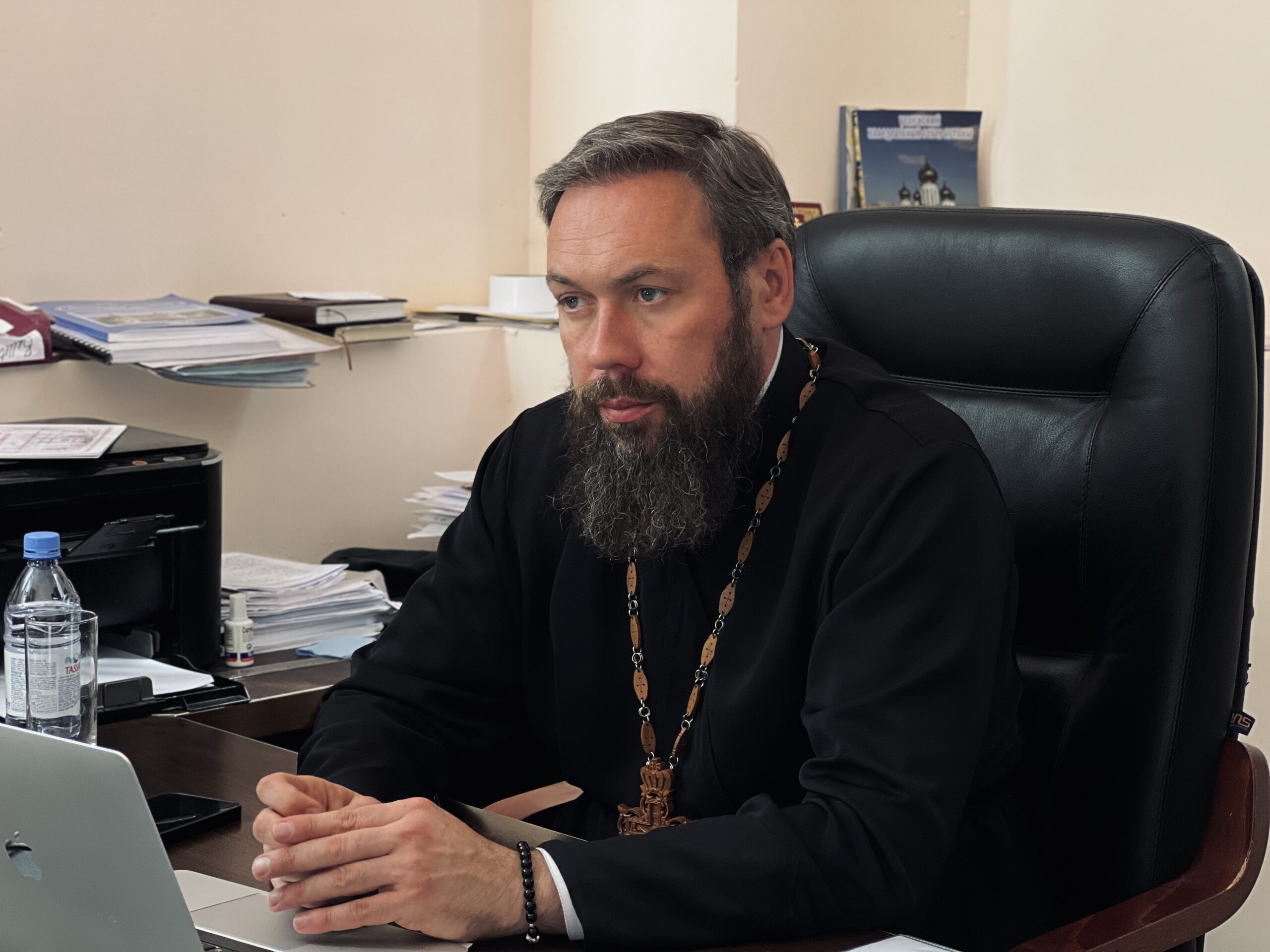
Father Dmitry. Photo credit: The Astana Times/ Aida Temerkhan
As Astana prepares to host the Eighth Congress of Leaders of World and Traditional Religions this September, I sat down with Father Dmitry, a Hieromonk (Orthodox monk-priest) of the Astana church district, as part of a series of conversations with religious representatives of Kazakhstan. For me, this subject is deeply personal. Alongside discussing the importance of the congress, especially at a time when wars fracture the world along religious and other divides, I also asked Father Dmitry about the crisis of faith and whether faith can remain relevant in the age of artificial intelligence.
Coexistence of religions in Kazakhstan
The coexistence of Orthodoxy and Islam in Kazakhstan has developed historically, and its contribution to the country’s spiritual dialogue is hard to overstate.
“Indeed, the Russian Orthodox Church, together with the Spiritual Administration of Muslims of Kazakhstan, are the two largest religious organizations in our country. Of course, it is difficult to overestimate their contribution to public life. Peaceful coexistence is the foundation of our common life,” said Father Dmitry.
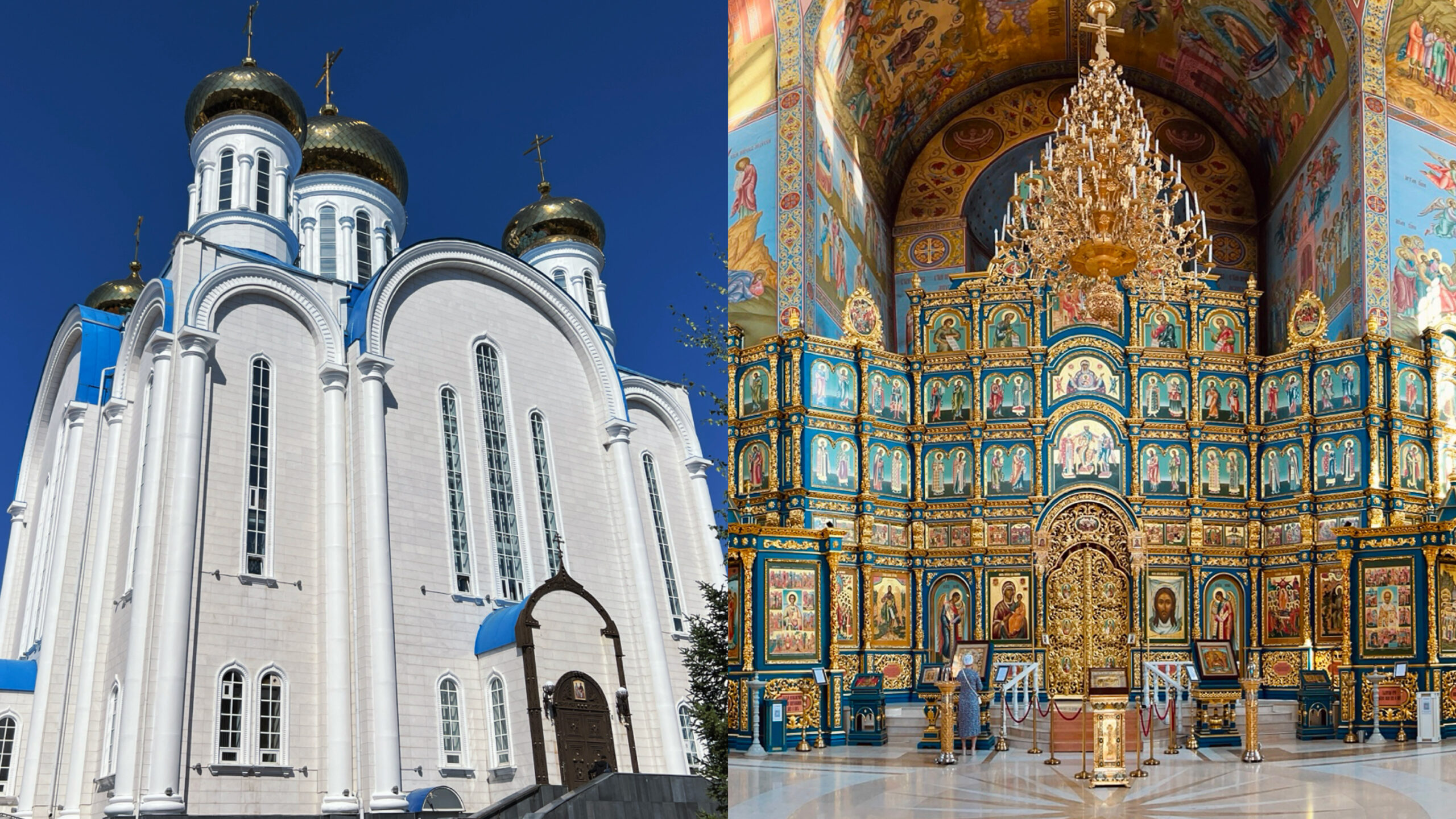
Exterior and interior views of Assumption Cathedral in Astana. Photo credit The Astana Times / Aida Temerkhan.
He emphasized that the country’s citizens live in a society where cultures permeate each other, where folk traditions intertwine with religious practices.
“For us, such multiconfessionality is the norm of life. I think it’s wonderful, remarkable. And in many ways, it should serve as an example for other countries where one religious organization dominates,” he noted.
Although the majority of the population identifies with Islam, Father Dmitry said the Russian Orthodox Church feels secure and respected in Kazakhstan.
“At all state events, by good tradition, priests and imams always stand side by side. In our sermons and public statements, our positions are often very close,” he said.
The uniqueness of the congress
In his view, while the very idea of gathering religious leaders is not unique, Kazakhstan’s forum is distinctive because it is initiated by the state.
“The state acts as an arbiter, bringing everyone to the table so people can voice their positions on vital global issues — peace, relations between peoples, contemporary culture, the place of a human being in today’s world. That is extremely important,” Father Dmitry explained.
Aida Haidar and Father Dmitry. Photo credit: The Astana Times/ Aida Temerkhan
“When leaders of different faiths sit at one table, especially in our turbulent times of cultural, ideological, and military conflicts, this becomes an example for many. It shows that the goals are common. There is no need to divide, to prove one’s superiority. Everyone can keep their own traditions, but it is essential to listen to others and accept their views without losing your own,” he said.
He added that the scale of the congress also sets it apart: Kazakhstan invites leaders of the world’s major traditional religions.
“For instance, the previous congress welcomed the late Pope Francis. This year, we expect the visit of His Holiness Patriarch Kirill, who will be participating for the second time, after first attending in 2013,” Father Dmitry said.
I asked Father Dmitry what value faith and religious dialogue hold today, in a world so fractured by mistrust and division.
“Unfortunately, there is no universal remedy to end these confrontations,” he said.
“When politics interferes with religious relations, we see the tragic consequences. When some people think others should not even live on this or that territory that they are somehow inferior — that is unacceptable. Forums like the one our country hosts help to find a way out of such dead ends, to find points of contact that help people remain human. That is invaluable,” he said.
The core of Christian teaching
I also asked Father Dmitry to share some of the Orthodox teachings that could serve as a unifying message even for those who may doubt or struggle with faith.
“There is no need to reinvent the wheel. The Gospel says: if you love Me, keep My commandments. That is the essence,” he explained.
“The Lord tells us that love for God is revealed through love for those around us. Who is our neighbor? The one who stands beside us. Love for people is how we show love for God — never the other way around,” he said.
“Faith in God helps us live, helps us remain human. It should encourage us to see in every neighbor the image of God, for Scripture teaches us that each person is created in His image. Religion teaches us not to see an enemy, but a fellow human being. If we all understood this, much of the suffering in our world today would not exist,” he explained.
Dialogue, he stressed, is always essential because people need to talk and listen to each other and express their views — but without pulling the blanket over themselves, insisting only they are right.
«Our world is diverse. People are diverse. We cannot all be the same, nor can entire nations. That is why dialogue is so crucial. God grant that it bears fruit,” he added.
The crisis of faith
Lately, I have been troubled by the thought that while more people openly leave their faith behind, many who claim to believe seem to simply perform rituals without genuine conviction. I asked Father Dmitry if this could be called a crisis of faith and what advice he would give to someone struggling with trust in God.
“In the early 19th century, Saint Seraphim of Sarov said: save yourself, and thousands around you will be saved. Do not try to change the whole world — you won’t succeed. Change yourself for the better,” he answered.
“Faith is a gift of God. If a person does not believe, it doesn’t mean they are somehow deficient — perhaps they are simply not yet ready to receive that gift. Religious practice — fasting, prayer, participation in worship — helps us pause in the rush of life, look around, and hear God’s voice in our hearts. That requires dedicating time to oneself,” Father Dmitry explained.
He compared spiritual practice to caring for the body.
“If you want a healthy body, you must live accordingly — proper nutrition, regular exercise. The same applies to the soul. The Greek words ‘athlete’ and ‘ascetic’ differ by only one letter. One is care for the body, the other for the soul. Both require immense effort. Faith is indeed a demanding labor,” he said.
I asked whether experiencing a crisis of faith might itself be a good sign — proof of a desire to draw closer to God.
“That is wonderful. You see, God always extends His hand to us. The challenge is to find and grasp it amid the noise of our times. God wants us to be with Him. But we must also want it and do everything we can on our side, because God is always ready to be with us,” he said.
He explained the Christian view of the Incarnation.
“God took upon Himself the very nature we had corrupted. The Infinite became finite, becoming human in order to heal that nature and return it to us restored. Imagine taking a damaged genome into yourself, healing it, and then handing back a healthy DNA molecule so life could continue. That is what God has done for humanity. It is up to us to accept it,” he explained.
Father Dmitry also emphasized that God created people free, and freedom is above all responsibility.
“Responsibility for our actions, for our choices — that is what we carry,” he said.
Faith in the age of AI
We also discussed the place of faith in a future dominated by artificial intelligence. Already, people turn to AI platforms — including ChatGPT — for advice and support. Is this dangerous?
Father Dmitry said he does not see AI as a threat to faith.
“These are simply different dimensions of existence. Modern information technologies are wonderful, we use them too. But AI is not a personal being. It is a compilation of what exists on the internet, more advanced than a search engine, but still the same principle. There is no need to fear it. Faith belongs to an entirely different sphere: it lives inside us. Technology does not touch it. These are two different worlds,” he said.
A message ahead of the congress
Finally, I asked Father Dmitry what message he would like people of different faiths to take from the upcoming congress.
“I would like ordinary people to see how the leaders of world religions can sit together at one table. Nobody quarrels, nobody imposes their opinion. They talk, they meet, they communicate. That is the example to follow. Perhaps one of the goals of this congress is precisely to show that religions can sit together, speak, and listen,” he said.
Looking deeper, he added, all faiths ultimately speak of the same thing: that peace is needed, that we must respect each other, and at the same time preserve and value what is our own.
“But we must not imagine ourselves smarter or better than others, specially chosen above the rest. No — we are all human,” he said.
“People everywhere want the same things: a secure tomorrow, not to live in poverty, hunger, or war. Since we all want this, we must strive for it together. Sadly, selfish individuals often exploit people’s good intentions, creating enemies where there are none. Yet when politics does not interfere, people live peacefully and normally together,” Father Dmitry concluded.
