
When we think of Astana, the first thing that comes to mind is high-level visits of politicians and international summits. It’s a city of strategy, diplomacy, and national ambition. But beneath that polished, political surface lies something quieter — yet just as powerful: a city that creates space for dreams. As Astana celebrates its birthday on July 6, we take a closer look at the people who shape the city’s creative soul — artists, thinkers, and quiet visionaries who prove that this capital is more than glass and steel.
This is the second part of the series.
ASTANA — Natalya Zamyatina is one of them. A designer, psychologist, mentor, and mother, she came to Astana two decades ago with a newborn son, no contacts, and a dream. What she found — and built — in the capital transformed not only her career, but the lives of those around her. In her atelier, clothing is more than fabric — it becomes therapy, dignity, and proof that beauty can rise from even the hardest beginnings.
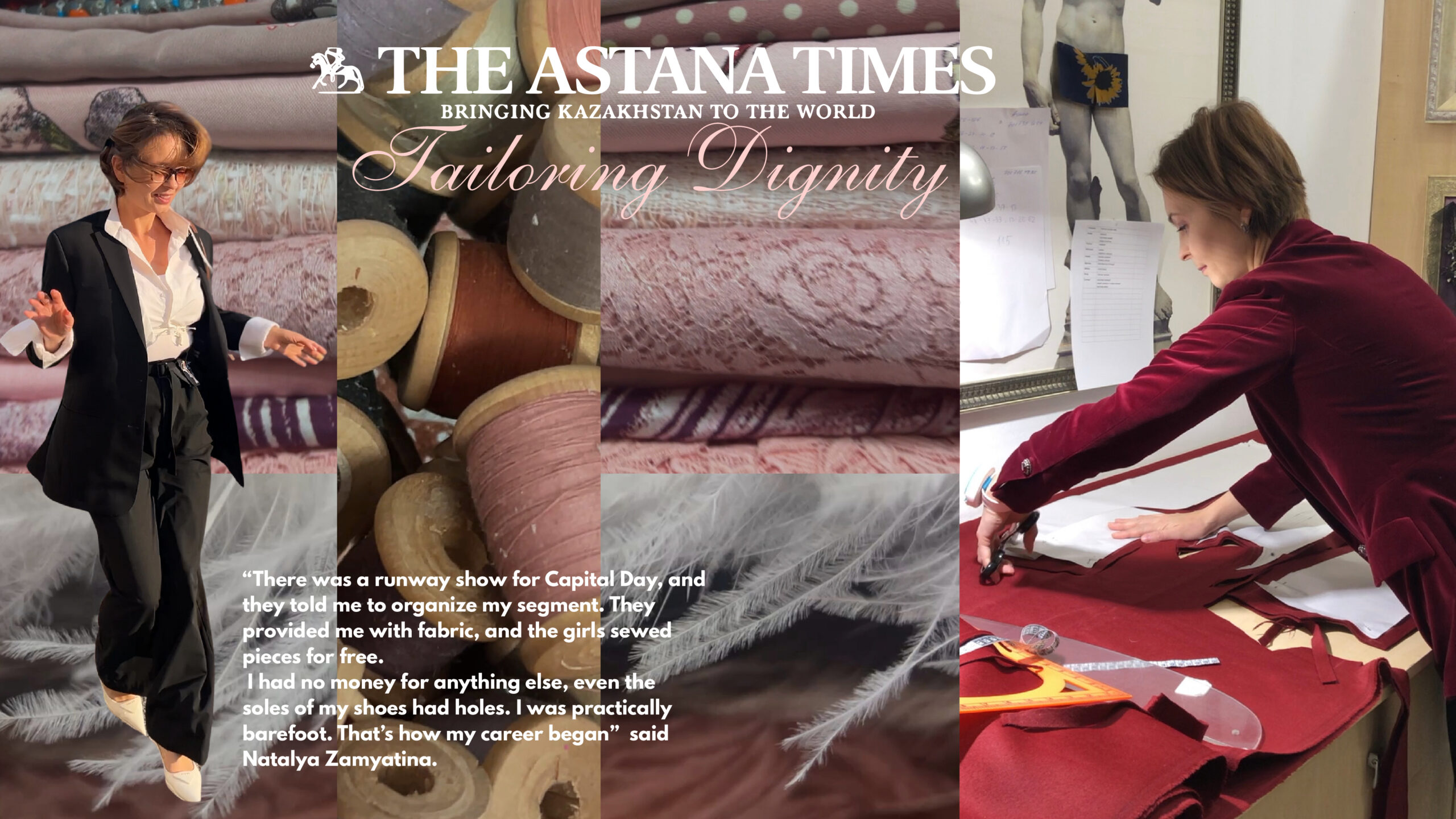
Photo illustration created by Fatima Kemelova.
When she moved to Astana at the age of 25, she arrived as a single mother with a newborn son and a deep, persistent dream: to become a designer. Originally from Petropavl, she arrived in the capital not just to start over, but to test her strength and her belief in what she was capable of. Two decades later, her atelier NZ & Co is more than a fashion studio; it’s a philosophy, a family, and a testament to resilience.
“I had my life in Petropavl, but I wanted to see what I was capable of here. And here, I was a newcomer. I had to prove that I was worth something. Later, I even studied to become a psychologist and I’m constantly learning. I’d call it self-education,” she said.
Her professional journey has always been mysteriously entangled with the milestones of Astana. She recalled how her first real test came during the Capital Day, when she was hired by a major tailoring studio, a rarity at the time.
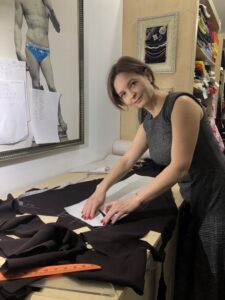
Natalya Zamyatina. Photo credit: Zamyatina’s personal archive
“There was a runway show for Capital Day, and they told me to organize my segment. They provided me with fabric, and the girls sewed pieces for free. I had no money for anything else, even the soles of my shoes had holes. I was practically barefoot. That’s how my career began,” she said.
She was hired on the spot. Since then, Zamyatina has become known for designs that don’t scream for attention but instead evoke emotion.
“We make pieces you forget you’re wearing. You’re not thinking about what you’re dressed in — you just notice people paying attention to you. Or not, if you prefer to disappear into the crowd. Either way, you’re comfortable and in control. The clothes are just the frame — the person is the painting,” Zamyatina explained, delving into the process of her work.
“I scan the person. We talk for at least an hour. I try to understand their psychological type: how they move, how they speak, what they live for. I also take into account their health and their posture. Women often come full of insecurities. They say, ‘Hide this!’ I say, ‘Stop. Let’s find your strengths first.’ Even if it’s your earlobes, we’ll work with that. There are so many tools: cut, fabric, color, and posture. But we always start with color,” she said.
Asked how Astana has shaped her, Zamyatina said, “There are so many opportunities in Astana. You just have to use them.”
She stays inspired by attending cultural events, surrounding herself with creative people, and listening to her clients, many of whom are highly educated and well-connected to the city’s intellectual circles.
But for Zamyatina, Astana’s impact goes far beyond her atelier. The city gave her son, the baby she once carried into the unknown, a chance that would have been impossible anywhere else.
“My son is now studying in Europe. But he got his start right here, in Astana. He graduated from the aviation school founded by Tokhtar Aubakirov, which was completely free for high schoolers. That kind of opportunity? You wouldn’t find it in Europe. But here, an ordinary kid got to learn how to fly. That’s something only Astana could offer,” she said.
Zamyatina said she has stepped back from career ambitions. “I’ve reprioritized. Now, it’s about health and family. I’m letting the younger generation move forward. I don’t chase trends. And I don’t chase clients either. The right ones find me.”
That doesn’t mean she’s slowed down. Instead, she’s gone inward. “I don’t want to expand. I don’t want more machines or a bigger space. We already have experience, we already have quality. Now I want intensity inward. I want to make fewer pieces, but better. More expensive, higher quality, so everyone wins — my team earns more, our clients get excellence,” she said.
Zamyatina’s atelier is also a haven — a place where talent and resilience quietly thrive. Her team includes women and men from vulnerable groups: single mothers with five children and cancer survivors with husbands recovering from illness. These are the hands behind her garments. She supports them not only in their craft but also through life’s hardest moments.
“During the pandemic, when emotions were raw, I had to be more than a designer. Sometimes, I had to be a psychologist. I had to calm them before we could even begin to sew. But now, almost all of them have bought apartments. Whatever their dream was, they made it a reality,” she said.
Still, Zamyatina insists on honoring the quiet dignity of craftsmanship, as exemplified by Xenia, one of her team members.
“She’s hearing-impaired, but one of the best on my team. You can feel it: every seam is perfect, every knot precise. She’s what we call a true couturier. People like her are sought after in luxury fashion houses,” Zamyatina said.
She is also proud of how free and empowered people feel in Astana. “My friends from Europe are stunned. One of my Italian friends’ daughters can’t even go to a shop alone. Meanwhile, my daughter goes horseback riding, to singing lessons, she moves around the city freely. And digital services that we enjoy? Instant, seamless. I love that,” she said.
In Zamyatina’s Astana, the wind might howl, but it carries possibility. And for her, that possibility has meant not just success, but a kind of quiet mastery — the ability to dress the soul, not just the body.
P.S.
Astana is a city of wind, wide skies, and quiet strength. It doesn’t hand you beauty — you carve it out. But in doing so, you become part of its story. For some, it’s a place to begin again. For others, a space to build, create, and grow. It may not offer centuries of history, but it offers something else: a future, unwritten, still warm in your hands.
That’s why the city feels alive. Because it doesn’t just house our dreams, it shares them. It watches us grow. It dares us to keep going. And it believes in what we’re becoming, even when we don’t yet.
This is the city we love.
The city that made us believe we can be more than we are.
The city that dreams with us.
Editor’s note: In the first story of our Astana: City That Dreams With Us series, we explored the quiet magic of puppetry with Kuralay Yeshmuratova — a pioneering artist who found beauty, meaning, and a home in the capital’s windswept landscape.
