
ALMATY – Art was never separate from life for the nomads of the Kazakh steppe. It lived in the objects of everyday life, from textiles to horse gear and jewelry, shaped by use as much as by beauty. In Kazakh culture, even a home could be understood as a work of art.
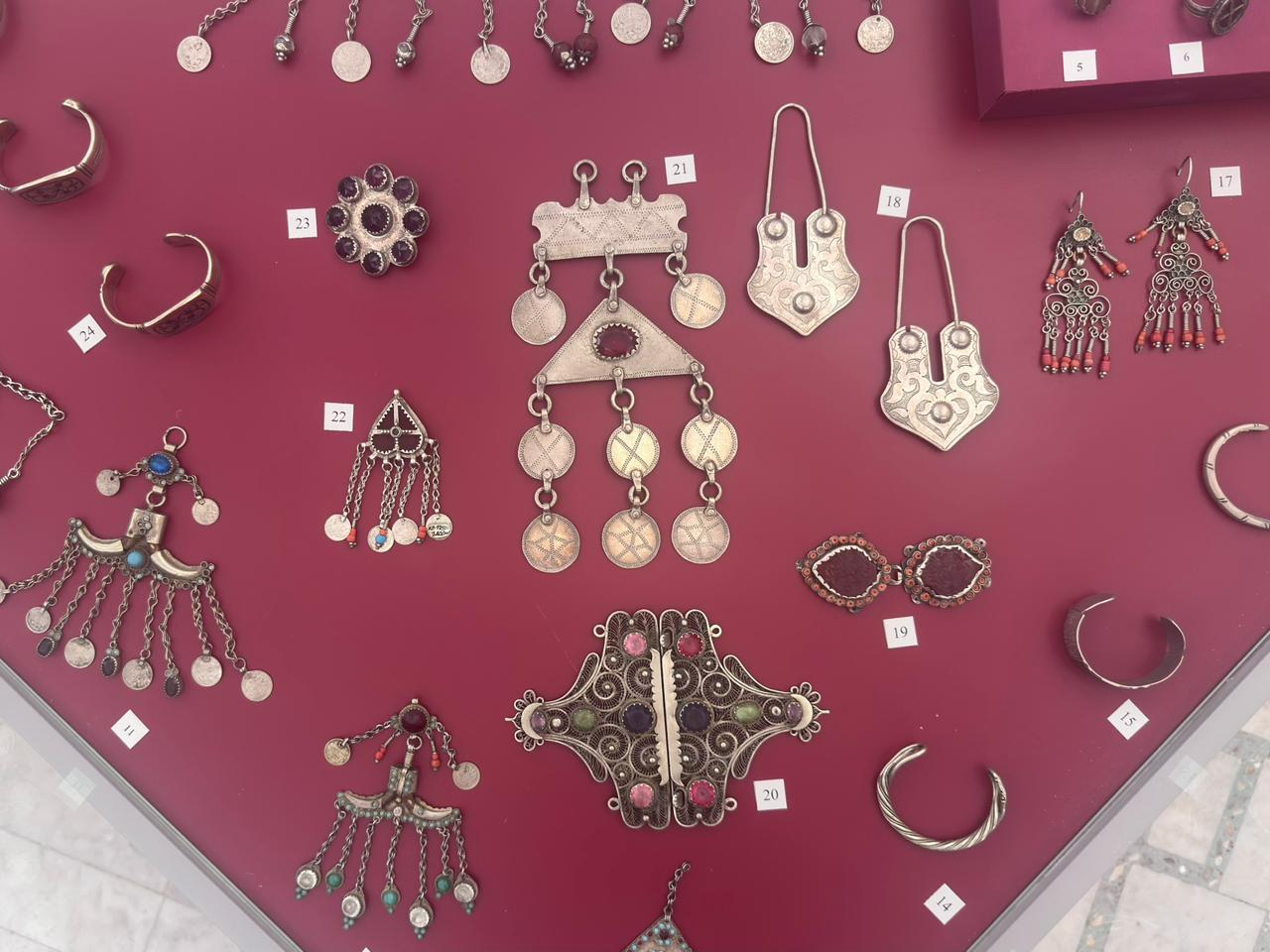
Today, the museum holds more than 1,000 pieces of jewelry alone, spanning the 19th and 20th centuries. Photo credit: The Astana Times.
That idea is perhaps most clearly embodied in the yurt itself. Speaking to the Astana Times, Natalia Bazhenova, head of the Department of Decorative and Applied Arts at the Abilkhan Kasteev National Museum of Arts, explains how the very structure of the yurt, a mobile nomadic home, reflects this philosophy.
She emphasized that creating the yurt was a deeply personal act, requiring skill and symbolism, expressed through thoughtful interior and design solutions.
“The yurt can be considered an artistic object in its own right. Nearly everything inside it was handmade by family members. In a way, it was like a personal exhibition of their skills, their beliefs, and their understanding of the world,” Bazhenova said.
From student to keeper of heritage
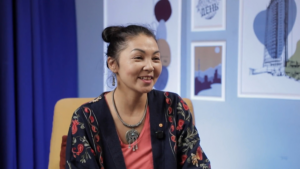
Natalia Bazhenova. Photo credit: personal archive.
This approach to art, where daily life, spiritual protection, and aesthetics intertwine, defines the treasures she curates. Her path into this world began with a love of making.
Bazhenova’s own story is as intertwined with Kazakh art as the objects she preserves. She studied decorative and applied arts at the Zhurgenov Kazakh National Academy of Arts, focusing on traditional techniques and artistic craftsmanship, and completed her master’s degree with research into the subject.
“I came to the museum while working on my thesis. I was looking for photographs and documentation for my research. I was sent to the storage rooms, and when I first saw the textiles, jewelry, and other objects, I experienced a cultural shock. The techniques, compositions, and color, all created by women with no formal art education, were extraordinary,” she said.
Her early fascination led to a permanent role in the museum, where she has worked for 20 years, leading research, curating exhibitions, and authoring monographs. One of them, in 2017, focused on Kazakh traditional weaving and identified more than 14 weaving techniques preserved in the collection.
“This is a treasure you can study your whole life and still never reach the end. Every object has its own story, its own energy,” Bazhenova said.
How a collection was built
The museum’s collection is not the result of a single acquisition, but decades of careful effort to preserve a disappearing heritage. Its history dates back to 1970, when the National Museum of Decorative and Applied Arts was founded. At its origin was Kulakhmet Khodzhikov, an artist and visionary who advocated for cultural preservation.
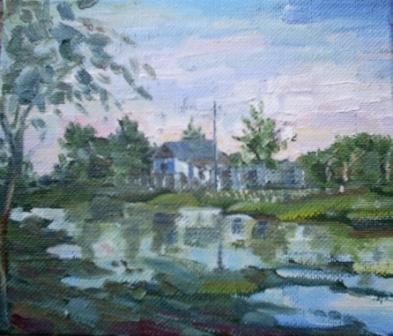
The Road to Home by Bazhenova. Oil on canvas. Photo credit: roerich.kz.
“He wrote letters explaining that Kazakhstan’s cultural heritage could disappear if it wasn’t collected and preserved. Thanks to his efforts, the museum was founded, and he became its director,” Bazhenova said.
From the beginning, she added, acquiring objects required travel and effort. Museum staff traveled to villages and towns across Kazakhstan and even to regions of Russia, where Kazakhs lived, gathering objects directly from families.
“These were not antiques bought from dealers. They came from homes, carrying the energy of everyday life, and that’s why the collection feels alive,” Bazhenova said.
The collection continued to grow through purchases and donations. Today, the museum holds more than 1,000 pieces of jewelry alone, spanning the 19th and 20th centuries.
“Even today, people bring family relics because they want them preserved professionally. We are always grateful to donors and to artists who trust us with their work,” she said.
Jewelry as protection
According to Bazhenova, one of the most remarkable aspects of the collection is its function. For the Kazakhs, jewelry was never just decoration, as it was deeply intertwined with spiritual protection and health. The placement of ornaments on the body followed beliefs about sacred spaces and vulnerability.
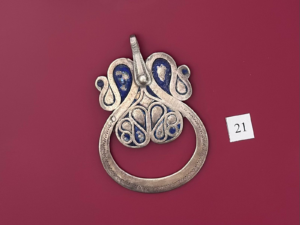
A special amulet worn by women who could not get pregnant, shaped like a small, stylized womb, and inside were tiny figures symbolizing children. Photo credit: The Astana Times.
“Nearly all traditional jewelry in the collection was made for women and most of it served a protective role. They protected women from evil forces — both human and unseen,” she said.
The spiritual significance extended to particular parts of the body. The spine, for example, was thought to be sacred and susceptible to harm, and a specific kind of jewelry was accordingly placed.
“Some amulets also contained real owl claws. The owl is a sacred bird. Its claws were placed inside silver cases. Even today, owl feathers are believed to protect against the evil eye,” Bazhenova said.
Bazhenova notes that the protective role of silver extended even into the most ordinary daily rituals, including cooking. In a traditional belief, a woman’s hands did not simply prepare food — they transferred energy to it, and silver acted as a purifier in that process.
“When a woman cooked, she was supposed to have rings on her fingers,” Bazhenova said. “It was believed that the food was touched through silver.”
The Astana Times YouTube channel also explored the hidden meanings behind traditional Kazakh jewelry — from silver amulets believed to ward off evil spirits to rings that revealed a woman’s marital status without a single word.
Fertility and intimate objects
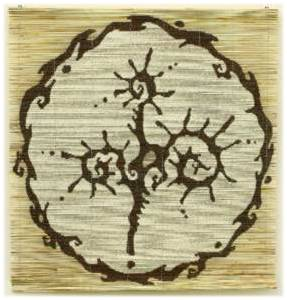
The symbol of the Trinity of Asia by Bazhenova. Weaving, chiy, wool. Photo credit: roerich.kz.
Bazhenova highlighted that some ornaments were intimately tied to life’s deepest hopes, including fertility. She explained that women who struggled to conceive carried specially designed amulets, which were both hidden and symbolic.
“There was a special amulet worn by women who could not get pregnant. It was shaped like a small, stylized womb, and inside were tiny figures symbolizing children,” she said.
These items were not worn as display pieces as they were personal, hidden under clothing, and accompanied by prayers.
Regional styles and cultural exchange
The museum organizes the collection by region, highlighting differences in style, material, and technique. As Bazhenova emphasized, northern and central regions of Kazakhstan favored filigree and intricate chains, while western Kazakhstan produced bold, monumental forms, with southern regions showing influence from Uzbekistan.
“Kazakhstan is huge, and each region developed its own style, because cultural exchange was inevitable. You can see influences from neighboring regions in materials and motifs,” she said.
The museum today: challenges and hope
According to Bazhenova, funding for expeditions and acquisitions is now limited. Many items, she added, now survive only in private collections.
“In the past, there were many expeditions, and staff could select objects directly. Now, that rarely happens. We hope that our national status will help change this, and allow us to preserve more heritage,” she said.
Private collectors sometimes fill the gap, though the loss of unique items abroad is a concern.
“It is painful when important pieces leave the country. But some collectors preserve what the museum cannot afford,” she said.
Art as living memory
For Bazhenova, every object is more than its materials or its beauty. Each carries the energy of the people who made it.
“Think how many hands touched them, how many lives and emotions passed through them. Even everyday objects were imbued with thought and care. That is what gives them life,” she said.
