
ASTANA – Kazakhstan and Pakistan signed 32 commercial agreements at a Feb. 4 business forum in Islamabad during President Kassym-Jomart Tokayev’s state visit. The agreements aim to expand bilateral cooperation across priority sectors, including finance, logistics, industry, energy, the agro-industrial complex, digital services, and infrastructure.
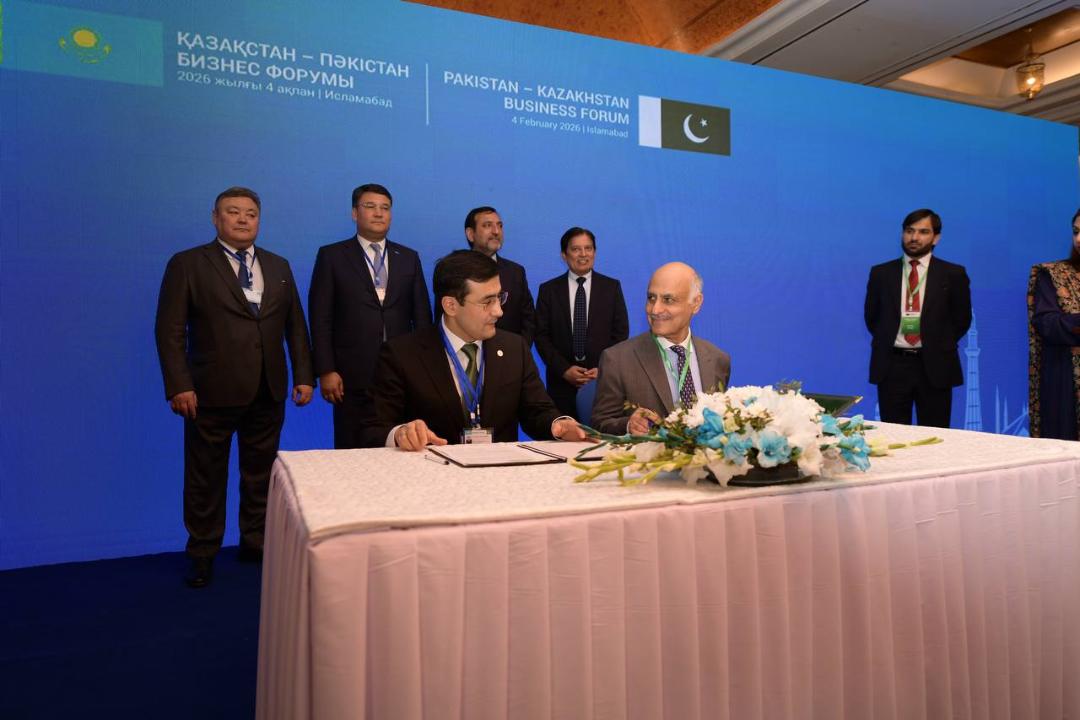
Photo credit: gov.kz
The largest industrial agreement concluded during the forum was a $108 million contract between Kazakhstan’s Falcon EuroBus LLP and Pakistan’s QCC International for the supply of domestically produced electric buses. The agreement is strategically significant for advancing Kazakhstan’s mechanical engineering sector, promoting the Made in Kazakhstan brand abroad, expanding export capacity, and supporting the localization of high-tech manufacturing, the Kazakh Ministry of Trade and Integration reported.
Several agreements focused on establishing joint investment mechanisms and strengthening the financial framework for cooperation. Samruk Kazyna Sovereign Wealth Fund and Pakistan’s Fauji Group of Companies agreed to create a joint investment platform to identify and implement projects in both countries. Baiterek Research Holding expanded its international partnerships through cooperation with Habib Bank Limited in project and trade finance, and with TCS Private Limited in transport and logistics.
In the financial sector, Freedom Holding Corp. and Freedom Bank Kazakhstan signed multiple agreements with partners in Pakistan. These include a $20 million agreement with Meezan Bank Limited to develop correspondent banking relations and international settlements, as well as additional arrangements to expand cross-border financial and digital services.
Transport and logistics featured prominently among the signed documents. Kazakhstan Temir Zholy and Pakistan’s National Logistics Corporation agreed to cooperate in multimodal transportation and transit development. Kazpost signed memorandums with Pakistan Post and TCS Private Limited to modernize postal and logistics infrastructure and introduce digital solutions. In maritime logistics, the Aktau International Sea Trade Port and the Port of Karachi reached agreements to enhance port cooperation and logistics connectivity.
In the industrial sector, KazFoodProducts and Pakistan’s Almoiz Group agreed to establish a joint venture for sugar production in the Zhetysu Region, with an investment of $20 million. Additionally, Kusto Group and QazTrade signed a memorandum to develop construction materials production, also valued at $20 million.
Agreements were also reached in the chemical and processing industries. BARK Qazaqstan LLP signed documents with partners, while NorSon Chemical Industries and the Baikonur Agricultural Production Cooperative agreed to launch chemical production facilities in the Kyzylorda Region.
Cooperation in digital services, IT, and telecommunications was reinforced through memorandums between Astana Hub and IGNITE Pakistan on startup ecosystem development, and between QazCode and Jazz Pakistan in the telecommunications sector. Further agreements addressed artificial intelligence, digital solutions, and payment system integration.
In education and healthcare, Astana Medical University signed a memorandum with Maroof International Hospital, while iTech KZ and Gift University agreed to expand academic and technological cooperation.
The space sector was also included, with Kazakhstan Gharysh Sapary and Pakistan’s SUPARCO agreeing on scientific and technical collaboration and satellite data exchange.
Additional agreements covered Islamic finance, with Otbasy Bank and Meezan Bank Limited signing cooperation documents, as well as memorandums aimed at developing the agro-industrial complex and strengthening business ties between trade and industrial organizations of both countries.
During the meeting between President Tokayev and Prime Minister Shehbaz Sharif on Feb. 4, Kazakhstan and Pakistan signed a Joint Declaration on the establishment of a Strategic Partnership. A total of 37 agreements were concluded, marking one of the most significant milestones in bilateral cooperation in recent years.
