
ASTANA – The Shanghai Cooperation Organisation (SCO) convened for its 25th summit in Tianjin on Sept. 1, marking the largest gathering of leaders in the organization’s history. Kazakh President Kassym-Jomart Tokayev also attended the summit, delivering remarks that outlined his country’s vision for how the 10-member SCO can move forward.
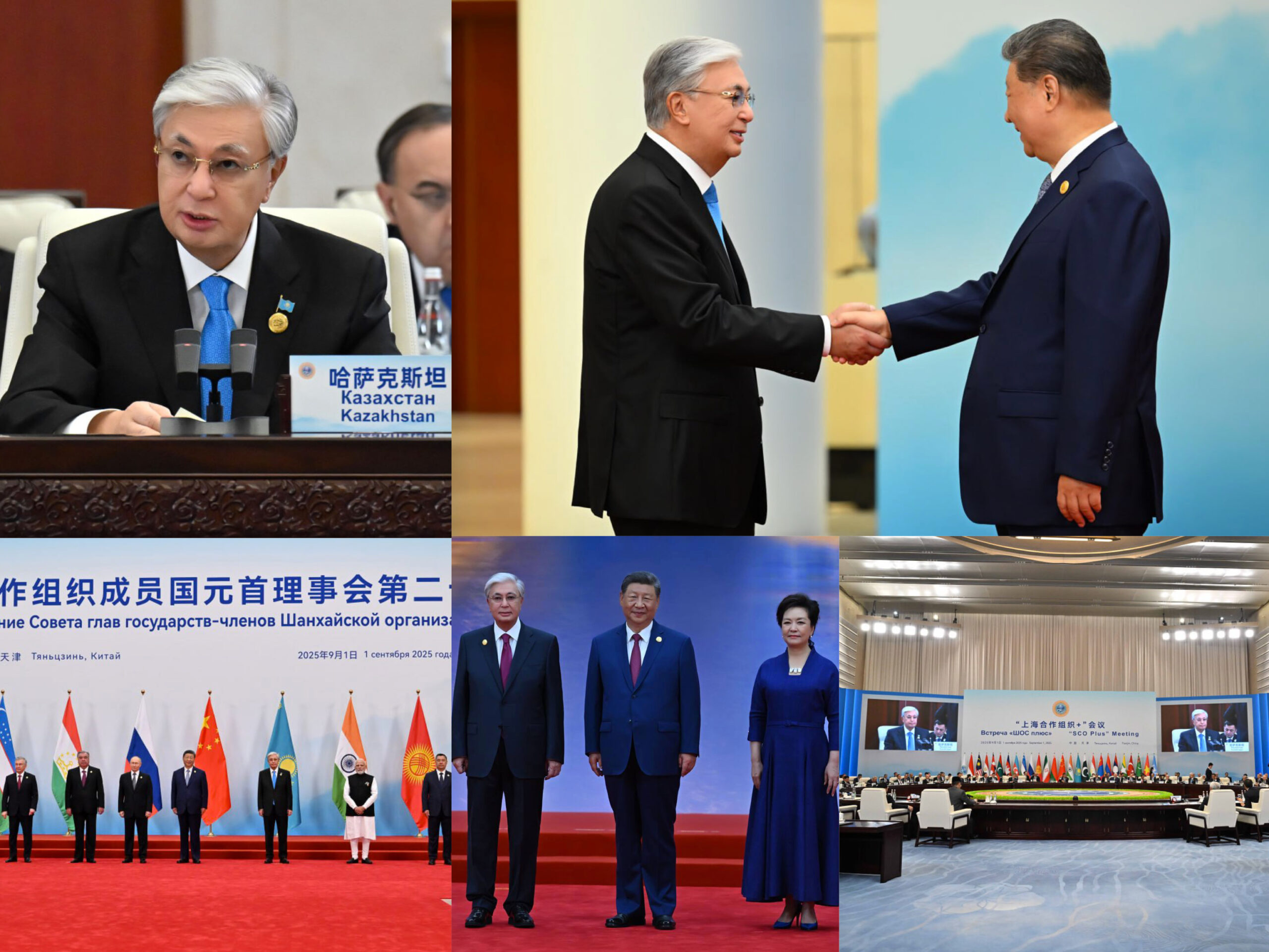
President Tokayev attends the SCO 25th summit in Tianjin, outlining Kazakhstan’s vision for regional cooperation. Photo credit: Akorda
At the summit, Tokayev addressed issues ranging from security, trade, and logistics to digitalization and environmental concerns. He reiterated Kazakhstan’s full support for the organization’s key priorities.
“Kazakhstan fully supports the key objectives of the SCO: an equitable multipolar world order, security and stability, non-interference in the internal affairs of states and recognition of their right to sovereign development, fair international trade, and mutually beneficial investment cooperation,” said Tokayev, who has been in China on an official visit since Aug. 30, marking an unusually extended schedule for the Kazakh leader.
The world’s largest regional organization
Founded in Shanghai in June 2001, the SCO has evolved from six founding members, China, Russia, Kazakhstan, Kyrgyzstan, Tajikistan, and Uzbekistan, into the world’s largest regional organization, boasting a combined economic output of nearly $30 trillion.
The two-day summit, attended by more than 20 world leaders and heads of 10 international organizations, adopted several key documents, including the Tianjin Declaration and a SCO development strategy until 2035. It also gave a green light to four new SCO centers aimed at bolstering regional security, tackling transnational organized crime, enhancing information security, and strengthening anti-drug cooperation.
China’s cumulative trade with SCO member states surpassed $2.3 trillion. Kazakhstan’s own trade with SCO member states reached nearly $70 billion in 2024, according to Tokayev.
China’s investments in other SCO member states exceed $84 billion, and its annual bilateral trade exceeded $500 billion. These substantial figures stem from a wide array of projects that China has spearheaded under the Belt and Road umbrella, unveiled by Xi in Kazakhstan in 2013.
“We should enhance cooperation in such areas as energy, infrastructure, green industry, the digital economy, scientific and technological innovation, and artificial intelligence,” Chinese President Xi Jinping said.
While calling leaders to rely on shared aspirations, promote inclusivity and openness, mutual benefit and win-win results, Xi also openly urged countries to “oppose the Cold War mentality, bloc confrontation and bullying practices.”
He suggested accelerating the establishment of a development bank run by the SCO, in an effort to “provide stronger underpinnings for security and economic cooperation among member states.”
Xi also pledged two billion yuan (US$280.1 million) in grants to SCO member states this year, plus an additional 10 billion yuan (US$1.4 trillion) in loans to the member banks of the SCO Interbank Consortium over the next three years.
Key messages from the summit
According to Qinduo Xu, a senior fellow at Pangoal Institution, a Beijing-based think tank, the Tianjin summit signals the “strengthening of multilateralism and non-Western governance models.”
“The summit demonstrates the Global South’s preference for dialogue over confrontation and inclusive development over exclusionary blocs. The ‘Shanghai Spirit,’ the SCO emphasizes repeatedly, contrasts with Western-led structures often perceived as imposing conditionalities and unilateralism,” Xu told The Astana Times in an email.
He believes the summit highlights how nations with different political systems and competing interests can unite around common priorities of development and security without forming an exclusionary military bloc.
“The framing of the SCO as a voice for the Global South is effective because it addresses a genuine and widespread desire for agency, respect, and a development path that is not dictated by the West,” he said.
Protectionist policies push rivals to dialogue
The summit convened at a time when the sweeping trade tariffs imposed by the United States under the leadership of Donald Trump raised a common frustration among nations toward protectionist policies.
The meeting between Xi Jinping and Indian Prime Minister Narendra Modi, the first in seven years in China, underscores how U.S. trade policies are driving other countries closer together. Modi’s presence is particularly notable given that he skipped last year’s SCO summit in Astana.
“India and China, both vying for global economic leadership, see the SCO format as an opportunity to stabilize and improve their relationship,” writes Kazakh political expert Gaziz Abishev in his Telegram channel.
“India’s position is particularly delicate. It faces pressure to abandon Russian oil, which it views as unfair. Prime Minister Modi must provide food, heating, and fuel for 1.5 billion people, ideally at affordable prices,” Abishev wrote.
Qinduo Xu, in turn, emphasized the growing demand for an “alternative development vision.”
“The attractiveness of the SCO and its associated initiatives like the Belt and Road Initiative underscores a global appetite for a development model that emphasizes connectivity, ‘win-win’ cooperation, and respect for national sovereignty, contrasting with models perceived as prescriptive,” he explained, adding further that the SCO offers a platform that doesn’t demand “political homogenization.”
“For many smaller and developing nations, the SCO provides a megaphone they would not otherwise have,” he added.
Tokayev’s visit to Beijing
Tokayev’s visit to Tianjin continued in Beijing, where he met top Chinese executives, solidifying the strategic partnership between the two neighbors, and addressed the Kazakh-Chinese Business Council meeting.
Kazakhstan’s bilateral trade with China reached a record $44 billion in 2024. Both Xi and Tokayev welcomed the positive dynamics during their tet-a-tet meeting on Aug. 30, highlighting room for growth.
China has invested $27 billion in the Kazakh economy, with more than 6,000 companies with Chinese capital working in the country.
At the council meeting, Kazakhstan and China signed 70 agreements worth nearly $15 billion, including a framework deal between KEGOC and Energy China on the EPC contract for the North-South direct current transmission line, and a partnership between Samruk Energo and China Southern Power Grid to jointly develop a pumped-storage hydropower plant.
Kazakhstan Temir Zholy reached an agreement with CRRC on the supply of modern locomotives to renew its railway fleet, among other initiatives. KazMunayGas national oil company and CNPC agreed to double the capacity of the Shymkent oil refinery up to 12 million tons a year.
Cooperation in the digital sector
At the SCO summit, Tokayev voiced support for China’s proposals to establish a global organization for AI cooperation and pledged Kazakhstan’s contribution to the initiative. He pointed out that by 2033, the global artificial intelligence market could reach $5 trillion, accounting for up to 30% of the global tech industry.
The President also called for deeper collaboration across the digital agenda, from applying smart solutions in industry, healthcare, and logistics to developing advanced urban management systems.
“China offers Kazakhstan considerable opportunities in terms of technology transfer and the establishment of joint ventures that could help Kazakhstan move up the value chain. For example, collaboration in electronics production and cloud computing services could accelerate the modernization of Kazakhstan’s economy while creating new high-value industries,” Oyuna Baldakova, a research associate at King’s College London, told The Astana Times in a written comment.
However, there is another side to the coin. “In particular, adopting Chinese-designed smart city technologies and surveillance systems would raise questions of data security and privacy. This underscores the dual challenge for Kazakhstan: to benefit from Chinese technological expertise and investment while ensuring safeguards that protect national interests and maintain citizens’ trust,” she said.
High level of political trust
According to Baldakova, Kazakhstan occupies a vital role in China’s regional strategy.
“Since 2013, Xi Jinping has visited Kazakhstan six times, second only to Russia, underscoring Astana’s importance for Beijing. Furthermore, in 2019, the bilateral relationship was formally upgraded to a ‘permanent comprehensive strategic partnership,’ signalling the highest level of political trust,” Baldakova said.
Baldakova, who is also a lead researcher at the European Research Council-funded DIGISILK project for Kazakhstan, views the nation’s long-standing multi-vector foreign policy as giving it the “tools to balance.”
“By cultivating ties not only with China but also with Russia, the EU, the US, and regional powers like Turkey, Astana seeks to avoid excessive dependence on any single actor. This approach allows Kazakhstan to welcome various Chinese initiatives while still preserving manoeuvring space,” she said.
“That said, China’s growing role in the region, especially as Russia’s influence has contracted since the start of its war in Ukraine, narrows Kazakhstan’s room for alternative choices. The nuclear power plant projects are a telling example: two of the three planned plants will be built by Chinese firms, underscoring both the scale of Chinese involvement and Kazakhstan’s potential future dependence on Chinese technology and capital in critical infrastructure,” Baldakova explains.
“The challenge for Kazakhstan is therefore less about resisting China outright and more about embedding its own priorities into Chinese-led initiatives. Astana’s success will depend on how effectively it leverages alternative partnerships and regional institutions to maintain agency,” she added.
