
ASTANA — Kazakhstan launched Central Asia’s most powerful supercomputer in July, marking a milestone in the region’s technological development. The Astana Times examines what this means for the country’s digital landscape, who the key stakeholders are, and how such computing power can impact the economy.
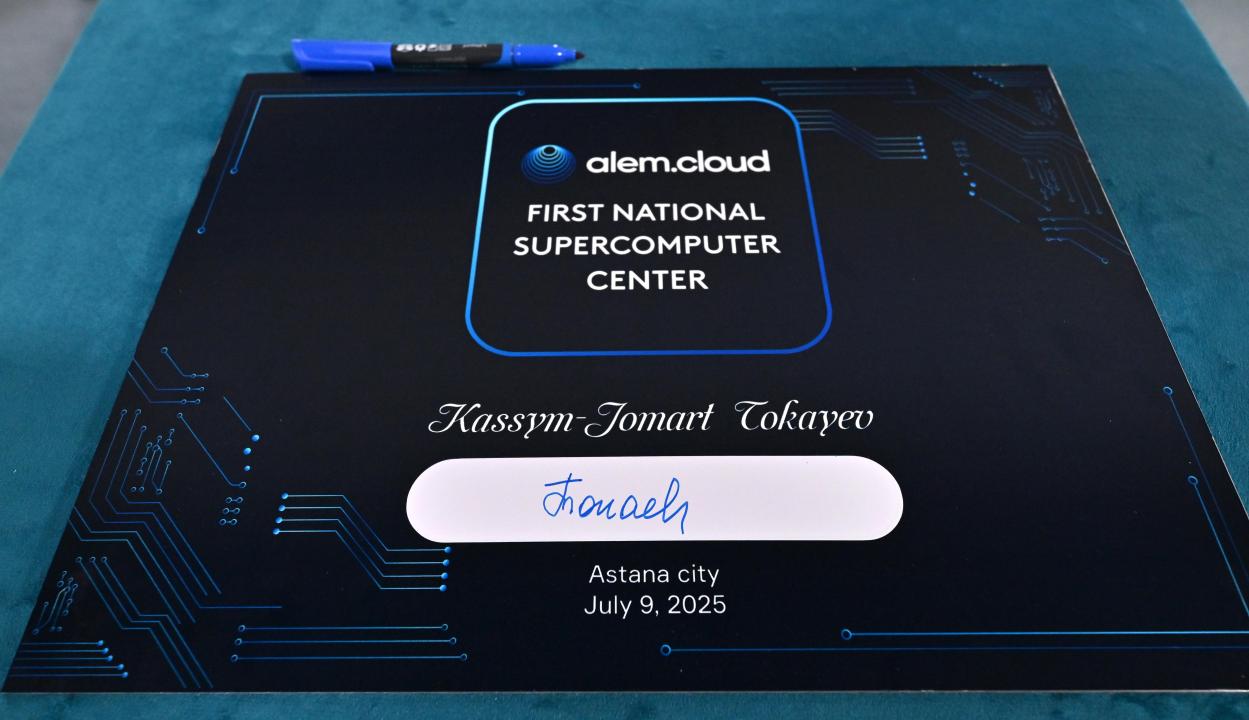
First National Supercomputer Center signed by Tokayev. Photo credit: Ministry of Digital Development, Innovations and Aerospace Industry
What is a supercomputer?
Supercomputers are machines capable of processing data at speeds impossible for regular computers. Globally, they are used to forecast weather, design advanced materials, study pandemics, and train artificial intelligence systems.
“The supercomputer’s configuration allows for peak performance of up to two exaflops in FP8 format when all accelerators are fully engaged. This sets a regional record and paves the way for building a full-scale high-performance computing ecosystem in Kazakhstan,” the Ministry of Digital Development, Innovations and Aerospace Industry told The Astana Times in a comment for this story.
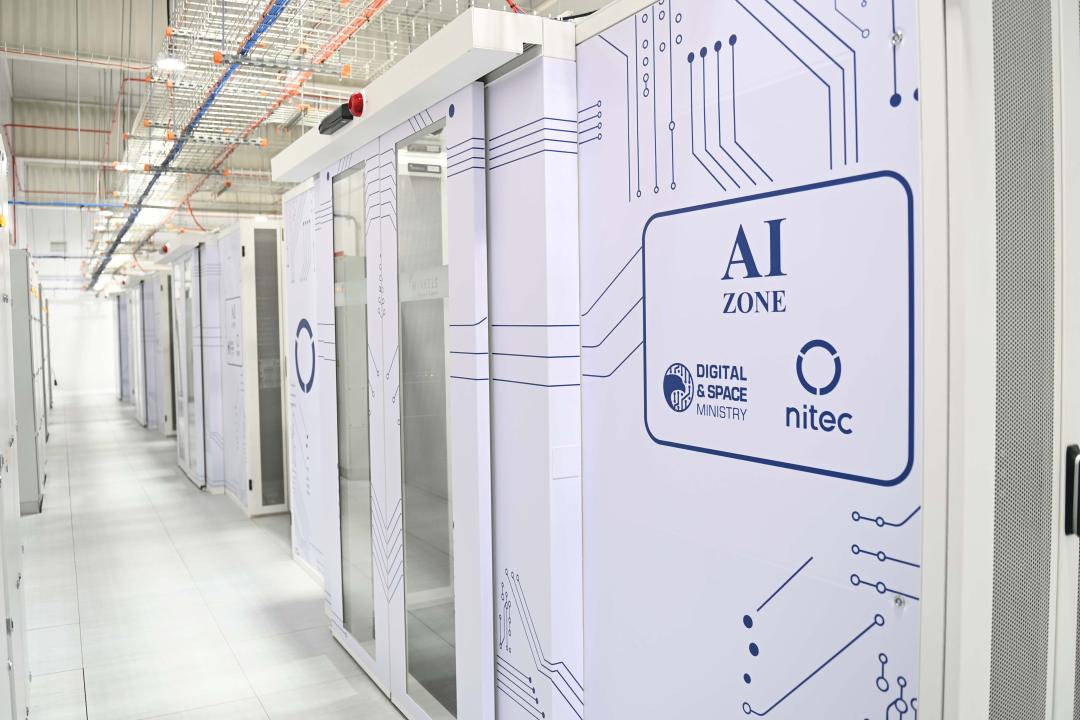
AI Zone. Photo credit: Ministry of Digital Development, Innovations and Aerospace Industry
To put the figure in perspective, one exaflop equals a quintillion calculations per second. At two exaflops, the system can handle simulations and data processing in seconds that would take standard computers months or years.
Their ability to run vast datasets and highly sophisticated algorithms allows researchers to solve problems once thought unsolvable. For example, according to the RIKEN Center for Computational Science, Japan’s Fugaku supercomputer was used in 2020 to simulate the spread of COVID-19 droplets in the air, helping policymakers assess the effectiveness of masks.
Kazakhstan’s system will be applied to train large language models, simulate urban traffic patterns, assist doctors with diagnoses from big data, and support the development of domestic AI products without relying on foreign servers. Until now, many local startups, banks, and research centers have depended on foreign providers such as Amazon and Google, often at a high cost and with data security risks.
“Kazakhstan’s new national supercomputer can perform in just one second as many calculations as the entire world’s population – all eight billion people – could do in over four days if each person solved one equation every second,” said Minister Zhaslan Madiyev.
Building the system
The supercomputer is based on the latest NVIDIA H200 chips, designed for AI and high-performance computing (HPC). Delivered to Kazakhstan in May, it was installed at the ministry’s Tier III data center.
The ministry noted that the project was carried out under an agreement between National Information Technologies and NVIDIA’s official global distributor. Company specialists, including system engineers and AI architects, oversaw delivery, installation and setup. The system is housed in a secure data center to ensure uninterrupted operation.
For the first time, Kazakhstan has developed a mechanism for importing high-tech equipment without customs duties or value-added tax (VAT), aiming to attract international IT companies and data center operators.
National AI strategy
According to the ministry, the supercomputer will serve as the backbone of the National Artificial Intelligence Platform, enabling government agencies to connect via application programming interfaces for tasks in healthcare, education, energy, and public service delivery.
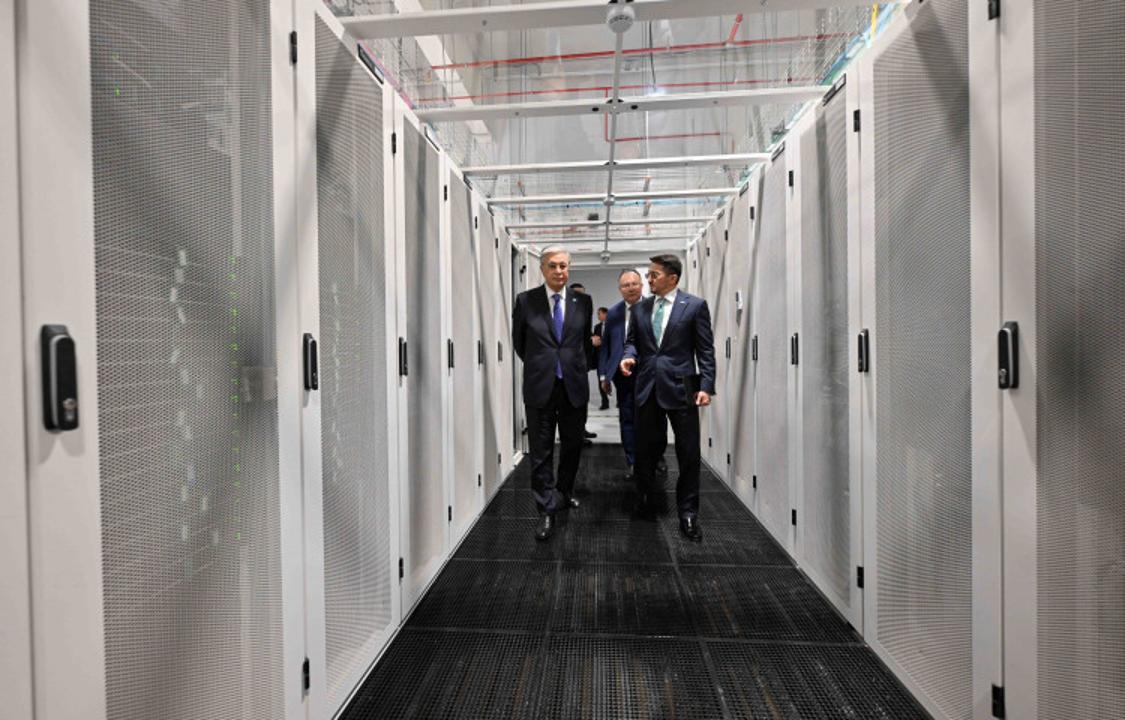
President Kassym-Jomart Tokayev and Minister of Digital Development Innovations and Aerospace Industry Zhaslan Madiyev at the ministry’s Tier III data center. Photo credit: Ministry of Digital Development, Innovations and Aerospace Industry
“The project is a key step in implementing the national artificial intelligence development concept through 2029 and in building modern information and technology infrastructure,” said the ministry.
By offering these resources to government bodies, startups, universities, and research centers, the government aims to stimulate domestic AI development and reduce long-term costs associated with public services.
“All tasks will be carried out upon official requests from government bodies, research institutions, and other authorized organizations (…) The ministry has taken all necessary steps to optimize the equipment configuration and reduce the project’s total cost without compromising performance or technical specifications,” the ministry said.
Open source and international collaboration
As part of the project, Kazakhstan is collaborating with international partners to develop a sustainable digital ecosystem. One of them is SUSE, a global open-source software company supporting the national AI platform through its SUSE AI Suite.

Marijn de Vos, a regional director for Eastern Europe, Central Europe and Central Asia at SUSE
“The launch of this supercomputer is a foundational step for Kazakhstan and the wider Central Asia region. It signifies a major investment in sovereign technological capability, accelerating innovation and economic growth,” Marijn de Vos, a regional director for Eastern Europe, Central Europe and Central Asia at SUSE, told The Astana Times.
He emphasized the value of open-source systems in ensuring flexibility.
“High-performance computing requires a secure and reliable software foundation. Open source provides the freedom to innovate and integrate the best technologies without being tied to a single vendor, fostering collaboration between academia, public institutions, and private industry,” he said.
According to de Vos, the most significant impact will be the acceleration of AI and data-intensive research as this infrastructure empowers local experts to address regional challenges in sectors such as energy, finance, and logistics. It enables the development of new solutions and business opportunities.
“The difference will be felt across society. Researchers can now process massive datasets to make new discoveries. Businesses can develop new AI-powered services. Young talents and skilled experts will further spark local innovation. Ultimately, citizens will benefit from the data-driven advancements in public and private services,” he said.
Global outlook
The launch comes amid rapid growth in the global supercomputing market, which is expanding as demand for AI and big data solutions accelerates worldwide.
According to the 65th edition of the Top500 ranking of the world’s most powerful publicly known supercomputers published in June, the top systems include El Capitan, Frontier and Aurora in the United States, followed by JUPITER Booster in Germany, Eagle in the U.S. and HPC6 in Italy.
The top 10 also features Fugaku in Japan, Alps in Switzerland, LUMI in Finland, and Leonardo in Italy.
The U.S. leads the list with 175 supercomputers, followed by China with 47 and Germany with 41.
The Research and Markets report published in August valued the supercomputers market at $13.6 billion in 2025, with projections to reach $53.9 billion by 2033 at a compound annual growth rate of 18.8%. The growth is driven by demand in scientific research, industry, big data, and AI applications, as well as government investments in national infrastructures.
Domestic tech view
Speaking to The Astana Times, Oleg Kruglyak, a chief operating officer of AgileSoft.kz, a strategic IT outstaffing company connecting global businesses with software developers from Central Asia, said that the launch is especially timely given the global shortage of computing capacity.

Oleg Kruglyak, the chief operating officer of AgileSoft.kz. Photo credit: Kruglyak’s personal archives
“We view the news about the opening of an advanced data center in Kazakhstan very positively. Especially since, as far as we know, it was built on NVIDIA processors – the most optimal modern solution for artificial intelligence tasks. There is currently a global shortage of computing power, which makes the launch of this supercomputer in our country all the more timely,” said Kruglyak.
He noted that corporations can use the system to train large language models and cut costs by automating routine tasks.
“It is even possible that, in the future, Kazakhstan could have its own analogue of ChatGPT,” he added.
Kruglyak noted that although large corporations are likely to be the initial beneficiaries of the system, ensuring access for startups will be essential to fostering a more inclusive and dynamic digital ecosystem.
“Of course, we would like computing power to be made available to smaller startups as well, perhaps in the form of grants. That would give an additional boost to the development of new AI-based products, inevitably improving the quality of services for the population and stimulating the export of IT services abroad. Startups are usually very effective in inventing new ideas and digital products,” said Kruglyak.
“Kazakhstan has every chance to establish itself as a regional leader in this field,” he added.
