
ASTANA — Kazakhstan is celebrating the 120th anniversary of Ahmet Zhubanov, a composer, conductor, musicologist and scholar who helped shape Kazakhstan’s professional music. Born on April 29, 1906, in today’s Aktobe Region, he turned folk melodies, dombyra traditions and scholarly research into a foundation for national musical institutions.
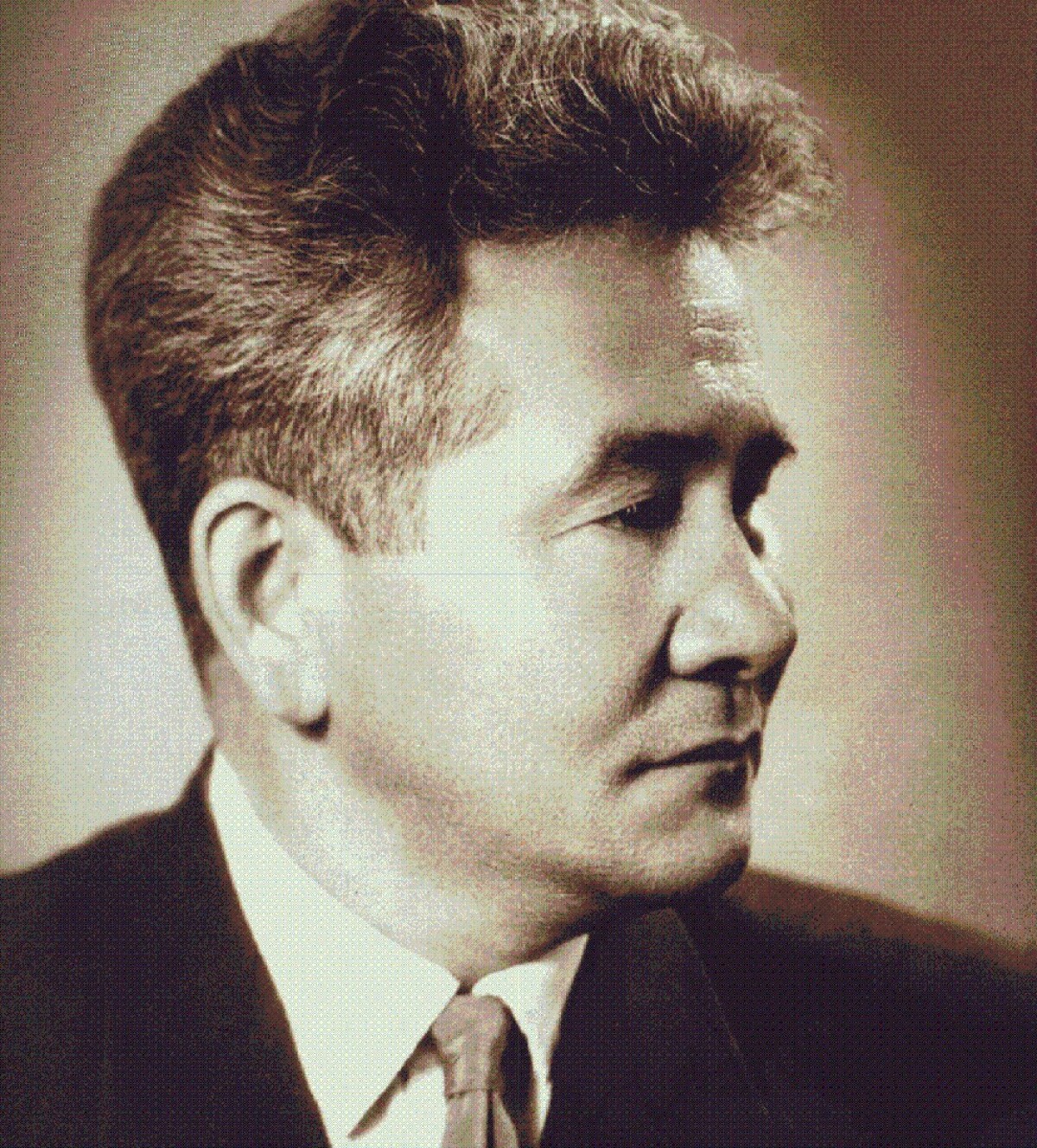
Ahmet Zhubanov. Photo credit: adebiportal.kz
Zhubanov, a People’s Artist of the Kazakh Soviet Socialist Republic (SSR), professor and academician, played a key role in systematizing Kazakh music through education, research and performance, helping bring it from an oral tradition into an organized cultural field.
From early training to formal education
Zhubanov showed an early aptitude for music, learning to play the dombyra, a traditional Kazakh two-stringed instrument, at seven, when he also began attending a local school. His early training came from those around him, including his father Kuan and brother Kudaybergen, as well as local kuishi Talym and teacher Kussaiyn Azhigaliyev, through whom he developed skills in instruments such as violin, mandolin and balalaika.
In Temir, a town in today’s Aktobe Region in western Kazakhstan, he continued his studies with Pyotr Chernyuk, learning solfeggio, violin and music theory while participating in an amateur orchestra of folk instruments. This period marked his first systematic engagement with musical notation, which later became central to his work.
In 1929, he moved to Leningrad, now St. Petersburg, where he studied at the Mikhail Glinka Music College and later at the conservatory, focusing on music history and theory. His studies exposed him to classical traditions and approaches to adapting folk instruments for ensemble performance.
Building institutions and expanding sound
Zhubanov returned to Kazakhstan in 1933 to teach at the newly opened musical drama college in Almaty. His work there focused on developing a system for professional music education and creating the conditions needed for performance and research.
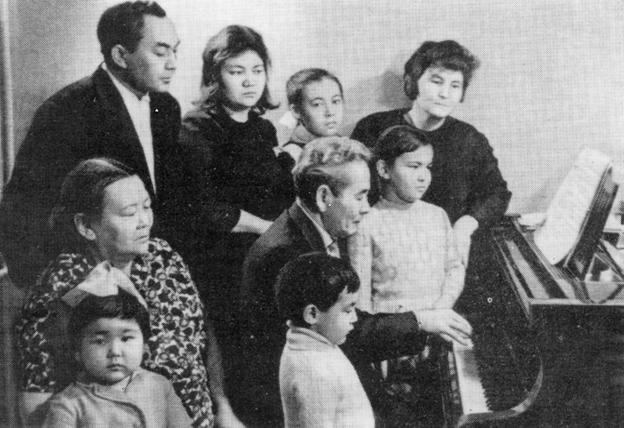
Zhubanov’s family. Photo credit: adebiportal.kz
He initiated the establishment of a research unit and an experimental workshop dedicated to improving traditional instruments such as the dombyra and kobyz. These efforts led to the development of new instrument forms suited for ensemble performance, with stronger and more stable sound.
“Teachers and students initially looked skeptically at this initiative. What particularly concerned them was that we, the young leadership of the college, were engaged in matters not provided for in the curriculum,” Zhubanov wrote.
Working with instrument makers, he contributed to the development of orchestral versions of traditional instruments, including dombyra-prima and kobyz-prima. These changes expanded both the technical possibilities of performance and the range of repertoire.
“The new dombyra resembled the dombyras common in western and southern Kazakhstan. Today, the dombyra created in Zhubanov’s workshop is considered the gold standard and is widely used both in orchestral and solo performance,” said instrument maker Zholaushy Turdugulov in one of the interviews.
In 1934, Zhubanov formed an ensemble of dombyra players that later became the Kazakh State Orchestra of Folk Instruments. As its first conductor, he introduced performance based on written notation, helping unify interpretation and tempo. The ensemble was later named after Kurmangazy and remains one of Kazakhstan’s leading cultural institutions.
He also adapted works by international classical composers so they could be performed on Kazakh instruments, expanding their repertoire.
“He brought together all the well-known musicians of that time who played folk instruments. It was not easy to manage them because each performed in their own way at different tempos. He managed to make them perform one piece together at a single tempo,” said Ersaiyn Basykara, a professor at the Kurmangazy Kazakh National Conservatory.
Alongside this work, Zhubanov contributed to the establishment of key institutions, including the Kazakh State Philharmonic, the Kazakh Conservatory and academic research structures dedicated to music. Expeditions organized with his participation collected thousands of folk songs and kuis, preserving musical heritage from across the country.
Composer, scholar and cultural legacy
Zhubanov’s research focused on the structure, history and performance of Kazakh music. He authored books such as “Gasyrlar Pernesi” (strings of centuries) and “Zamana Bulbuldary” (nightingales of the centuries), and produced studies on major composers and performers, helping to form the academic foundation of Kazakh musicology.
As a composer, he wrote orchestral, vocal and chamber works, including “Kazakh Dances,” “Tajik Dances,” “Abai Suite,” and “Tulegen Toktarov.” His compositions combined traditional motifs with classical forms, expanding the expressive range of Kazakh music.
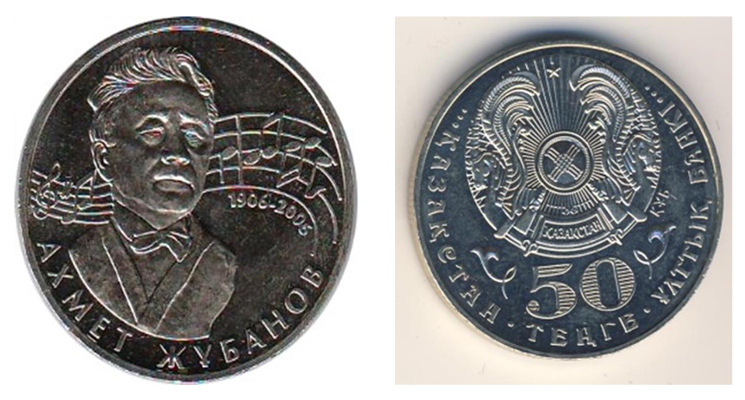
Akhmet Zhubanov’s 100th anniversary commemorative coin, issued in 2006. Photo credlt: Scientific Library of Asfendiyarov Kazakh National Medical University.
Among his most influential works is the opera “Abai,” written with Latif Khamidi and premiered in 1944 with a libretto by Mukhtar Auezov. The opera integrates traditional songs into a symphonic structure and remains a central work in Kazakhstan’s musical repertoire.
From 1945 to 1951, Zhubanov served as a rector of the Almaty Conservatory. He later headed the folk instruments department he founded, teaching conducting, instrument studies and the history of Kazakh music.
He also translated major works on music into Kazakh and remained active in criticism and public discussions on culture and education.
Beyond his professional legacy, he was also a father of five. Two of his daughters followed artistic paths: Gaziza Zhubanova became a composer, and Roza Zhubanova a pianist and teacher, while his sons, Bolat and Kaiyr, pursued careers in chemistry, and his youngest daughter, Azhar, became a biochemist. His musical lineage continued through later generations, including conductor Alan Buribayev, who has described Zhubanov as a figure of broad talent comparable to Renaissance polymath Leonardo da Vinci.
His great-granddaughter, pianist Karina Izmailova, said his life was not without hardship.
“People think his life was covered with roses, but in reality he was a person who went through many difficulties. Despite this, he saw his mission in developing the art and culture of Kazakhstan,” she said.
Zhubanov died on May 30, 1968, in Almaty. His name has been given to streets, schools and cultural institutions across Kazakhstan, including a music college in Aktobe and the national music school in Almaty. His home has been turned into a museum, and his legacy continues through generations of musicians and scholars shaped by his work.
