
ASTANA — For decades, Saudi Arabia’s place in the global economy was defined by one commodity: oil. Today, the Kingdom is betting that its future will be shaped by another set of resources entirely. As demand for critical minerals surges amid the expansion of artificial intelligence, clean energy technologies, electric vehicles and advanced manufacturing, countries around the world are racing to secure access to the raw materials that power the modern economy.
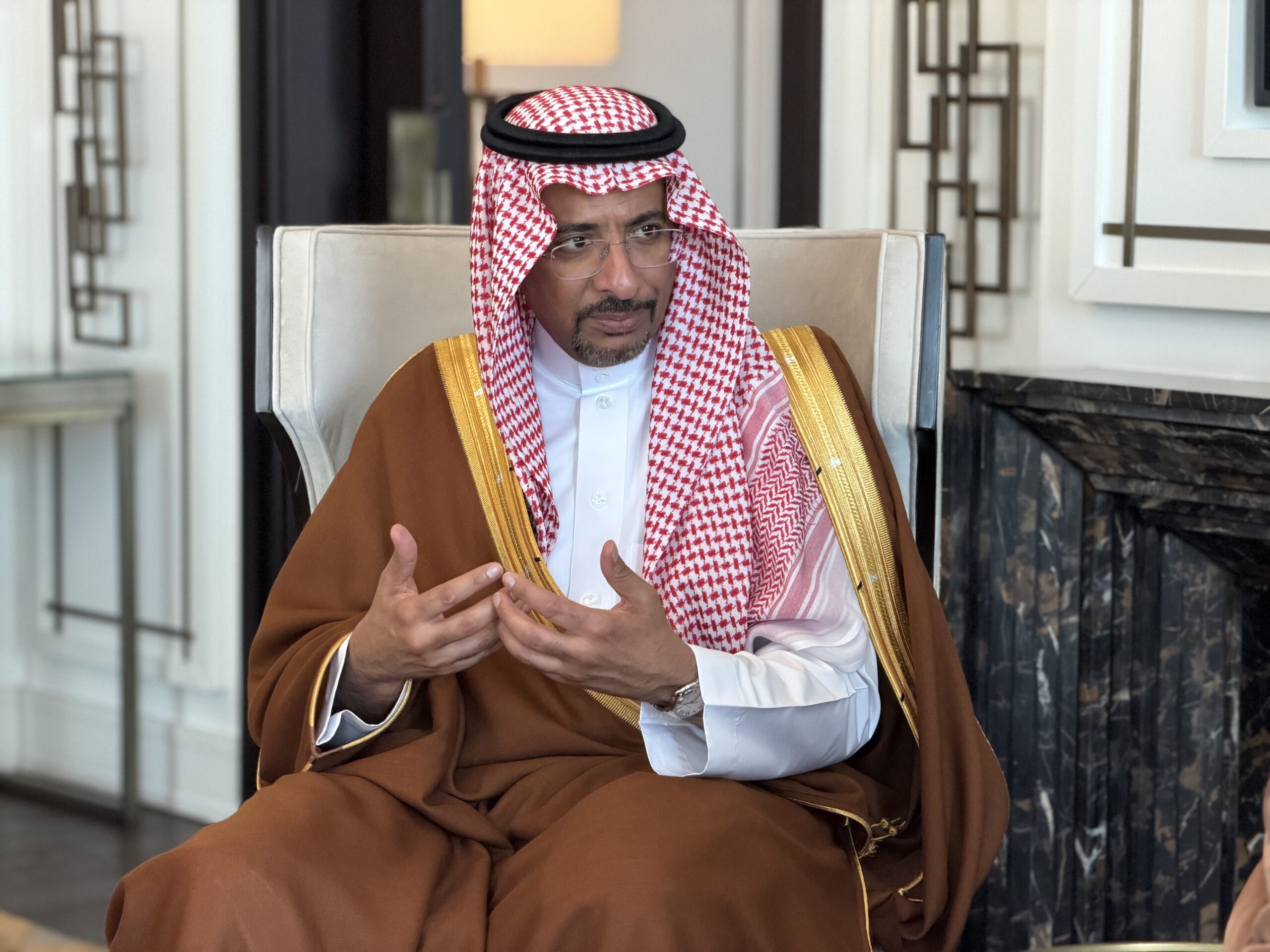
While the two countries have traditionally enjoyed warm political relations, AlKhorayef believes the next chapter should be defined by trade, investment and industrial cooperation. Photo credit: The Astana Times/ Nargiz Raimbekova
Yet the conversation is no longer only about who controls the resources. Increasingly, it is about who can process them, refine them and transform them into industrial growth. Saudi Arabia wants to be one of those countries. In an exclusive interview with The Astana Times, Saudi Minister of Industry and Mineral Resources Bandar AlKhorayef outlined how the Kingdom is leveraging mining as a pillar of its economic diversification strategy and why Kazakhstan could emerge as an important partner in that effort.
While the two countries have traditionally enjoyed warm political relations, AlKhorayef believes the next chapter should be defined by trade, investment and industrial cooperation.
“As you know, our two countries have great relations in terms of leadership and people-to-people ties. But it is our responsibility to build on this relationship through more economic ties, more trade and more investment,” he said.
Mining sits at the center of that vision. For Saudi Arabia, the sector has become a strategic priority under Vision 2030, the Kingdom’s ambitious economic transformation agenda designed to reduce dependence on hydrocarbons and create new engines of growth. For Kazakhstan, mining is hardly new. The country possesses some of the world’s largest reserves of metals and minerals and has supplied global markets for decades. Yet despite its vast resource base, much of Kazakhstan’s potential remains under explored and, in many cases, under appreciated by international investors. That is one of the reasons Saudi Arabia sees opportunity.
Drawing on Saudi Arabia’s experience, AlKhorayef noted that attracting international attention and investment requires continuous engagement with global stakeholders and effective platforms that connect opportunities with investors. Photo Credit: The Astana Times/ Nargiz Raimbekova
“Mining is a sector where Kazakhstan has a long history and long knowledge. There is a lot of area for cooperation and to work with each other, from exploration to mining to processing and technology,”AlKhorayef said.
Kazakhstan’s vast mineral wealth is not in question. What remains a work in progress is building a clearer picture of where those resources are located, how economically viable they are and what it will take to develop them. This challenge has been repeatedly acknowledged by President Kassym-Jomart Tokayev, government officials and industry experts. While Kazakhstan possesses significant reserves of critical minerals and metals, many deposits still require additional geological exploration and assessment in accordance with international reporting standards. For investors, that information is essential. Understanding not only what resources exist, but also the infrastructure, timelines and capital required to develop them often determines whether investment decisions move forward.
As Kazakhstan seeks to attract more international mining companies, improving geological knowledge and investment visibility has become as important as the resources themselves. In many ways, this is where Saudi Arabia’s recent experience becomes particularly relevant. The Kingdom’s mining transformation did not happen because it suddenly discovered resources. Rather, it happened because policymakers made a deliberate effort to create an investment environment that international companies could understand and trust.
Drawing on Saudi Arabia’s experience, AlKhorayef noted that attracting international attention and investment requires continuous engagement with global stakeholders and effective platforms that connect opportunities with investors. In this context, he emphasized the value of cooperation between Saudi Arabia and Kazakhstan, including through the Ministry of Industry and Construction and Astana International Financial Centre, to showcase mining opportunities and strengthen dialogue with the global mining community through platforms such as the Future Minerals Forum.
When asked which reform had the greatest impact on Saudi Arabia’s mining sector, AlKhorayef pointed to the Kingdom’s Mining Investment Law introduced in 2021. The legislation was designed around a simple premise: make the rules clear, predictable and globally competitive. The reform incorporated environmental, social and governance standards, established clearer requirements for responsible mining and created a tax framework designed to reduce uncertainty for investors. Perhaps most importantly, it shifted the financial burden away from the earliest stages of exploration, when companies are taking the greatest risks.
“Companies know exactly what is the maximum they have to pay. Most of the tax will come at a later stage, so they don’t have to put a lot of money in the beginning,” AlKhorayef said.
The lesson may be particularly relevant for countries seeking to attract long-term mining investment at a time when global competition for capital is intensifying.
Yet throughout the conversation, AlKhorayef repeatedly returned to a topic that extends far beyond mining itself. For resource-rich nations, he argued, the real challenge is not extracting minerals. It is creating enough value from those resources before they leave the country.
That question resonates deeply in Kazakhstan. For decades, the country’s economy has grappled with a familiar dilemma. While Kazakhstan exports significant volumes of raw materials, much of the higher-value processing and manufacturing often takes place elsewhere. As a result, many policymakers continue to ask how resource-rich economies can move further up the value chain. AlKhorayef acknowledged that there are no easy answers. “This is the most challenging question,” he said.
Saudi Arabia’s response has been to treat mining and industrial development as two sides of the same strategy. The Kingdom deliberately combined industry and mining under a single ministry, ensuring that decisions about resource extraction are linked directly to decisions about manufacturing and downstream industries. The objective is not to stop exports. That would be unrealistic for countries whose resource production far exceeds domestic demand. Instead, the goal is to create enough industrial capacity to capture a greater share of the value chain at home.
AlKhorayef pointed to Saudi Arabia’s aluminum sector as an example. The industry began by exporting raw materials because there was little domestic demand. Over time, however, government incentives encouraged manufacturers to establish local operations capable of producing higher-value goods. Today, Saudi aluminum is increasingly used in automotive components, packaging products and potentially aerospace applications.
“It takes a long time. You need to start with making sure that you have the right policy from the beginning,” AlKhorayef said.
The Kingdom now offers substantial tax incentives to companies that invest in refining, processing and downstream manufacturing rather than simply exporting raw materials. Yet policy alone is not enough.
One of the most striking parts of the discussion centered on technology. As countries compete for critical minerals, access to processing technology is becoming as important as access to the minerals themselves. This challenge is particularly acute in sectors such as rare earth elements, where specialized expertise remains concentrated among a handful of countries.
“Without it, there is no way you can benefit,” AlKhorayef said, referring to advanced processing know-how. “And it is not easy to access this kind of technology,” he added.
The same logic increasingly applies to artificial intelligence. While AI has become a buzzword across industries, AlKhorayef sees it as a practical tool already transforming mining operations. Geological exploration generates massive volumes of data that can take years to analyze using conventional methods. AI is helping companies process that information faster, identify promising deposits and reduce exploration risks.
“Mining data is very heavy. We are shortening the time needed to understand what is available,” he said.
But the broader significance of AI extends beyond exploration. As countries seek to build competitive industrial sectors, technologies such as artificial intelligence, robotics and advanced manufacturing are becoming essential components of economic strategy rather than optional additions.
For Saudi Arabia, this technological transformation forms part of a larger vision. For Kazakhstan, it may also offer a glimpse of what the next phase of resource development could look like. The global race for critical minerals is often framed as a competition over geology. Yet AlKhorayef’s message suggests something different. Mineral wealth alone is no longer enough. The countries that benefit most from the next industrial era will not necessarily be those with the largest deposits underground. They will be those that can attract investment, develop technology, build industrial capacity and create value long after the minerals leave the mine.
For resource-rich economies from Central Asia to the Gulf, that may be the most important lesson of all.
