
ASTANA – Kazakhstan is considering banning children under 16 from registering on social media platforms as authorities seek to address growing concerns about cyberbullying, harmful content and the impact of excessive screen time on adolescents’ mental health.

Photo credit: iStock
The Ministry of Culture and Information has developed draft amendments to legislation concerning online platforms and mass media, which are currently under review by government agencies.
The proposal would prohibit children under 16 from registering on social media platforms, while still allowing access to instant messaging services. According to the ministry, the measure is intended to protect minors from harmful online content, cyberbullying, and addictive platform algorithms designed to maximize user engagement.
“The ban is primarily due to the fact that social networks, by their nature, are focused on engagement mechanisms, algorithmic content distribution, and the commercial monetization of user attention. For minors, this creates increased risks of exposure to destructive, harmful, or age-inappropriate content, as well as cyberbullying and addictive behavior,” said the ministry in a written comment to The Astana Times.
As the world changes at an unprecedented pace, leaving little time to pause and connect with loved ones, the beginning of the summer holidays in Kazakhstan serves as an important reminder of the irreplaceable value of time spent with children.
Today, however, much of children’s lives is shaped not by face-to-face communication, but by digital space, which offers both opportunities and risks and has already created serious challenges for families worldwide.
What is the under-16 ban?
The under-16 ban refers to a growing international legislative trend aimed at restricting children under 16 years old from accessing major social media platforms. The approach places greater responsibility for child safety on technology companies rather than solely on parents.
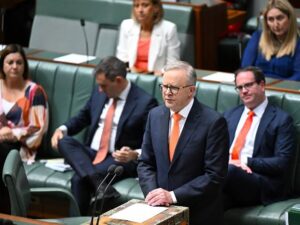
Australian Prime Minister Anthony Albanese supported legislation setting a minimum age of 16 for social media use and urged public support for the measure. Photo credit: Al Jazeera
Australia has implemented restrictions on minors’ access to social media beginning Dec. 10, 2025. Indonesia introduced similar measures in March, while Türkiye adopted related legislation in April. France is also moving toward tighter restrictions, with relevant legislation currently undergoing final approval procedures.
Discussions on comparable measures are underway in Spain, Denmark, and the United Kingdom, reflecting a broader shift in public policy toward digital risk prevention for minors.
The Kazakh authorities say they are studying international experience while considering national legislation, technological infrastructure, and digital development.
The digital reality in Kazakhstan
The growing debate reflects the scale of children’s online activity in Kazakhstan. According to research published in December 2024 by the Kazakhstan Institute of Public Development (KIOR), the impact of social media on children’s mental health is shaped by time spent online, the type of content consumed, and the influence of digital environments on sleep, physical activity, and emotional well-being.
Research by the WHO Regional Office for Europe found that 44% of adolescents in Kazakhstan are active social media users, while 31% remain online almost constantly throughout the day. Another 12% reported problematic social media use associated with lower mental, social, and academic well-being.
Entertainment content dominates among Kazakhstan’s adolescents, particularly on TikTok, Instagram, and YouTube, where short videos, music, challenges, and gaming-related content attract the largest audiences.
The findings have fueled growing concern among policymakers and parents about the amount of time children spend online and the potential effects on their emotional well-being.
While social media can provide access to educational resources, online communities, and opportunities for creativity and self-expression, researchers increasingly link excessive use to anxiety, depression, cyberbullying, sleep disturbances, internet addiction, and lower self-esteem.
The American Academy of Pediatrics found that teenagers who spend more than three hours per day on social media face a higher risk of depression, anxiety, and suicidal thoughts. A study by the University of Pennsylvania also showed that reducing social media use to 30 minutes per day significantly lowered feelings of loneliness and depressive symptoms.
The issue has attracted particular attention in Kazakhstan, where youth mental health remains a concern. While experts cite multiple factors behind adolescent suicide, including family and social pressures, public discussions increasingly focus on the role of excessive online activity and digital addiction.
Media literacy and parental trust
Alongside legislative measures, Kazakhstan’s Ministry of Culture and Information is expanding its efforts to improve media literacy through training programs conducted in collaboration with local authorities, NGOs, universities, and international organizations. These initiatives focus on identifying fake information, cybersecurity, artificial intelligence tools, and responsible online behavior.

Valentina Mukhanova-Biryukova. Photo credit: Mukhanova-Biryukova‘s personal archive
Experts, however, caution that legislation alone cannot fully solve the problem.
Valentina Mukhanova-Biryukova, master of science, clinical psychologist and neuropsychologist, believes limiting uncontrolled social media use among adolescents may reduce anxiety, exposure to cyberbullying, and harmful social comparison. At the same time, she warns that strict bans may also have unintended consequences, including social isolation and teenagers attempting to bypass restrictions through fake accounts or VPN services.
“Teenagers whose emotional development is still ongoing are especially vulnerable to idealized online images and constant comparison,” she told The Astana Times.
At the same time, social media and digital platforms also provide educational opportunities, communication with peers, and access to valuable information.
Mukhanova-Biryukova noted that digital safety should rely not only on restrictions but also on strengthening digital literacy, critical thinking, and trust within families.
According to her, children should be taught how to respond to cyberbullying, recognize online fraud, protect personal information, and critically assess manipulative online behavior. Parents, she said, should focus on maintaining open communication rather than relying entirely on prohibitions.
“The most dangerous thing about such restrictions is the illusion that the problem has been solved. By blocking access to social media, we will not automatically teach children digital safety,” she said.
As Kazakhstan considers stricter regulation of children’s access to social media, the debate reflects a broader global challenge: how to protect adolescents from the psychological risks of the digital environment without isolating them from the educational, social, and creative opportunities the online world provides.
Experts increasingly agree that legislation alone will not solve the problem. Long-term digital safety will depend equally on media literacy, parental involvement, and young people’s ability to develop healthy online habits in an increasingly connected world.
