
ASTANA – Kazakhstan’s economic growth is set to ease in 2026 and 2027 as oil production approaches its peak and private demand weakens, according to the April 2026 edition of the Asian Development Outlook, released April 10 by the Asian Development Bank.

ADB Country Director Utsav Kumar opens the ADO Launch Event on April 10 in Astana. Photo credit: ADB
Kazakhstan’s economy is projected to grow at 4.8% in 2026 and 4.5% in 2027, slowing from 6.5% growth in 2025. Momentum is sustained by ongoing government investment and quasi-fiscal support. At the same time, private consumption is expected to ease due to tighter lending conditions, higher taxes and more modest gains in real incomes.
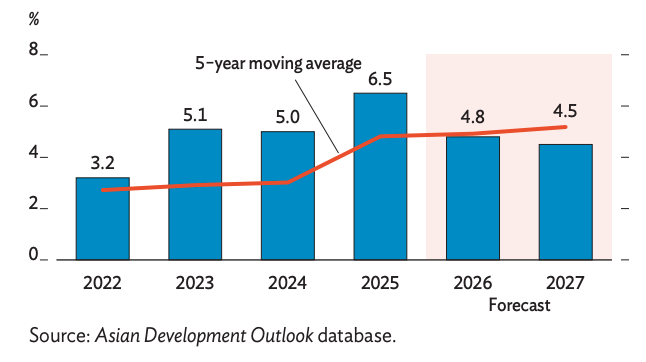
GDP growth is projected to moderate in 2026 and slow further in 2027. Photo credit: ADB
The outlook, however, is subject to elevated uncertainty. The projections are based on assumptions finalized in early March, including a scenario of early stabilization in the Middle East. Since then, there has been a higher likelihood of more prolonged disruptions, which could impact Kazakhstan’s outlook through supply chain pressures, tighter global financial conditions, weaker demand in key trading partners and rising import-driven inflation.
Period of strength
Even so, Kazakhstan is entering this period of slower growth from a position of relative strength, according to ADB analyst Sanzhar Kaldarov.
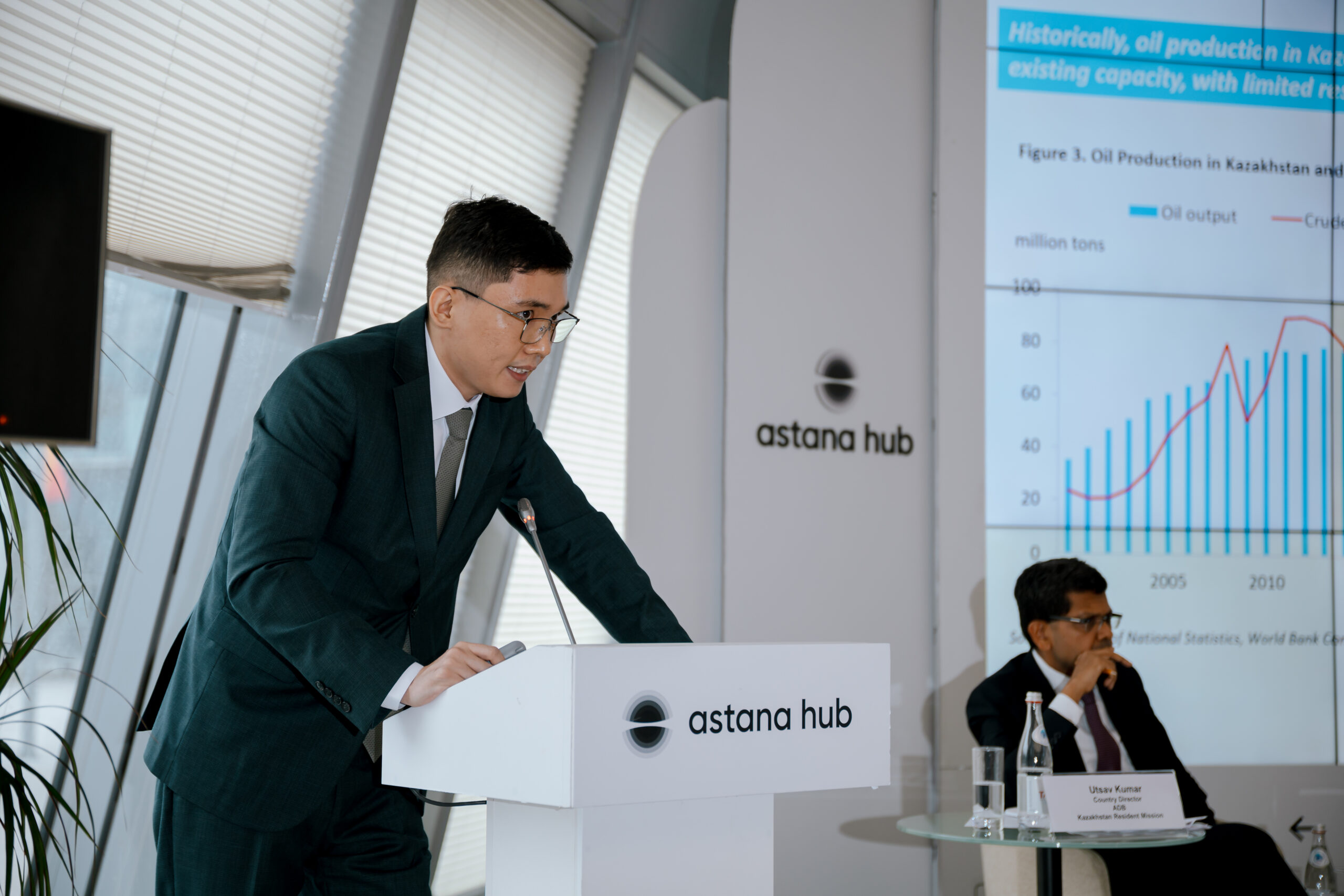
Sanzhar Kaldarov presents key highlights on Kazakhstan from the report. Photo credit: ADB
Economic growth reached 6.5% in 2025, the highest level in more than a decade, largely driven by increased oil output. A key factor was the ramp-up of the Future Growth Project at the Tengiz oil field, which pushed total production close to 100 million tons.
“Last year, we saw the ramp-up of the Future Growth Project at the Tengiz oil field. As a result, total oil production in Kazakhstan reached almost 100 million tons. Because of that, we see a huge increase in the GDP output,” he explained, adding that its effects extend beyond the sector itself, generating spillovers across related industries and supporting broader economic activity.
According to the report, inflation is forecasted at 10.4% in 2026 and 9.5% in 2027, from 11.4% in 2025. Analysts point to several factors contributing to the elevated inflation.
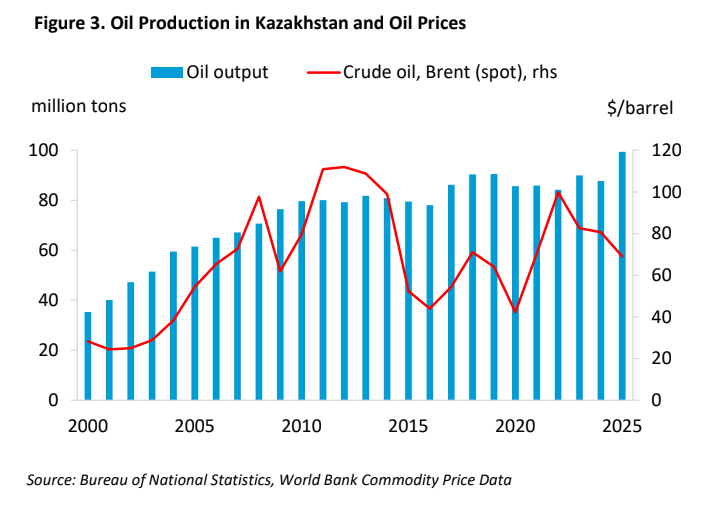
Photo credit: ADB
“The major one is the utility tariff increases. Most utility prices in Kazakhstan are still government-regulated, and there was some adjustment around March, which contributed to overall inflation,” Kaldarov said.
Tax policy changes have also played a role. The introduction of a new budget and tax code, including a value-added tax (VAT) increase, led businesses and consumers to bring forward purchases, adding to short-term demand and price pressures.
Impact of Middle East tensions
The external environment adds another layer of uncertainty, particularly tensions in the Middle East. However, Kaldarov emphasized that their effect on Kazakhstan’s growth is likely to be limited.
“When people hear about the Middle East conflict, they immediately assume that it should boost Kazakhstan’s growth. But first, let me mention that it depends on the output. Historically, Kazakhstan has been a classical price taker, in the sense that the output in Kazakhstan does not really depend on the prices. Between the 2015-2020 period, we see that the oil production was stable and even increasing despite the commodity price shock,” said the expert.
Another key factor is export geography. Unlike many Asia-Pacific economies, Kazakhstan’s main oil export markets are in Europe, including Italy, the Netherlands, Romania and France, which account for a significant share of shipments.
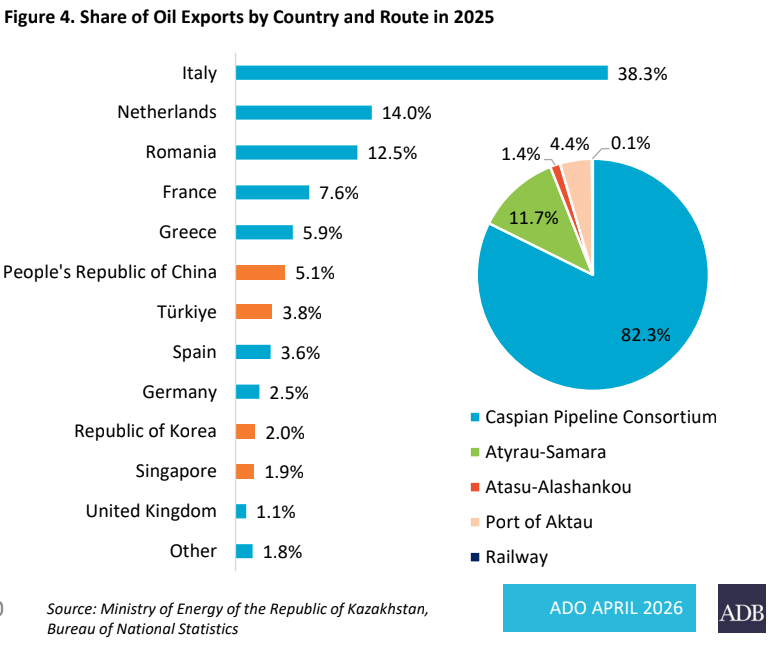
Photo credit: ADB
“If you see the pipelines, it’s a similar story. The main pipeline for Kazakhstan is the Caspian Pipeline Consortium, which exports oil mostly to European countries. There are some other routes, like Atyrau-Samara, and this Chinese route, Atasu-Alashankou, and some shipments through the port of Aktau and the railways,” Kaldarov said.
In practical terms, Kazakhstan’s oil exports are more closely tied to European markets than to developments in the Middle East. He noted this means that disruptions along export routes, such as those affecting the Caspian Pipeline Consortium, can have a direct impact on how much oil ultimately reaches global markets.
In terms of impact on inflation, it is also expected to be limited. Kaldarov went on to explain that the country has relatively low direct trade links with the region, with both exports and imports accounting for less than 1%. As a net energy exporter, Kazakhstan is less vulnerable to rising global energy prices compared to importing economies.
However, some indirect effects may emerge over time.
“They will materialize through either food prices or fertilizer prices. (…) After the escalation of the Middle East conflict, the food prices across all categories spiked, which, in effect, can also impact inflation,” he said.
Similarly, fertilizer costs, an important input for agriculture, may rise.
“Kazakhstan also imports a lot of fertilizers. About 56% are nitrogen-based fertilizers, but they come not from Middle East countries, but from countries like Russia and Uzbekistan and it also may affect inflation, but not immediately,” he said.
Fiscal indicators
According to the report, the budget deficit edged up slightly from 2.6% of GDP in 2024 to 2.7% in 2025, while the non-oil deficit narrowed to 7.1%, pointing to some improvement in underlying fiscal performance. Revenue growth was driven largely by an increase in tax receipts, specifically an 18% jump in VAT and a 24% surge in corporate income tax.
At the same time, transfers from the National Fund of Kazakhstan declined, reflecting efforts to reduce reliance on oil savings and strengthen fiscal discipline.
Upside and downside risks
“We believe that growth in Kazakhstan will moderate this year and the next year,” said Kaldarov. “The main reason for that is, first of all, oil production. After the launch of the Tengiz Growth Project, oil production capacity is already at the limit. It may increase, but the additional gains will be marginal.”
“On the demand side, we see that there will be a softer private demand because of both taxes and the slower real income growth. On the inflation side, we also expect it to ease. It should reach the single digits by 2027,” he explained. “It may happen, among other factors, because of tight monetary conditions and the fading tax effects.”
The report indicates that mining growth is projected to slow to 1.1% as production nears capacity limits and remains constrained by OPEC+ commitments and potential disruptions to the Caspian Pipeline Consortium, which handles around 80% of Kazakhstan’s oil exports.
“Manufacturing is projected to expand by 5.7%, underpinned by government efforts to promote domestic production under the National Development Plan. Growth in services is projected to slow to 4.5% amid weaker domestic demand and softer business activity following tax changes,” reads the report.
On the demand side, growth in Kazakhstan is expected to be driven largely by state-linked spending, while private consumption is expected to weaken.
“The National Bank and the Agency for Regulation and Development of the Financial Market have been working to tighten prudential measures, both microprudential and macroprudential, which might affect the lending rate and credit lending in Kazakhstan, which, in turn, will slow down the demand from the private side,” said Kaldarov.
The report also points to fiscal decentralization as a longer-term reform priority. Experts highlight that greater autonomy for regional governments could both strengthen revenues and improve the efficiency of public spending.
