
ALMATY – The water level of the Caspian Sea along Kazakhstan’s coastline continues to decline, according to the country’s Ministry of Ecology and Natural Resources, reported the Tengrinews agency on March 9.
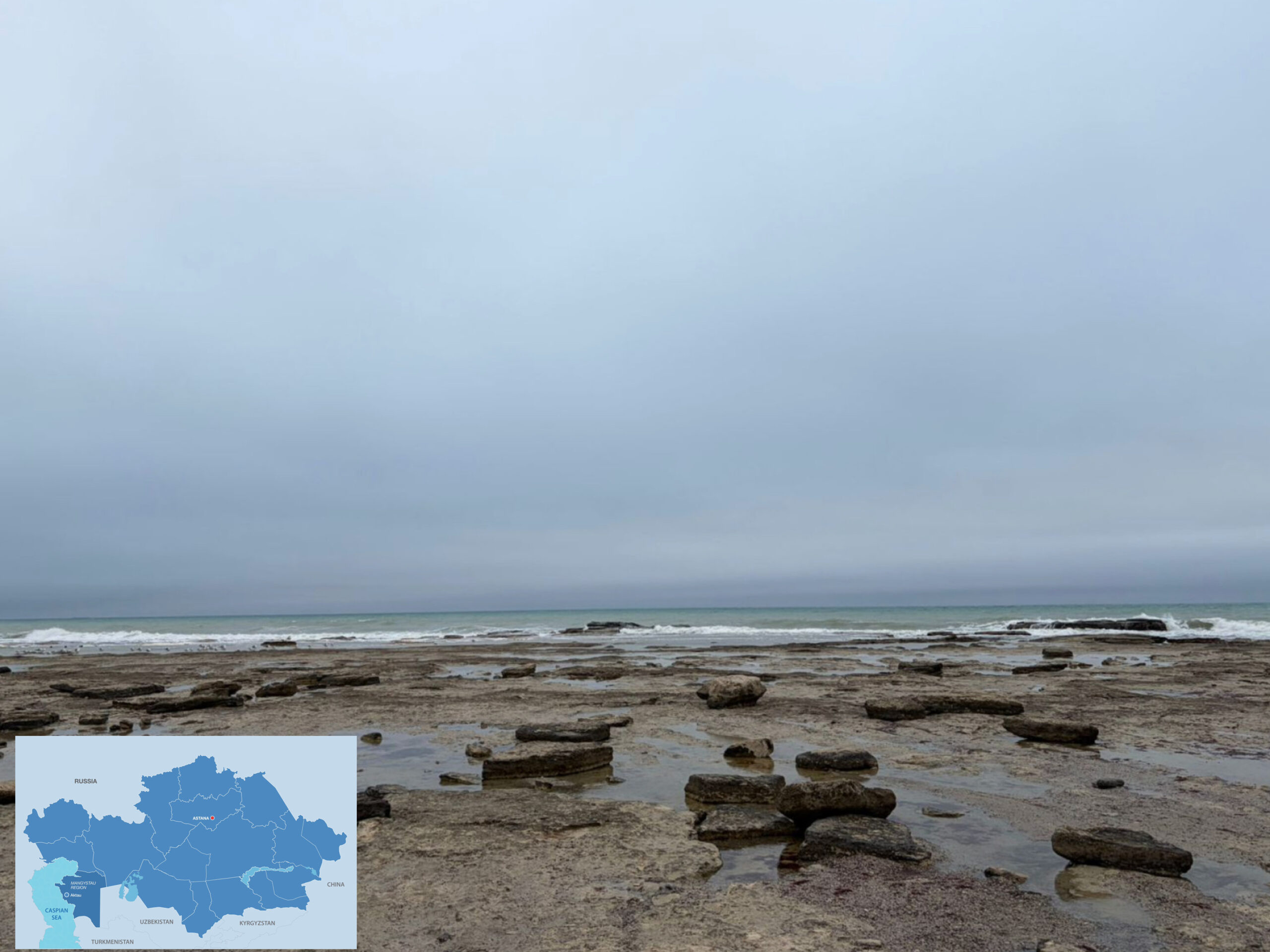
The water level of the Caspian Sea along Kazakhstan’s coastline continues to decline. Photo credit: Tengrinews. Click to see the map in full size. The map is designed by The Astana Times.
Officials said that between 2006 and 2025, the shoreline in some areas of Kazakhstan retreated by 30–35 kilometers, reflecting a steady drop in sea levels.
According to monitoring stations, the average water level in the northeastern part of the Caspian Sea in 2025 was –29.23 meters relative to the Baltic height system, with fluctuations ranging from –28.52 to –29.78 meters. In the eastern part of the sea, the average level reached –29.47 meters, varying between –29.07 and –29.88 meters.
Overall, the average level across Kazakhstan’s sector of the Caspian Sea stood at –29.35 meters according to the Baltic height system, which uses the average level of the Baltic Sea as a reference point.
Most vulnerable areas and causes
The ministry identified the northeastern Caspian region, the coastline of the Mangystau Region, and the Zhaiyk River delta as the areas most vulnerable to falling water levels. Experts attribute the shallowing of the sea primarily to climate change, increased evaporation, reduced river inflow, and human economic activity.
According to the national meteorological service Kazhydromet, fluctuations in the Caspian Sea level are largely driven by changes in the water balance caused by climate processes in the Caspian region and human impacts on river runoff.
Two possible scenarios by 2050
A long-term forecast prepared by Kazhydromet in 2020 outlines two possible scenarios for the future of the sea. Under the optimistic scenario, the water level could fall to –29.8 meters by 2030 and decline further to –32.4 meters by 2050.
However, under a more pessimistic climate scenario, the sea level could reach –30 meters by 2030 and drop to as low as –34 meters by 2050. According to the forecast, such changes would push the shoreline farther from existing coastal areas and gradually transform former seabed territories into land.
Scientific monitoring
Kazakhstan has raised the issue at the international level and is calling for stronger regional cooperation among Caspian countries. According to the ministry, President Kassym-Jomart Tokayev has instructed the government to work with other Caspian littoral states to develop an intergovernmental program for the preservation of the Caspian Sea’s water resources.
To strengthen research efforts, Kazakhstan established the Kazakh Research Institute of the Caspian Sea in 2025. The institute joined an association of universities and research centers from Caspian countries and conducts research and monitoring along Kazakhstan’s coastal zone.
Beginning in 2026, the institute plans to expand monitoring into the sea itself. The research program will include systematic observations of hydrometeorological, hydrochemical, and hydrobiological conditions, allowing government authorities to use scientific data in policymaking and international cooperation.
The upcoming Regional Ecological Summit (RES) 2026, scheduled to take place in Astana on April 22-24, is expected to bring renewed global attention to environmental restoration in Central Asia, as the center of discussion will be key climate and environmental issues.
