
ASTANA – Kazakhstan is strengthening its position as a key Eurasian transport and logistics hub through large-scale railway expansion, digital modernization, and growing investment in international transit corridors.
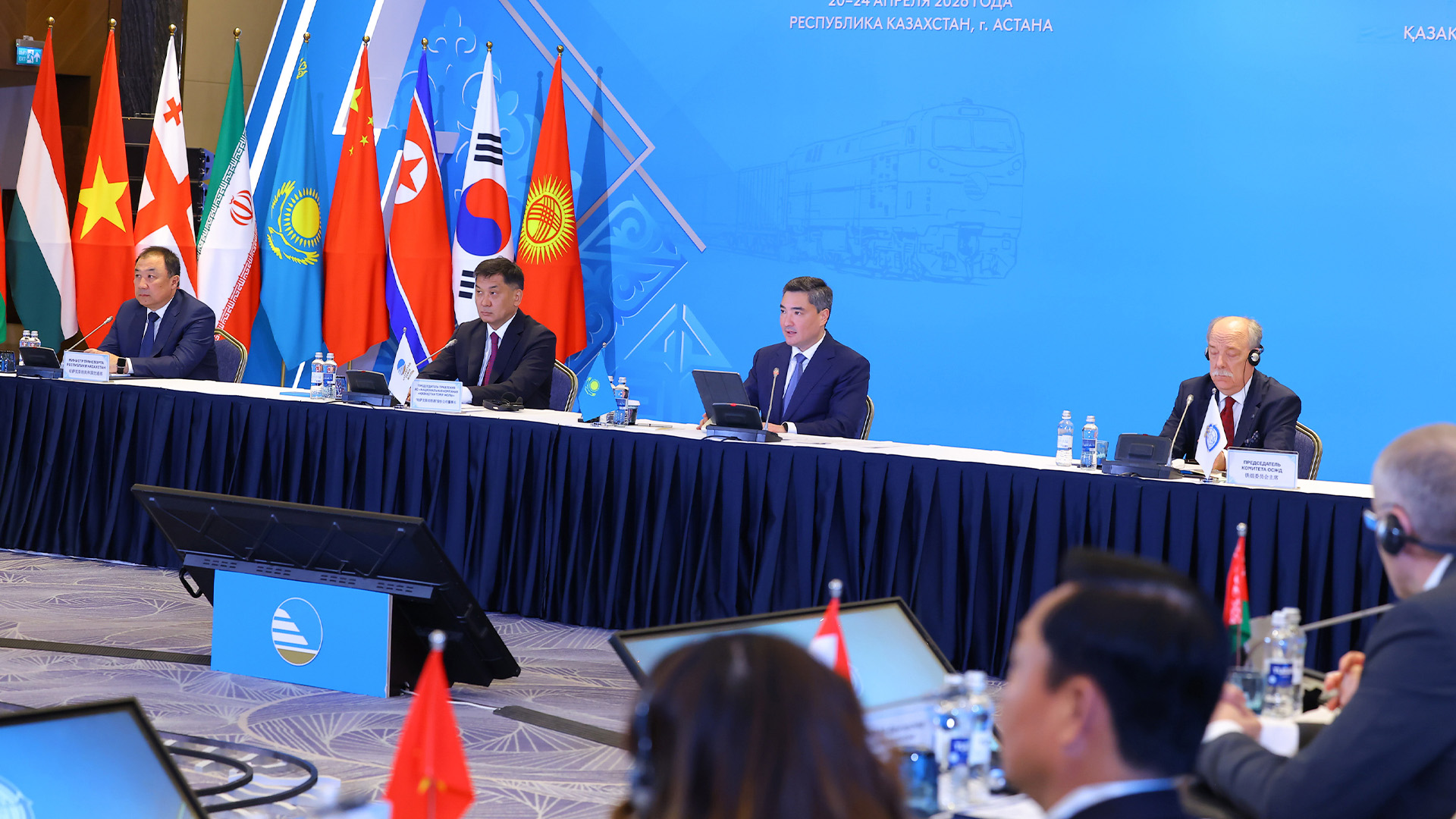
Photo credit: primeminister.kz
At the 40th Conference of General Directors of the Railway Cooperation Organization (OSJD), Prime Minister Olzhas Bektenov outlined the country’s long-term strategy to leverage its geographic position between East and West. He noted that Kazakhstan has already invested around $35 billion in the transport sector over the past 15 years and built more than 2,500 kilometers of new railway lines, reported the Prime Minister’s press service on April 23.
Bektenov stressed that Kazakhstan currently handles around 85% of overland transit between Western Europe and Western China. He added that the country plans to construct an additional 5,000 kilometers of railway lines over the next four years, with a target of increasing transit volumes to 100 million tons annually by 2035. He emphasized that the development of a modern and efficient transport system enables deeper integration into global supply chains.
A key focus is the expansion of the Trans-Caspian International Transport Route (TITR), also known as the Middle Corridor, which connects China, Central Asia, the Caucasus, and Europe. Kazakhstan is upgrading port infrastructure in Aktau and Kuryk in cooperation with international partners, aiming to increase container-handling capacity from 80,000 to 300,000 twenty-foot equivalent units (TEUs) per year by 2029. Transport times along the corridor have already been reduced to around 18 days, with a long-term target of 10 days. At the same time, the country is developing the North-South corridor to improve access to the Persian Gulf and Indian markets.
Digital transformation is another key priority. Kazakhstan has introduced the TezCustoms system, which has reduced border processing time with China from 8 hours to 30 minutes. It plans to further expand digital logistics solutions as part of its 2026 Year of Digitalization and Artificial Intelligence.
Rising transit volumes
Transit flows along the TITR have grown significantly, with container volumes increasing by 36% in 2025. Through Kazakhstan, 42,000 TEU were transported along the corridor, including 356 container trains from China, representing a 38-fold increase over 2023. The route is increasingly viewed as a competitive alternative to maritime shipping, supported by rising demand amid global supply chain restructuring.
Expansion of the international logistics network
In parallel, Kazakhstan is expanding its global logistics footprint through overseas terminal investments. Existing infrastructure includes the terminal in Lianyungang port in China, the Khorgos-Eastern Gate dry port at Altynkol, and a terminal in Xian, which handles a large share of container train traffic between China and Europe. The country is also pursuing acquisitions of terminal assets in Europe and the Caucasus to strengthen its integrated transport network, reported Kazinform on April 23.
New infrastructure projects
Kazakhstan is also advancing construction of a new rail border crossing with China, financed by a Chinese bank, with the first phase scheduled for completion in 2027. Once fully operational, the project is expected to significantly expand rail capacity to China, supporting long-term transit growth targets.
Officials described these developments as part of a broader strategy to build a seamless Eurasian transport system connecting East-West and North-South corridors. Kazakhstan is positioning itself not only as a transit country but as an integrated logistics hub embedded in global supply chains through infrastructure expansion, digitalization, and international partnerships.
