
ALMATY – Long before written language became widespread, the nomadic world spoke through patterns. In Kazakh culture, ornaments were more than decoration: they carried identity, beliefs, and a way of seeing the world shaped by life in the steppe.
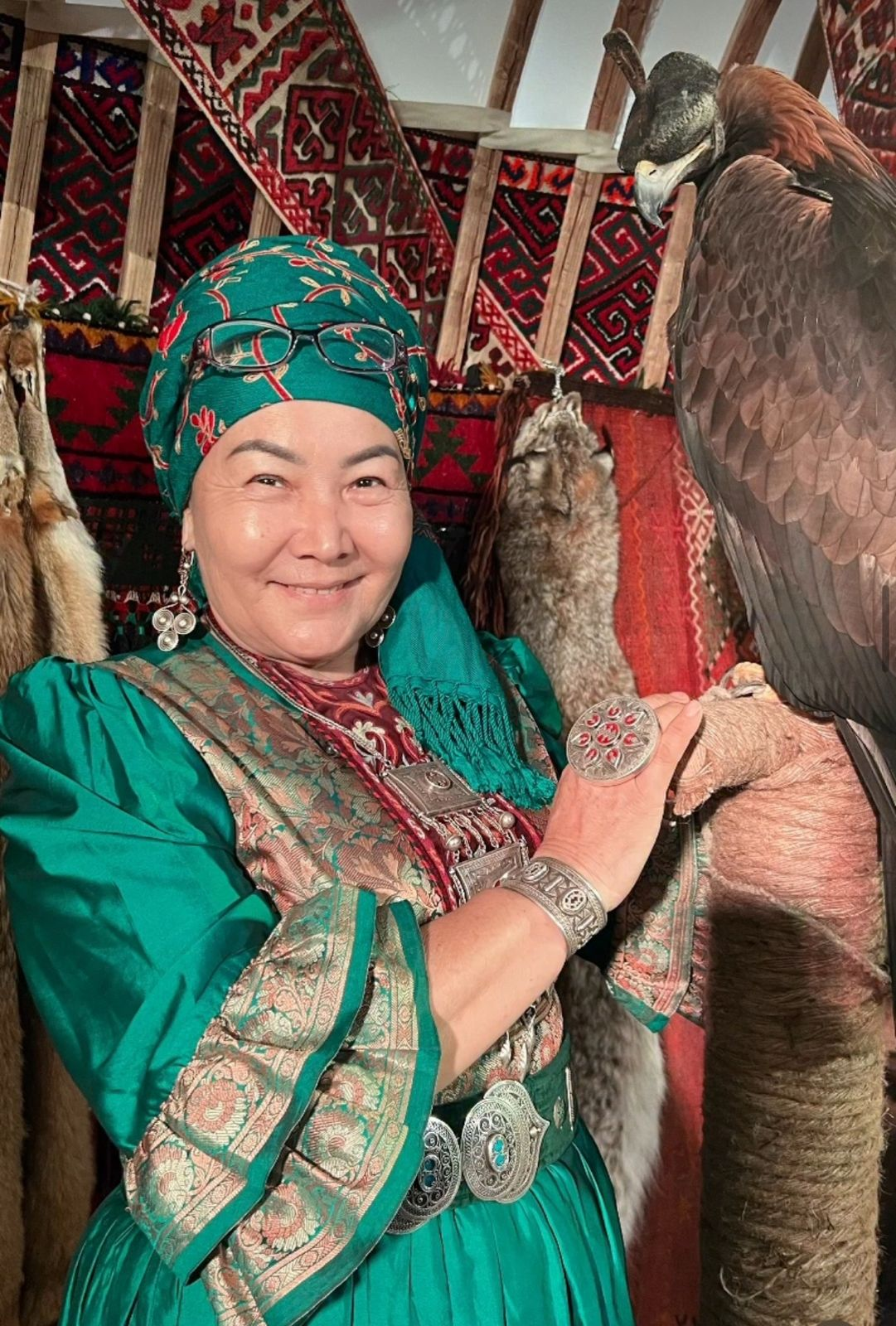
Bulbul Kapkyzy. Photo credit: Kapkyzy’s Instagram page.
Ethnographer and craftswoman Bulbul Kapkyzy says traditional oyu-örnek (ornament) should be understood not as a single concept but as a layered cultural language, where each element carries its own meaning and function.
More than an ornament
According to Kapkyzy, although the terms oyu (carved ornament) and örnek (embossment) are often used together, they refer to different techniques and forms of expression.
Oyu is created through cutting and appliqué, forming patterns that are then applied to felt carpets, clothing, and household items. On its own, it is incomplete, as it becomes meaningful only when integrated into an object.
Örnek, in contrast, refers to engraved or embossed patterns, most commonly seen in jewelry and metalwork. Together, they form a unified visual system that reflects both craftsmanship and worldview.
A language without words
According to Kapkyzy, ornaments once functioned as a form of communication. What is now perceived as decoration once served as a kind of visual passport. Patterns on clothing, weapons, or everyday items could reveal a person’s origin, social status, or occupation.
Along trade routes such as the Silk Road, where people spoke different languages, these symbols allowed communication without words. Much like modern signage, they helped people navigate their identities and meanings in unfamiliar environments.
“If today we navigate by uniform signs at airports or road signs, then for our ancestors, such a navigator was oyu. It is important to remember that this is a symbol that defines our national mentality and value system,” she said.
Nature as the source
According to Kapkyzy, the foundation of Kazakh ornamentation lies in nature. Living in close connection with their surroundings, nomads transformed elements of the natural world into symbolic motifs. These patterns varied across regions, shaped by landscape and way of life.
In East Kazakhstan, where livestock breeding dominates, horn-like motifs such as koshkar muiz (ram’s horn) are common. In addition, there are symbols representing other animals and birds: tuye taban (camel foot), qaztaban (goose feet), botamoyin (camel baby’s neck), qazmayin (goose neck), qus kanaty (bird wing), balik koz (fish eye), botagoz (camel baby’s eye), and qustumsik (bird beak).
In South Kazakhstan, where agriculture is more prevalent, floral and plant-based motifs dominate. In the western part of the country, patterns inspired by grains such as wheat and barley symbolize abundance and prosperity.
Each ornament, she said, becomes a reflection of how people lived and what they valued.
Craft and technique
According to the craftswoman, ornaments are also defined by how they are made and where they are used. Architectural patterns are evident in structures such as the Mausoleum of Khoja Ahmed Yasawi, where geometric precision prevails.
In everyday life, ornaments appear on felt carpets like syrmak and tekemet, as well as on clothing and accessories. Jewelry involves techniques such as engraving, filigree, and embossing, while household items rely on embroidery, weaving, felting, and appliqué.
Ornament as meaning
Kapkyzy emphasizes that ornaments are not purely decorative, because they carry intention. Patterns often function as wishes, blessings, or protective symbols. A turtle motif, for example, represents longevity and safe return, and was traditionally used for those embarking on long journeys.
Bird motifs symbolize freedom and the sky, while plant patterns represent life and growth. Through these images, artisans expressed hopes for well-being, strength, and harmony.
At the same time, certain symbols require careful use. The shanyrak, the sacred top of the yurt, is considered a powerful cultural symbol and is never placed on objects that are stepped on.
According to Kapkyzy, oyu is not strictly divided into male and female patterns, but there is a concept of personality status.
“For example, the Kün (Sun) pattern is a symbol of power and personality. It was embroidered on the backs of men’s hats, family heads, and leaders as a wish for good luck. It should not be used in carpets or women’s clothing. The remaining patterns are a shared heritage, and it is important to use them appropriately and tastefully. The key is to find the right combination between tradition and creativity,” she said.
Despite their symbolic depth, Kazakh ornaments are not governed by rigid rules. Artisans historically relied on intuition and artistic judgment rather than strict guidelines. The same motif could appear across different objects – carpets, clothing, jewelry – adapted to context and scale. However, balance remains essential.
Kapkyzy notes that proportion and restraint define true craftsmanship. Large items require bold, expressive patterns, while clothing calls for more delicate and refined designs. Overuse of ornament, she says, disrupts harmony rather than enhancing it.
According to the craftswoman, the Kazakh ornament is a balance between the master’s imagination and respect for tradition. Each ornament has a hidden meaning: the master takes images from nature and transforms them into a message or a protective charm. Each pattern encodes a fragment of the nomadic worldview – how people understood nature, structured their lives, and expressed their hopes.
Curious what these patterns really mean? Watch our full YouTube story to discover the deeper meanings behind Kazakh ornaments.
The article was originally published in Kazinform.
