
ALMATY — Kazakhstan is intensifying efforts to digitalize water management and expand water-saving technologies to ensure sustainable water use amid rising demand and climate pressures, as Vice Minister of Industry and Construction Kuandyk Kazhkenov addressed the current plans at a Jan. 13 government meeting.

Photo credit: Shutterstock
Kazhkenov also emphasized that between 2026 and 2028, the country plans to install more than 3.6 million smart water meters, enabling automated data collection through telemetry systems.
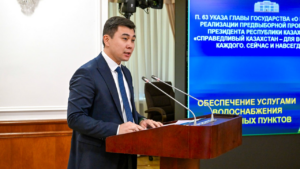
Vice Minister of Industry and Construction Kuandyk Kazhkenov. Photo credit: Prime Minister’s press service.
“Together with domestic and international experts, the activities of water utilities in five cities, Astana, Shymkent, Uralsk, Ekibastuz and Shakhtinsk, were assessed. Based on the results, recommendations were prepared for optimizing processes and a technical specification was developed for the preparation of a feasibility study, which provides for unified digital solutions and a phased implementation,” he said.
Water-saving technologies and illegal use prevention
Minister of Water Resources and Irrigation Nurzhan Nurzhigitov reported that the 2025 irrigation season was completed without critical consequences despite drought conditions, thanks to improved coordination and expanded water-saving technologies.
In 2025, 11.1 cubic kilometers of water were used to irrigate 1.2 million hectares of farmland, while water-efficient technologies were applied on 153,500 hectares. Updated water-use limits based on pessimistic flow scenarios will be prepared in early 2026, alongside adjustments to crop structures.
To combat illegal water use, the government is establishing a national interagency working group with law enforcement agencies, supported by a joint action plan developed with the Prosecutor General’s Office.
Industrial water reuse and digital platforms
According to Nurzhigitov, under the new Water Code, industrial enterprises should transition to systems of recycled and circulating water supply within seven years. This measure is expected to increase reuse from 13% to 28% by 2030, saving approximately 1.5 billion cubic meters of water.
Nurzhigitov noted that digitalization is improving transparency, with contracts for water supply to farmers moving to an electronic format, covering the entire cycle from application to billing.
“The implementation of the system eliminates discrepancies in data, optimizes administrative processes, minimizes the influence of the human factor, and ensures objectivity in the distribution of water resources and calculations for water use,” he said.
National water information system
Deputy Prime Minister and Minister of Artificial Intelligence and Digital Development Zhaslan Madiyev announced the development of the National Water Resources Information System, integrating data from 11 government platforms. The system will support analytics, forecasting, and secure data exchange, forming a unified digital water management space.
According to Madiyev, automation of 103 irrigation canals will begin this year, with plans to digitize an additional 264 canals with support from the Islamic Development Bank.
Long-term control and water culture
Prime Minister Olzhas Bektenov stressed that ensuring access to drinking water is an ongoing process requiring constant oversight. He called for full digital control of water resources “from the source to the end consumer” and ordered the creation of a unified national water platform by the end of the year.
“As the population and the economy grow, water consumption will increase. Therefore, ensuring access to clean drinking water will become more important every day,” he said.
Bektenov also emphasized the importance of fostering a culture of responsible water use from a young age, instructing education and science ministries to integrate these principles into learning programs.
“Careful, responsible treatment of water must become part of our national ideology,” he said.
