
ALMATY – President Kassym-Jomart Tokayev delivered a landmark lecture at the United Nations University (UNU) in Tokyo on Dec. 19, becoming the first head of state from Central Asia to speak at the institution.
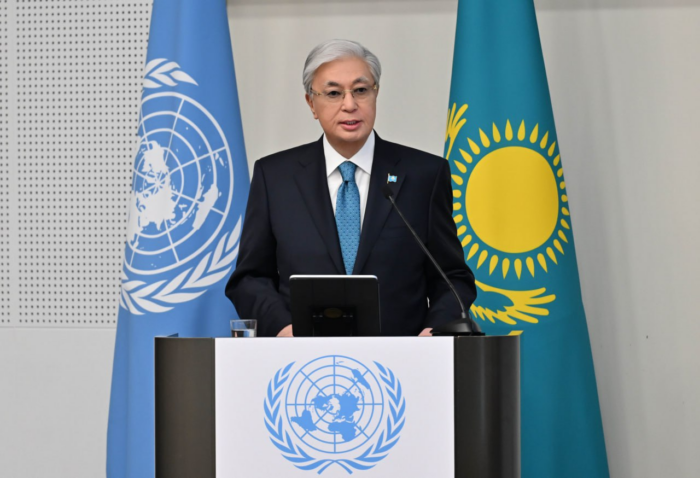
President Kassym-Jomart Tokayev warns of rising global conflicts and urges collective action in UN university lecture. Photo credit: Akorda
Addressing scholars, diplomats, and students, he outlined Kazakhstan’s vision for restoring global strategic trust amid rising geopolitical turbulence and proposed new avenues for strengthening multilateral cooperation, reported the Akorda.
“I see this opportunity as a sign of genuine trust in Kazakhstan’s growing international role and recognition of our continuous efforts to advance multilateralism and uphold global stability,” he said.
Harmony, stability, and a changing global landscape
President Tokayev also warned that the world is facing its highest levels of conflict in decades.
“The number and intensity of armed conflicts worldwide have reached their highest point in recent decades, while global military spending hit a record $2.7 trillion last year,” he said.
According to Tokayev, deepening rivalry among major powers has rendered the UN Security Council unable to resolve large-scale conflicts.
UN reform as a strategic necessity
Tokayev emphasized that restoring trust and predictability must become the foundation of effective international institutions.
“No state can address today’s challenges alone. Only principled and effective joint action can lead to long-term solutions. In this context, the UN must continue to play a central role as a universal and irreplaceable organization,” he said.
Tokayev said that geopolitical polarization has undermined the UN’s capacity, making comprehensive reform both urgent and unavoidable.
“Any meaningful reform must begin with reaffirming commitment to the UN Charter. However, some of its provisions no longer reflect today’s realities, including those that are unfair to Japan and other countries that make significant contributions to the Organization.” he said, arguing that it is time for a responsible dialogue on how to ensure the charter’s continued relevance.
Expanding the role of responsible middle powers
Tokayev called for a stronger presence of middle powers from Asia, Africa, and Latin America in the UN Security Council.
“Kazakhstan sees its foreign-policy mission in this role, conducting principled, balanced, and constructive multivector diplomacy grounded in our national interests and identity,” he said.
Tokayev reiterated that Kazakhstan’s foreign policy is anchored in cooperative relations with its neighbors and major partners.
Nuclear disarmament: a shared moral duty
Turning to nuclear security, Tokayev underscored the unique moral authority of Kazakhstan and Japan.
“Hiroshima, Nagasaki, and Semipalatinsk remind us of the high price of nuclear responsibility. The global security architecture cannot rely on nuclear deterrence,” he said, calling for high-level dialogue among nuclear powers and faster progress toward disarmament.
AI governance and future goals
Tokayev highlighted opportunities and risks posed by artificial intelligence, including unequal access to AI technologies and the dangers of their misuse.
“The UN must play a central coordinating role, just as it once shaped global norms for nuclear safety and civil aviation,” he said.
Tokayev also proposed establishing a UN University regional branch in Almaty, focusing on water and climate security, conflict prevention, sustainable development, and AI governance.
